
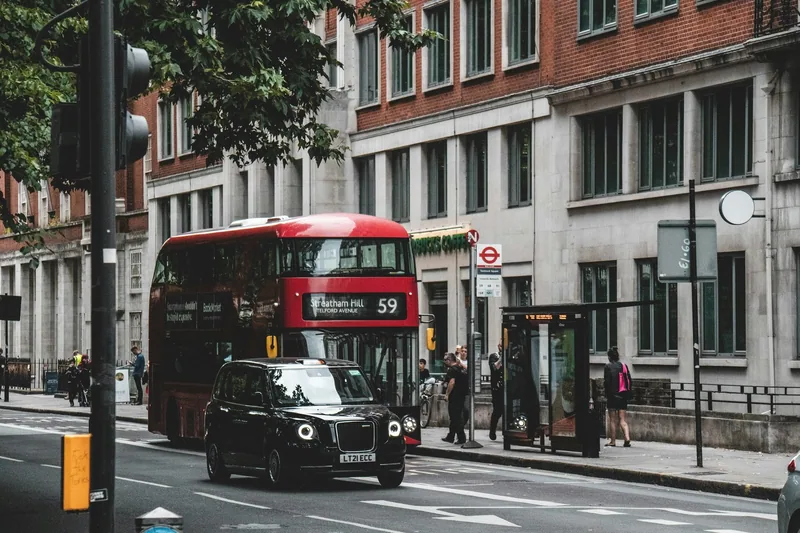
London's red buses are the cheapest way to get around the city: every journey costs a flat £1.75 with a contactless card or Oyster card (rising to £1.85 on 1 November 2026), you can change buses free within an hour, and you never pay more than £5.25 in a day. Buses are slower than the Tube, but from the top deck you see the city as you travel, and many routes run all night.
There are no paper tickets and no cash on London buses. You get on at the front, touch your card or phone on the yellow reader next to the driver, and get off through the middle or rear doors when you reach your stop. You do not touch out. The fare is the same whether you ride two stops or to the end of the line.
For visitors, buses have two big advantages over the Underground. They are much cheaper per journey, and they are an easy way to see the streets between the sights rather than a dark tunnel. This guide explains how paying works, which routes pass the landmarks, how to use night buses and when the Tube is still the better choice.
London buses at a glance (September 2026)
- Single journey, adult
- £1.75, rising to £1.85 on 1 November 2026
- Hopper fare
- Unlimited bus and tram journeys within one hour of touching in, for one fare
- Daily cap, bus and tram only
- £5.25 (rising to £5.55 on 1 November 2026)
- Weekly cap, Monday to Sunday
- £24.70
- Cash
- Not accepted
- Children aged 5-10
- Free, no card needed
- Accessibility
- All buses are wheelchair-accessible
How to pay: contactless, Oyster and no cash
You can pay with a contactless bank card, a phone or watch with Apple Pay or Google Pay, or an Oyster card. All of them charge the same fare. Cash has not been accepted on London buses for years, and drivers cannot sell tickets, so make sure you have one of these before you board.
Hold the card flat on the reader until it beeps and shows a green light. If you are travelling as a couple or a family, each adult needs their own card or device. You cannot touch one card twice to pay for two people. You can pay for a companion only by using a different card or device for them.
If you use Oyster, there is a small safety net. A card without enough credit can still make one more bus journey, but it then goes into a negative balance and must be topped up before you use it again. Topping up is done at Tube stations, some rail stations and Oyster Ticket Stops (usually newsagents), not on the bus. Our comparison of Oyster and contactless payment helps you choose, especially if your bank charges fees on foreign card payments.
One card per bus reader, not one per group. The reader cannot tell that four people are standing behind you. Each person aged 11 or over needs their own card or device, and a wallet with several contactless cards held against the reader may charge the wrong one. Take out only the card you want to pay with.
The Hopper fare and the daily bus cap
The Hopper fare makes changing buses free. When you touch in on a bus, you can take any number of further bus or tram journeys that start within one hour, for no extra charge. It works automatically if you use the same card or device. You still touch in on every bus, but you are charged only once.
The daily cap is the most you pay in one day. On buses and trams only, the cap is £5.25, which is reached after three journeys (or three hours of Hopper travel). After that, every bus ride that day is free. The travel day runs from 04:30 to 04:29 the next morning, so a late bus home after midnight still counts towards the day before. Over a fixed Monday to Sunday week, bus and tram travel is capped at £24.70.
If you also use the Tube, the higher Tube cap applies instead: £8.90 for Zones 1-2, including your bus journeys. Current fares are on TfL's bus and tram fares page.
| Bus and tram fares, adult | Until 1 November 2026 | From 1 November 2026 |
|---|---|---|
| Single journey (pay as you go) | £1.75 | £1.85 |
| Daily cap | £5.25 | £5.55 |
| 1 Day Bus & Tram Pass | £6.00 | £6.40 |
| 7 Day Bus & Tram Pass | £24.70 | £26.10 |
The 1 Day Bus & Tram Pass costs more than the daily cap, so there is no reason for a visitor paying by card to buy one.
What a day on the buses costs a couple or a family
A couple who spend a day hopping between sights by bus, each with their own contactless card, will pay at most £5.25 each, or £10.50 together. A single Tube journey inside Zone 1 costs £3.10 at peak times, so the bus is much cheaper if you are not in a hurry.
Families save even more. Children aged 5 to 10 travel free on buses without a card (unless they look older than 10, so carry proof of age). Children aged 11 to 15 can get the Young Visitor discount added to an Oyster card, which gives 50% off adult pay as you go fares and caps for up to 14 days. A family of two adults and two children aged 6 and 9 would therefore pay no more than £10.50 for a whole day of bus travel. Our guide to children's fares explains the rules for each age.
Getting on and off: bus stops, bells and signals
Each bus stop has a red and white sign with the route numbers that stop there. In busy areas, stops also carry a letter (for example "Stop K"), and maps near the stop show which letter serves which direction. Journey planners such as TfL Go refer to these letters, which makes it much easier to find the right side of the road.
- Signal the bus. When your bus approaches, hold out your arm so the driver knows you want it to stop. At busy stops served by many routes, the driver may otherwise drive past.
- Board at the front and touch in on the reader by the driver.
- Press the red bell or button before your stop. The screen at the front shows "Bus stopping".
- Get off through the middle or rear door. There is no need to touch out.
Screens and announcements on board name the next stop, so you can follow along. The top deck is steep to reach, so hold the handrail on the stairs and do not go up or down while the bus is moving fast.
Sightseeing bus routes that pass the landmarks
Several ordinary routes pass so many sights that they work as a cheap alternative to a tour bus. Sit at the front of the top deck for the best view. There is no commentary, and you will share the bus with people going to work, but the fare is £1.75. Routes and stops can change, so check each one on TfL's bus maps before you set off.
| Route | From - to | What you pass |
|---|---|---|
| 15 | Blackwall - Charing Cross | Tower of London, Monument, St Paul's Cathedral, Fleet Street, the Royal Courts of Justice, the Strand |
| 9 | Aldwych - Hammersmith | Trafalgar Square, Piccadilly Circus, the Royal Academy, Green Park, Hyde Park Corner, Knightsbridge, Royal Albert Hall, Kensington Palace |
| 11 | Fulham Town Hall - Waterloo | King's Road in Chelsea, Sloane Square, Victoria, Westminster Abbey, Parliament Square, County Hall |
| 24 | Pimlico - Royal Free Hospital (Hampstead) | Victoria, Westminster Abbey, Whitehall, Trafalgar Square, Leicester Square, Camden Town and Camden Market |
| 88 | Parliament Hill Fields - Clapham Common | Camden Town, Oxford Circus, Piccadilly Circus, Whitehall, Westminster, Tate Britain |
Route 15 is our pick for the City: board near the Tower of London and ride west past St Paul's Cathedral to Trafalgar Square. Route 9 is the one for the West End and Kensington, as it runs along the edge of Hyde Park and Kensington Gardens to the Royal Albert Hall.
Route 11 links Chelsea's King's Road with Westminster, stopping right by Westminster Abbey. Route 24 is the simplest way from Westminster to the markets of Camden Town, while route 88 drops you near Tate Britain on the riverside south of Parliament.
Route 15 costs less than a coffee. A ride on route 15 from Tower Hill to Trafalgar Square shows you the Tower, the City and St Paul's for £1.75, and under the Hopper fare you can hop off, look around and board the next bus within the hour at no extra cost. Commercial tour buses add commentary and a fixed loop; our comparison of hop-on hop-off bus tours helps you decide whether that is worth the extra money.
Night buses: how London gets home after midnight
When the Tube closes, the night buses take over. London has an extensive network of night routes, most with numbers starting with "N", such as the N9 or N11. Some ordinary daytime routes also run through the night. Night buses cost the same flat fare as day buses, and the Hopper fare and daily cap apply as normal.
Night routes often follow a Tube line or a main road out from the centre, with Trafalgar Square, Oxford Circus and other West End hubs as key starting points. The N9, for example, runs from Aldwych through Trafalgar Square, Piccadilly Circus, Knightsbridge, Kensington and Hammersmith all the way to Heathrow Central Bus Station and Terminal 5. It is slow, but useful if you land very late or need to reach the airport before the first trains. Our guide to late-night and early-morning airport transport compares the options.
On Friday and Saturday nights, some Tube lines also run all night. Our guide to the Night Tube explains which sections, and night buses connect with many Night Tube stations. To find a night route, enter your destination in TfL Go or Journey Planner, or look up the route on TfL's bus maps.
Night buses are generally safe and well used, especially on weekend nights. Sit on the lower deck near the driver if you prefer, keep your phone out of sight near the doors, and plan your final stop before you board. If you ever feel unsafe, you can text British Transport Police on 61016, or call 999 in an emergency.
Buses with luggage, pushchairs and wheelchairs
All London buses are wheelchair-accessible, with a ramp and a dedicated space inside. That often makes the bus the easiest step-free option in the city, since only a little over a third of Tube stations are step-free. Our guide to step-free travel in London covers the other options.
Buses are less suited to big suitcases. There is little room for luggage, and a large case in the aisle at rush hour will not make you popular. For airport transfers with heavy bags, a train or the Tube is usually easier.
When a bus beats the Tube, and when it doesn't
A bus is the better choice when:
- the journey is short and in the centre, where walking down to a deep Tube platform takes longer than the ride;
- you want to see the city, or you are on a tight budget;
- you have a pushchair or wheelchair and the nearest Tube station has stairs;
- the Tube is closed for engineering work or a strike. Our advice on getting around during Tube strikes explains how buses fill the gap.
Take the Tube when you are crossing a long distance, travelling in the weekday rush hours, or in a hurry. Central London traffic is slow, and a bus can take far longer than the train over the same distance. Our guide to the Underground explains how to plan a Tube journey, and our tips for London on a budget show how buses fit into a cheaper trip.
Frequently asked questions
Can you pay cash on London buses?
No. London buses do not accept cash, and drivers do not sell tickets. You pay by touching a contactless bank card, a phone or watch with a payment app, or an Oyster card on the reader when you board. Each person aged 11 or over needs their own card or device.
How much is a bus fare in London?
A single bus journey costs £1.75 for an adult with contactless or Oyster until 1 November 2026, when it rises to £1.85. With the Hopper fare, further bus journeys started within one hour are free, and the daily cap for bus and tram travel is £5.25 (rising to £5.55 on 1 November 2026).
Do you need to touch out on London buses?
No. You touch in only once, when you get on at the front. Every bus journey costs the same flat fare, so there is no reader at the exit doors. On the Tube, DLR and trains you must touch in and out, but not on buses or trams.
Do London buses run all night?
Many do. London has an extensive network of night bus routes, most numbered with an "N", and some ordinary routes also run 24 hours. Night buses charge the normal flat fare. Use TfL Go or Journey Planner to find the night route to your hotel.
Which London bus route is best for sightseeing?
Route 15 passes the Tower of London and St Paul's Cathedral on its way to Trafalgar Square, and route 9 runs from Trafalgar Square past Piccadilly Circus and Hyde Park Corner to the Royal Albert Hall and Kensington Palace. Routes 11, 24 and 88 all pass through Westminster.
Sources
- Transport for London - Bus and tram fares (checked September 2026)
- Transport for London - Fare capping (checked September 2026)
- Mayor of London - MD3517 July 2026 fare changes (checked September 2026)
- Transport for London - Visitor Oyster card (checked September 2026)
- Transport for London - Unified API, bus route sequences (routes 9, 11, 15, 24, 88, N9) (checked September 2026)
- Transport for London - The Night Tube and night buses (checked September 2026)