
The British Museum in Bloomsbury is free to enter and holds about two million years of human history, from the Rosetta Stone to the Parthenon sculptures. Book a free timed ticket online, arrive at your slot, and two well-planned hours will show you its greatest objects.
The museum was founded in 1753 and opened to the public in 1759, which makes it one of the oldest public museums in the world. It is not an art gallery and not a history museum of Britain alone: it collects objects from every continent and every period, so in one morning you can walk from ancient Egypt to Assyria, Greece, Roman Britain, medieval Europe, China and Japan. The official visitor page says there are more than 50 galleries.
That size is the main problem for a first visit: nobody sees it all in one day. This guide explains where the famous objects are, what is closed this autumn, how the free tickets and bag rules work, and a realistic two-hour route you can follow.
British Museum at a glance
- Price
- Free for the permanent collection; special exhibitions are paid
- Booking
- Free timed ticket recommended; walk-up entry is available each day, subject to capacity
- Opening hours
- Daily 10:00-17:00, Fridays to 20:30; last entry 16:45 (Fridays 20:15); closed 24-26 December
- Rosetta Stone
- Room 4, ground floor
- Parthenon sculptures
- Room 18, ground floor (closed 14-25 September 2026)
- Nearest Tube
- Tottenham Court Road, about 5 minutes on foot
- Address
- Great Russell Street, London WC1B 3DG (second entrance on Montague Place)
How the building works: the Great Court and the two entrances
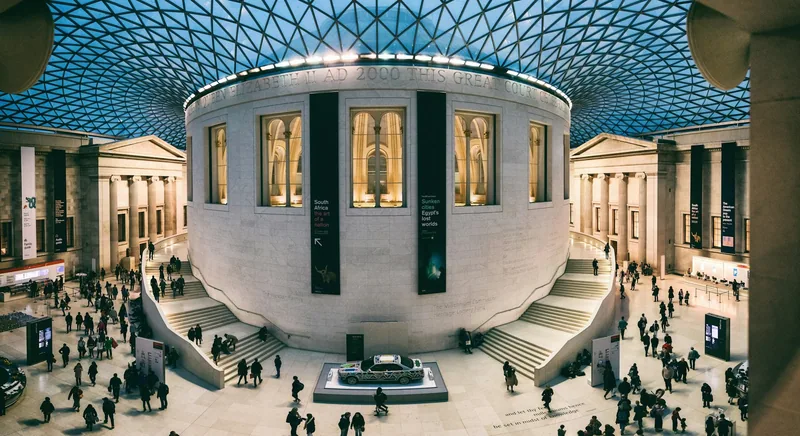
Most visitors arrive through the main gates on Great Russell Street, walk past the columns of the Greek-style front and enter the Great Court. This is the huge covered courtyard at the centre of the building, with a glass and steel roof completed in 2000 and the round Reading Room in the middle. It is where you find the information desk, the guide desk, shops and cafés, and it is the easiest place to meet people or get your bearings.
There is a second entrance at the back, on Montague Place. It is often quieter, and it is useful if you are coming from Russell Square or the University of London side of the Bloomsbury neighbourhood. Everyone passes a security check and bag search at either entrance.
The galleries are arranged over three levels. The ground floor holds the big stone sculpture: Egypt, Assyria and Greece. The upper floors hold smaller objects, including the Egyptian mummies, Sutton Hoo, the Islamic world, China and Japan. A small lower floor has the Africa galleries. Pick up or download the official map before you start; room numbers are the fastest way to find anything.
Finding the Rosetta Stone in Room 4
The Rosetta Stone is a broken slab of dark stone carrying the same decree, issued in 196 BC, written three times: in Egyptian hieroglyphs, in a later Egyptian script called demotic, and in ancient Greek. Because scholars could read the Greek, the stone became the key to reading hieroglyphs in the 1820s. French soldiers found it in 1799 near the town of Rashid (Rosetta), and it came to the British Museum in 1802.
It stands in Room 4, the long Egyptian sculpture gallery on the ground floor, a short walk to the left (west) from the Great Court. Room 4 also holds huge statues of pharaohs, including a colossal bust of Ramesses II, so it is worth a slow walk even after you have seen the stone.
The Rosetta Stone is almost always surrounded by people holding up phones. The crowd thins in the first half hour after opening and again late in the afternoon. The museum lists Room 4 as closed for maintenance from 11 to 22 January 2027, so check the dates if you are visiting then.
The Parthenon sculptures in Room 18
Room 18 displays marble sculptures from the Parthenon, the temple to Athena on the Acropolis in Athens, carved in the 5th century BC. You see figures from the two triangular pediments, square relief panels showing fights between Lapiths and centaurs, and long sections of the frieze, a carved procession that once ran around the temple. Many of them were removed by agents of Lord Elgin in the early 1800s and bought by the British government in 1816. Greece has asked for many years for them to be returned, and the debate is still open.
The official map marks Room 18 as one of its "don't miss" galleries. It is on the ground floor, beyond the Assyrian and Greek rooms on the west side of the building.
Room 18 is shut for maintenance until 25 September 2026. The museum's list of planned closures shows the Parthenon gallery closed from 14 to 25 September 2026. If the Parthenon sculptures are the reason for your visit, go from 26 September onwards and check the closures list on the visit page the day before.
Galleries with short opening hours
Some ground-floor and upper-floor rooms do not open all day. According to the official museum map, Rooms 7, 9, 10, 19 and 20 open from 11:00 to 15:00, and so do Rooms 57 and 58. Room 10 holds the Assyrian lion hunt reliefs, some of the finest carvings in the building, so if you want to see them, plan to pass through in the middle of the day. The museum also warns that some galleries close at short notice.
Mummies, Sutton Hoo and the upper floors
Many visitors, especially families, come for the mummies. They are upstairs in Rooms 62-63 (Egyptian death and afterlife), next to Room 61 with the painted tomb-chapel of Nebamun. These rooms get crowded around midday and in school holidays, so go early or late if you can.
On the same floor, Room 41 holds the finds from the Sutton Hoo ship burial, an Anglo-Saxon grave in Suffolk. The helmet is the object everyone recognises, but the gold buckle and shoulder clasps are just as remarkable up close. Nearby are Room 40 (medieval Europe), Room 49 (Roman Britain) and the clocks and watches in Rooms 38-39, a quiet gallery that often surprises people.
Further along are the Islamic world galleries (Rooms 42-43), China and South Asia (Room 33), Korea (Room 67) and Japan (Rooms 92-94). Several of these close for a week or two of maintenance this autumn (for example Rooms 42-43 from 12 to 23 October 2026), so check the planned-closures list on the visit page.
A two-hour route through the highlights
This route keeps walking to a minimum and uses the stairs only once. Start at the Great Court and follow it in order.
- Room 4, Egyptian sculpture (20 minutes). See the Rosetta Stone first, before the gallery fills, then walk the length of the room past the pharaohs.
- Rooms 6-10, Assyria (20 minutes). Room 6, beside Room 4, holds colossal Assyrian sculpture and the bronze Balawat Gates. If it is between 11:00 and 15:00, continue into Room 10 for the lion hunt reliefs.
- Room 18, Parthenon (20 minutes). Give the frieze a few slow minutes. Room 17 next door has the Nereid Monument, a small temple-tomb from what is now Turkey.
- Coffee in the Great Court (15 minutes). Go back through the middle of the building and take the stairs that curve around the Reading Room to the upper floor.
- Rooms 62-63, mummies (20 minutes), with a look at Nebamun's paintings in Room 61.
- Room 41, Sutton Hoo (15 minutes), then Room 40 or the clocks in Rooms 38-39 if you still have energy.
- Leave by the Great Court, or by Montague Place if you are heading north.
If you have a whole day, add the Islamic world and Japan upstairs and the Africa galleries on the lower floor. If you have only an hour, do steps 1 to 3 and skip the upper floor. For a wider day that combines the museum with other free sights, see our one-day London itinerary.
The free audio app saves hiring a guide. The museum's own audio app covers the galleries in several languages, including British Sign Language, and works on your phone. Download it at your hotel over Wi-Fi and bring headphones; the museum also has free Wi-Fi if you forget.
Free tickets, queues and the bag rules
Entry to the permanent collection costs nothing. The museum advises booking a free ticket online for a date and time. Holders get priority entry at busy times and are asked to arrive at their entry time, not earlier. You can book for up to nine people at once. If no slots are left, you can still walk up: the museum says walk-up visits are available each day, but non-ticket holders may wait longer when numbers are high. Groups of ten or more must book a group ticket.
Security is the main cause of queues. All bags may be searched, and the rules on luggage are strict:
- Wheeled suitcases are not allowed at all, whatever their size.
- No bag larger than 40 x 40 x 50 cm or heavier than 8 kg is allowed on the premises.
- Folding bicycles, adult scooters, skateboards and musical instruments are not allowed.
- Tripods, monopods and selfie sticks cannot be used inside.
If you are travelling on the day you check out of your hotel, leave the big case first. The museum points to luggage storage at Euston, King's Cross and Charing Cross stations, and our guide to left-luggage options around London lists more. The cloakroom (turn left after the main entrance) charges per item:
| Item | Cloakroom charge (September 2026) |
|---|---|
| Bag up to 4 kg | £4 |
| Bag 4-8 kg | £6 |
| Coat | £3 |
| Umbrella | £2 |
| Fold-up pushchair | Free |
The cloakroom takes its last deposits one hour before closing and has limited space. An easier access route is available for disabled visitors, people with buggies and children under five; ask uniformed staff at the gate. Our guide to getting around London with a wheelchair covers the wider picture.
The Bayeux Tapestry and other paid exhibitions
The permanent collection is free, but special exhibitions have their own tickets, and an exhibition ticket also lets you into the free galleries. The big event of 2026-27 is the Bayeux Tapestry, lent by France and shown in England for the first time since it was made nearly 1,000 years ago. The 70-metre embroidery tells the story of the Norman Conquest of 1066. It is on show in Room 30 from 10 September 2026 to 11 July 2027.
Demand is very high. The museum says tickets for 10 September to 31 December 2026 have sold out, bookings for January to March 2027 open on 21 October 2026, and April to July 2027 tickets open in early 2027. There is a maximum of ten tickets per booking, tickets can only be used by the booker, and ID may be checked.
| Bayeux Tapestry ticket | Standard | Off-peak |
|---|---|---|
| Adult | £33 | £27 |
| Adult with £3.50 donation | £36.50 | £30.50 |
| Student, 16-18, jobseeker | £25 | £25 |
| Under 16 (max four per adult) | Free, but must be booked | Free, but must be booked |
A "super off-peak" adult ticket costs £25 on term-time weekdays for the 15:30-16:20 slots. A couple pays £66 at the standard price, and a family of two adults with two children under 16 pays the same £66, because the children go free. Check current prices and releases on the official Bayeux Tapestry page. Another exhibition, Korea, runs from 1 October 2026 to 31 January 2027.
Opening hours, Friday evenings and the quietest times
The museum is open daily from 10:00 to 17:00 and until 20:30 on Fridays, with last entry at 16:45 (20:15 on Fridays). Staff begin clearing galleries ten minutes before closing. The Great Court stays open until 17:30 on normal days. The museum is closed on 24, 25 and 26 December, and there is no late opening on Good Friday (26 March 2027). The Bayeux Tapestry exhibition keeps longer hours of its own: 10:00-18:00 Sunday to Wednesday and 10:00-21:00 Thursday to Saturday.
Friday evening is the best time for a calm visit, with fewer school groups and shorter security lines. We would book a slot for about 17:30 on a Friday and start with the Parthenon gallery. Our guide to museum late openings across London lists the other evening options.
The busiest times are late mornings, weekends and school holidays, and any day it rains. The British Museum is one of the first places people think of on a wet day in London, so on a rainy Saturday a booked slot matters more than usual.
Getting to Great Russell Street by Tube and bus
Four Tube stations are within walking distance. The official times are Tottenham Court Road 5 minutes (Central and Northern lines and the Elizabeth line), Holborn 7 minutes (Central and Piccadilly), Russell Square 7 minutes (Piccadilly) and Goodge Street 8 minutes (Northern). From Heathrow, the Piccadilly line to Holborn or Russell Square, or the Elizabeth line to Tottenham Court Road, brings you here without changing. Our guide to using the Underground explains the lines, and how contactless and Oyster fares work covers paying.
Many buses stop nearby, on New Oxford Street, Tottenham Court Road and Southampton Row. There is no public parking at the museum, and on-site bicycle racks are temporarily unavailable because of building works. A Santander Cycles docking station is two minutes away, at the corner of Great Russell Street and Montague Street.
Cafés, breaks and what to combine it with
The museum has several places to eat. The Court Cafés in the Great Court are open 10:00-17:00, the Great Court Restaurant 11:30-17:00 (last sitting 16:00), the pizzeria 11:00-16:00 and the coffee lounge 10:30-16:30. Prices are those of a central London café, so a packed lunch eaten outside in one of the Bloomsbury squares is the cheapest option in good weather.
The museum sits between two busy areas. Ten minutes south is Covent Garden, with its market hall and street performers. To the east, near Holborn, is Sir John Soane's Museum, one of the most unusual houses in London; see our round-up of smaller museums worth a detour. Book lovers can walk to the shops described in our pick of London bookshops, several of them in Bloomsbury.
If you want another big free museum on the same trip, the National Gallery on Trafalgar Square is about 20 minutes' walk away; read our National Gallery guide before you go. For the full list of places that cost nothing to enter, see free museums in London, and for every museum on this site, start from our museums and galleries section.
Frequently asked questions
Is the British Museum really free?
Yes. Entry to the permanent collection, including the Rosetta Stone, the Parthenon sculptures and the mummies, is free for everyone. You pay only for special exhibitions such as the Bayeux Tapestry, for the cloakroom, and for food. The museum welcomes donations.
Do I need to book a ticket for the British Museum?
You do not have to, but the museum recommends a free timed ticket. Ticket holders get priority entry at busy times, while walk-up visitors enter depending on capacity and may wait longer. Booking takes a few minutes online, and you can book for up to nine people.
How long do you need at the British Museum?
Two hours is enough for the main highlights if you follow a plan: the Rosetta Stone, Assyria, the Parthenon sculptures, the mummies and Sutton Hoo. A half day lets you add a few galleries that interest you. Seeing everything properly would take several visits.
Can I bring a suitcase into the British Museum?
No. Wheeled suitcases are not allowed on the premises at all, and bags larger than 40 x 40 x 50 cm or heavier than 8 kg are refused. Leave luggage at your hotel or at a left-luggage service in a main railway station before you come.
When can I see the Bayeux Tapestry in London?
The Bayeux Tapestry is at the British Museum from 10 September 2026 to 11 July 2027 and needs a paid, timed ticket. Tickets until the end of December 2026 have sold out; January to March 2027 tickets go on sale on 21 October 2026.
Sources
- British Museum - Visit (opening hours, tickets, getting here, bag rules, planned closures; Internet Archive copy of 11 September 2026) (checked September 2026)
- British Museum - The Bayeux Tapestry (Internet Archive copy of 7 September 2026) (checked September 2026)
- British Museum - Museum map (PDF) (checked September 2026)
- Transport for London - Journey Planner (checked September 2026)