
The IFS Cloud Cable Car (now called the London Cable Car on TfL's own pages) carries you across the Thames in East London, between Greenwich Peninsula and the Royal Docks, up to 90 metres above the water. A one-way adult ride costs £7.00 and takes up to 10 minutes. It works best as part of a day in Greenwich or Docklands, not as a trip on its own.
The cable car is part of the Transport for London (TfL) network, so it appears on the Tube map and you can pay with a contactless bank card or an Oyster card. In practice, very few people use it to get to work. Most riders are visitors who want a different view of London and a short, gentle ride in a glass-sided cabin.
The two terminals sit next to North Greenwich station on the Jubilee line, south of the river, and Royal Victoria station on the Docklands Light Railway (DLR), north of the river. TfL describes it as the UK's first and only urban cable car. It is not in the centre of London, so you need to plan how it fits into your day. This guide explains the prices, the opening hours, what you can see and how to combine the ride with the sights around it.
London's cable car in brief
- Route
- Greenwich Peninsula Terminal (south bank) to Royal Docks Terminal (north bank)
- Nearest stations
- North Greenwich (Jubilee line); Royal Victoria (DLR)
- Adult fare
- £7.00 one way, £13.50 round trip (from 1 March 2026)
- Child fare
- £3.50 one way, £6.75 round trip
- Ride time
- Up to 10 minutes each way
- Height
- Up to 90 metres above the Thames
- Pay as you go
- Contactless and Oyster accepted, but the ride does not count towards daily or weekly caps
What the ride is like
You board at one of the two terminals. The cabins keep moving slowly through the station, and staff help you step in. A new cabin arrives about every 30 seconds, and each one holds up to 10 people, so queues usually move quickly. At busy times TfL puts different groups into the same cabin to keep the line moving, so don't count on having a cabin to yourself on a sunny Saturday.
Once the cabin leaves the terminal, it climbs over the river on a long cable held up by tall towers. The ride takes up to 10 minutes one way. It can be slower when many people are boarding or when the wind picks up. The cabins have seats and large windows on all sides.
The highest point is about 90 metres above the Thames. TfL warns that wind can make the cabins sway slightly, and that the ride may not suit people with vertigo, motion sickness, a fear of heights, heart conditions or anxiety disorders. If you are unsure, ask your doctor before you book. The cabin is enclosed and you cannot get out until you reach the other side, which is worth knowing if anyone in your group is nervous about heights.
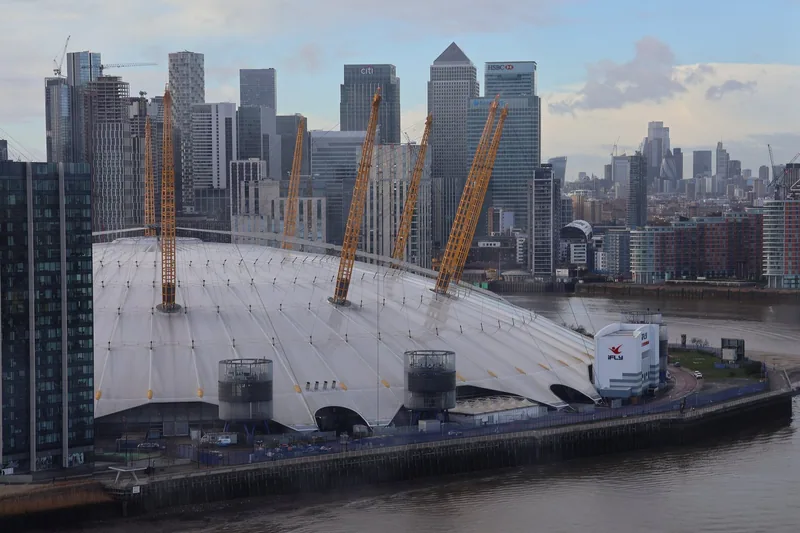
Photo: DiscoA340 · CC BY-SA 4.0 · Wikimedia Commons · resized
What you can see from 90 metres up
The view is the reason to go. On a clear day TfL lists St Paul's Cathedral, the Gherkin, the Thames Barrier, Maritime Greenwich and Queen Elizabeth Olympic Park among the sights. Nearer to you are the white dome of The O2, the towers of Canary Wharf and the wide water of the Royal Docks, with London City Airport further east along the docks.
This is a view of working, modern East London rather than of Big Ben and the palaces. If you want the classic riverside skyline of Westminster, the London Eye on the South Bank is the better choice, although it costs much more. For more ideas, see our list of places to see London from above without paying.
The view changes a lot with the light. Around sunset the river and the Canary Wharf towers turn gold, and after dark the city lights spread out below you. The cable car stays open until 21:00 or later every day, which makes it one of the few ways to see London from high up in the evening. Our guide to evening things to do in London has more ideas for later in the day.
Cross at dusk and come back after dark. If you ride over just before sunset, have a walk or a meal on the other side and return once the lights are on, a round trip at £13.50 gives you both the daytime and the night-time view of the river for the price of one ticket.
Tickets and fares in 2026
The fares below have applied since 1 March 2026. Check the current prices on the TfL cable car fares page before you travel.
| Ticket | Adult | Child |
|---|---|---|
| One way | £7.00 | £3.50 |
| Round trip | £13.50 | £6.75 |
| Multi-journey ticket (10 one-way journeys, ticket offices only) | £20 | - |
A family of two adults and two children paying the standard round-trip fare spends £40.50. A couple taking a one-way ride as part of a longer day out spends £14.00.
There are four ways to pay: online in advance, with a contactless card or device, with an Oyster card, or with cash or card at the ticket offices in the terminals. TfL offers discounts of up to 30% online on selected tickets and dates. The full 30% is only available on off-peak round trips booked at least 7 days ahead, and event tickets are excluded. The official online shop is cablecartickets.tfl.gov.uk, which also sells combined cable car and river tickets, fast-track options and experience packages.
The multi-journey ticket is aimed at regular users. It costs £20 for 10 one-way journeys, is valid for 12 months, cannot be shared between people and does not include priority boarding. For most visitors, a single round trip is all they need.
Carers travel free with a paying adult or child, if they show evidence such as a Blue Badge or a letter from a recognised health body. The paying guest must buy a full-price ticket at the ticket office. Concession fares for Freedom Pass and 60+ London Oyster photocard holders are only sold at the ticket office too.
Paying with contactless or Oyster
You can simply touch in at the gate with a contactless bank card, a phone or an Oyster card, as you would on the Tube. There is an important difference, though: cable car journeys do not count towards the daily or weekly caps that limit what you pay on the rest of the network. If you have already reached your daily cap on the Tube, you still pay the full cable car fare. Our guide to contactless, Oyster and daily caps explains how capping works elsewhere.
You cannot top up an Oyster card at the cable car terminals, so add credit online or at a station ticket machine before you arrive. Each person needs their own card or device. If you bought a Visitor Oyster card before your trip, TfL lists discounts on the London Cable Car among its extras, so ask about it at the ticket office.
Book the return trip a week ahead to save the most. If you know your date, an off-peak round trip bought online at least 7 days before can be up to 30% cheaper than paying at the gate. Pay as you go is convenient for a spontaneous one-way ride, but it will not beat an advance online fare.
Opening hours and when to go
The cable car runs every day. These are TfL's published hours (September 2026):
| Day | Hours |
|---|---|
| Monday to Thursday | 08:00-21:00 |
| Friday | 09:00-22:00 |
| Saturday | 09:00-23:00 |
| Sunday and bank holidays | 09:00-21:00 |
The cable car may close for a while in very strong wind, when there is lightning nearby, or in extreme heat. Check the live cable car status on the day, or call TfL's travel information line on 0343 222 1234. Autumn and winter storms are the most likely reason for a closure, so keep a backup plan on windy days. Our page on London's weather through the year will give you an idea of what to expect.
Weekday mornings and early afternoons are usually quietest. Weekends, school holidays and summer evenings are busier, and a Saturday evening ride before the late closing time is popular. If you want the sunset, check the sunset time for your date and arrive about half an hour before.
Next to the Greenwich Peninsula Terminal is the London Cable Car Experience, an indoor space with activities for children. It opens 10:00-19:00 during UK school holidays, weekends and bank holidays, and 10:00-17:00 at other times. It sometimes closes for private events, so check the TfL page before you promise it to the children.
Getting to the Greenwich Peninsula Terminal
The southern terminal is at Edmund Halley Way, SE10 0FR, about 5 minutes' walk from North Greenwich station and The O2. The easiest route from central London is the Jubilee line, which runs through Westminster, Waterloo, London Bridge and Canary Wharf; see our guide to using the Tube if you have not used it before. Follow the signs from the station exit.
You can also come by bus: route 188 runs from central London to North Greenwich bus station. It is slower, but cheap, and a good way to see South London from the top deck. Our guide to riding London's buses explains the flat fare and how to pay.
The most scenic option is the river. North Greenwich Pier is close to the terminal and is served by the Uber Boat by Thames Clippers river bus. Read our guide to the river bus for routes and fares, and note that river journeys, like the cable car, do not count towards daily caps.
Getting to the Royal Docks Terminal
The northern terminal is at 27 Western Gateway, E16 1FA, next to Royal Victoria DLR station. The DLR is the driverless light railway that serves Docklands and East London. Royal Victoria is on the branch to Beckton: take a DLR train towards Beckton (some start at Tower Gateway, near the Tower of London), or change at Canning Town, which is also on the Jubilee line. Our explainer on the DLR and the Overground shows how the lines connect.
The Royal Docks side is quieter than Greenwich. The large ExCeL exhibition centre is nearby, so if you are in London for a trade fair or conference, the cable car is a useful short link to the Jubilee line on the other side of the river.
Combining the cable car with a day out
Because the terminals are outside the centre, the ride makes most sense as one part of a longer day. Here are three routes that work well.
Greenwich by river, cable car, then Docklands
Take the river bus from central London to Greenwich and spend the morning around the Royal Observatory and the Cutty Sark. The Royal Observatory is open daily from 10:00 to 18:00 until 2 November 2026, then closes for a major transformation until summer 2027; the National Maritime Museum next door is free and stays open, as do the Cutty Sark and the park. From there, go on to North Greenwich, ride the cable car across to the Royal Docks, and return to the centre by DLR. Our Greenwich neighbourhood guide covers the market, the park and places to eat.
Canary Wharf and the history of the docks
Start at Canary Wharf, with its towers, shopping centres and waterside paths. The free London Museum Docklands is about 3 minutes from West India Quay DLR station and tells the story of the river and the port; see our page on the London Museum and its sites. It is open daily from 10:00 to 17:00. Then take the Jubilee line one stop to North Greenwich for the ride over the river.
An easy afternoon with children
For families, the cable car is a short, exciting ride that rarely bores anyone. Combine it with the London Cable Car Experience, a walk along the river path on the Greenwich Peninsula, and a meal at The O2. Our family guide to London has more ideas for keeping children happy on the move.
Worth the fare if...
- You are already visiting Greenwich, Canary Wharf or the ExCeL centre
- You want an unusual view of East London and the river
- You are travelling with children who enjoy a short ride
- You want a high viewpoint that is open in the evening
Skip it if...
- You only have a day or two and want the central sights
- You expect a close view of Westminster and Big Ben
- Anyone in your group is uncomfortable with heights or swaying
- The forecast is stormy and the service may close
Accessibility, bikes and luggage
The cable car is step-free, and most wheelchairs, including motorised wheelchairs and mobility scooters, can use it. The maximum weight is 300 kg and the maximum size is 700 mm by 1,300 mm. You get on and off through the same doors, so you may have to reverse out of the cabin. Staff can slow the cabins down to give you more time to board, and electric wheelchairs and scooters must be switched off during the ride. Both nearby stations, North Greenwich and Royal Victoria, fit into TfL's step-free network; our guide to step-free travel in London explains the help staff can give.
Bicycles are allowed at all times, and riders with bikes travel free before 10:30 on weekdays (not bank holidays). E-bikes, e-scooters and e-unicycles are banned, in line with TfL policy. If you are exploring on a hire bike, our guide to cycling in London covers Santander Cycles, although you should check the docking stations near the terminals before you plan on returning a bike there.
You can bring a picnic and soft drinks on board, according to TfL. Large suitcases are best left at your hotel; a cabin shared with strangers has little room for luggage.
Frequently asked questions
How much does the London cable car cost?
Since 1 March 2026, an adult one-way ride costs £7.00 and a round trip costs £13.50. Children pay £3.50 one way or £6.75 for a round trip. Booking online can save up to 30% on off-peak round trips bought at least 7 days ahead.
Can I use contactless or Oyster on the cable car?
Yes. You can touch in with a contactless card, a phone or an Oyster card. The fare does not count towards the daily or weekly cap, so you pay the full fare even if you have already reached your cap on the Tube. You cannot top up Oyster at the terminals.
Is the cable car worth it?
It is worth it if you are already in Greenwich, Canary Wharf or the Royal Docks, or if you want an unusual view of East London. It is not a good use of time on a short trip focused on central London, because the terminals are some distance from the main sights.
Does the cable car close in bad weather?
It can close temporarily in very strong wind, when there is a risk of lightning nearby, or in extreme heat. Check the live status on the TfL website or call 0343 222 1234 before you set out, especially on a stormy day.
How long is the ride across the Thames?
A one-way ride takes up to 10 minutes, depending on the number of passengers and the weather. Cabins arrive about every 30 seconds, so you rarely wait long, although queues to buy tickets can build up at weekends and in school holidays.
Sources
- Transport for London - London Cable Car (checked September 2026)
- Transport for London - London Cable Car location and opening hours (checked September 2026)
- Transport for London - London Cable Car fares (checked September 2026)
- Transport for London - Taking a ride on the London Cable Car (checked September 2026)
- Mayor of London - MD3464 March 2026 Transport for London fare changes (checked September 2026)
- Transport for London - Visitor Oyster card (checked September 2026)