
The Royal Academy Summer Exhibition is a huge open-submission show held at Burlington House on Piccadilly every summer since 1769. Anyone may enter a work, Royal Academicians choose and hang the show, and almost everything on the walls is for sale, from small prints to major canvases.
It is not a curated exhibition in the usual sense. In 2026 it filled the Main Galleries with more than 1,800 works, hung close together from floor to ceiling in many rooms, by first-time exhibitors next to some of the best-known artists in Britain. You walk round with a list of works and prices, and a red dot on the wall beside a number means that piece has found a buyer.
Our guide to the Royal Academy of Arts covers the building, the free displays and whether this show is your kind of exhibition. This page is about how it works: the season and the ticket, how a work gets onto the wall, and what actually happens if you decide to buy one.
Summer Exhibition at a glance
- Where
- Main Galleries, Burlington House, Piccadilly, W1
- Season
- About three months between mid-May and late August; the exact dates change every year
- 2026
- 16 June to 23 August 2026 (past)
- 2027
- 18 May to 15 August 2027; Friends preview days 15 to 17 May (RA, checked November 2026)
- Tickets
- £23.50 to £25.50 including a donation in 2026, varying by day; 2027 prices not yet published (November 2026)
- Size
- More than 1,800 works in 2026
- Entrance
- Burlington House, Piccadilly; the Burlington Gardens entrance is closed until autumn 2027
- Nearest stations
- Green Park and Piccadilly Circus
The oldest open submission in the world
The Royal Academy calls it the world's oldest open-submission exhibition, and it has run every year since 1769. In the eighteenth century it was known simply as "The Exhibition", and it was where Reynolds and Gainsborough, and later Turner and Constable, competed for attention on the same walls.
Each year a different Royal Academician coordinates the show and gives it its character, working with a committee of Academicians who serve in rotation. Ryan Gander RA coordinated 2026; Helen Sear RA is the coordinator for 2027. Academicians exhibit as well as select, and the RA says that in previous years nearly two-thirds of the exhibits were by non-Academicians.
The hang has a vocabulary of its own. In the old Academy, the "line" was the height at which the bottom edge of the most important pictures sat, eight feet from the floor; smaller works went below it, and lesser artists were "skied" above. Today's show mixes densely packed rooms in that tradition with lighter galleries given to film, photography, architecture or a single artist.
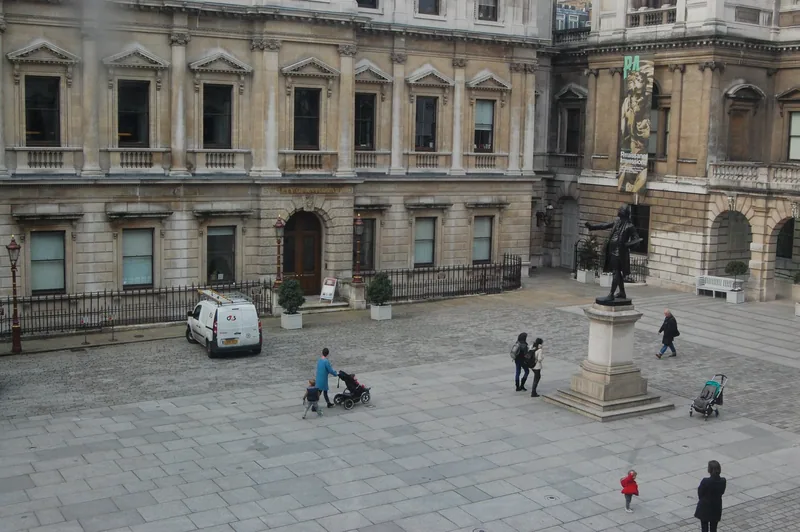
Photo: Andy Mabbett · CC BY-SA 4.0 · Wikimedia Commons · resized
When it is on, and what a ticket costs
The season is early to late summer, for about three months, but the dates move a long way. The 2026 show ran from mid-June to late August; the 2027 one opens in mid-May and closes in mid-August. Do not assume a July date in one year means July the next: check the exhibition page for your year, and use the factbox above for the dates we read.
Tickets are sold by the RA, with prices that vary within a band depending on the day. In 2026 they were £23.50 to £25.50 including a voluntary donation. RA Friends go free and get the preview days before the public opening. The RA's 2026 page said tickets for the final days had sold out online, with only limited tickets on the day at the desk, so the last fortnight is the period to book furthest ahead.
In 2026 the galleries opened 10am to 6pm Tuesday to Thursday and Sunday, and until 9pm on Friday and Saturday. The evening hours are the most pleasant time to go, as our guide to museum lates suggests for London in general. Large bags, backpacks and suitcases cannot be brought into the galleries or stored at the RA, so come without luggage.
Use the Piccadilly entrance this year, not the back door. The RA's second entrance, on Burlington Gardens, is closed while the Collection Gallery is extended. Every visitor comes in through the courtyard of Burlington House from Piccadilly, where the RA's security checks take place on arrival.
How a work gets onto the wall
The open submission is a real one. Anyone can register on the RA's submission site, and the 2027 rules allow one or two works per artist, at £40 per work, non-refundable. The fee covers administration. A collaboration counts as a separate entrant, but an artist may still enter only two works in total.
Judging happens in two rounds. The first is from digital images: entrants upload photographs, and the judges shortlist up to 4,000 works. Shortlisted artists then deliver the real object to Burlington House in April, on set days for architecture, sculpture and two-dimensional work. The final selection is made during an eight-day hang, and the show is fixed on "Sanctioning Day", after which nothing changes.
| Stage (2027 schedule, read November 2026) | When |
|---|---|
| Digital submission open | 5 to 21 January 2027 |
| Results of digital judging | 24 February 2027 |
| Delivery of shortlisted works | 6 to 9 April 2027 |
| Final results | 29 April 2027 |
| Non-Members' Varnishing Day | 10 May 2027 |
| Exhibition open | 18 May to 15 August 2027 |
The RA warns that some dates may change, and the window to submit is short: about two and a half weeks in January for 2027. If you are an artist planning to enter from abroad, the submission site also has guidance on VAT and on transport agents for shipping work in and out.
Varnishing Day and the walk down Piccadilly
Non-Members' Varnishing Day, a few days before the show opens, was once the artists' last chance to touch up a painting on the wall. Some still do; for most it is a celebration. Exhibitors are invited to a reception, and the RA describes a procession of artists down Piccadilly led by a steel band as one of the show's eccentricities.
For a visitor this is something you might see by chance rather than plan around. The day is not a public opening, the RA publishes the date in the exhibitors' schedule rather than as an event, and times are announced only nearer the day. If you are walking along Piccadilly that morning, it is a cheerful thing to stumble on.
Buying a work: what the red dot really means
Most works are for sale, at the price printed in the List of Works and online. The RA's selling guide is clear about the legal arrangement: the artist is the seller, and the RA acts as an introducer that takes a commission. When you make an "Offer to Purchase", you pay a deposit to the RA in person, by phone or online, and that deposit becomes the RA's commission once the sale completes. The RA takes 35% of the net price, plus VAT on its commission.
The balance, the delivery and any paperwork are then between you and the artist, who must contact you, confirm the price and send an invoice. You do not take the work home on the day. Exhibited works stay on the wall until the show closes, and the 2027 schedule has collections running from late August into mid-September.
- Prints and editions can sell many times over, so a print with several dots may still be available. If the edition has not all been printed yet, the artist must tell you and agree a delivery date.
- Buyers outside the UK are the importer of record, according to the RA's guide, and pay any import duty and local taxes at home. Our guide to shipping purchases home from London covers the practical side.
- Large purchases: anyone buying more than £7,000 of art at the show over 12 months must pass identity checks under anti-money-laundering rules.
- Online: since 2015 every work in the show has been browsable on the RA's Summer Exhibition Explorer, and many can be bought there, which counts as a distance sale with extra cancellation rules.
Sort the online list by price before you fall for a painting. The RA's online list of works can be sorted by price and medium, and an editioned print is usually the most affordable way to take the Summer Exhibition home. Make a short list at the hotel, then walk the rooms with it.
A visit that works
Allow at least two hours. The show is long and the rooms are full. Opening time and the late evenings are the calmer choices, in our view. The list of works is the only label for most pieces, so take it, or use the online version on a phone.
Before you go in, look at the courtyard. In 2026 the Annenberg Courtyard in front of Burlington House carried Ugo Rondinone's rainbow sculpture, invited by that year's coordinator, and anything placed there can be seen free from Piccadilly. Our guide to Mayfair and St James's covers the streets around it, and Bond Street and its commercial galleries are a few minutes north.
If you would rather see a smaller number of masterpieces than a great many new works, the National Gallery is a 15-minute walk east and free. For other things to do in early summer, see our guides to London in June and London in July. The Trooping the Colour rehearsals on Horse Guards Parade can fall in the same weeks.
Frequently asked questions
Can anyone submit work to the Royal Academy Summer Exhibition?
Yes. It is an open submission: any artist can register on the RA's submission site and enter one or two works, for £40 per work under the 2027 rules. Judges shortlist from digital images first, then choose from the delivered works. The fee is not refunded if your work is not selected.
How much does the RA Summer Exhibition cost?
In 2026 tickets cost £23.50 to £25.50 including a donation, depending on the day. RA Friends go free. Prices for 2027 had not been published in November 2026, so check the RA's exhibition page when tickets are released.
Is everything in the Summer Exhibition for sale?
Most of it is. Prices are printed in the List of Works and online. You make an Offer to Purchase through the RA, pay a deposit that becomes the RA's commission, and settle the balance and delivery with the artist after the show closes.
When is the Royal Academy Summer Exhibition?
It runs for about three months each summer, but the dates vary: mid-June to late August in 2026, and 18 May to 15 August in 2027. The RA publishes the dates on its exhibition page well in advance.
How long do you need at the Summer Exhibition?
Plan on two hours or more. There are well over a thousand works across the Main Galleries, hung densely, and most labels are numbers that refer to the printed or online list of works, which slows you down.
Sources
- Royal Academy of Arts - About the Summer Exhibition (checked November 2026)
- Royal Academy of Arts - Summer Exhibition 2027 (checked November 2026)
- Royal Academy of Arts - Summer Exhibition 2026 (checked November 2026)
- Royal Academy of Arts - Summer Exhibition 2027 submission site, FAQ and entry fee (checked November 2026)
- Royal Academy of Arts - Summer Exhibition schedule 2027 (PDF) (checked November 2026)
- Royal Academy of Arts - Guide to selling, Summer Exhibition 2027 (PDF) (checked November 2026)
- Royal Academy of Arts - Plan your visit (checked November 2026)