
The Boat Race is free, it happens on a Sunday afternoon in spring on a stretch of the Thames in west London, and the whole thing is over in about seventeen minutes. In 2027 it falls on Sunday 11 April, with the Women's race at 15:40 and the Men's at 16:40.
Two crews of eight rowers, one from Oxford University and one from Cambridge University, race four and a quarter miles upstream from Putney to Mortlake. Tens of thousands of people line the banks. Nobody buys a ticket.
Before you go, be clear about one thing: you will not see much of the race. The boats pass any given point in seconds. What you are going there for is the afternoon, the crowd and the moment they go past, not a sporting spectacle you can follow from start to finish.
The Boat Race 2027
- Date
- Sunday 11 April 2027
- Times
- 15:40 (Women's Boat Race) and 16:40 (Men's Boat Race)
- Course
- The Championship Course, Putney to Mortlake, 4 miles 374 yards
- Cost
- Free from the riverbank and the bridges
- On television
- Channel 4, with audio coverage on Times Radio
- 2027 in particular
- 100 years since the first Women's Boat Race, held on 15 March 1927
The course, and why the bends decide the race
The Championship Course runs from Putney, just upstream of Putney Bridge, to Mortlake, just past Chiswick Bridge. It is not straight. It bends first towards the Surrey bank, then back towards Middlesex, then towards Surrey again.
Whoever is on the inside of a bend has less water to cover, so the two stations, Surrey and Middlesex, are not equal at any given moment. The crews toss a coin before the race for the choice of station, and the winner picks based on the wind and the tide that day. That coin toss is a real tactical decision, not a formality.
The rules require both boats to pass through the centre arches of Hammersmith Bridge and Barnes Bridge, which stops a crew from cutting across. An umpire follows in a launch and is the sole judge of whether a boat is on its proper course; the umpire's main job during the race is to stop the two boats touching, and the umpire will warn a crew that is steering into the other's water.
The race is rowed with the incoming tide, which is why the start time moves from year to year. It is not scheduled for television convenience.
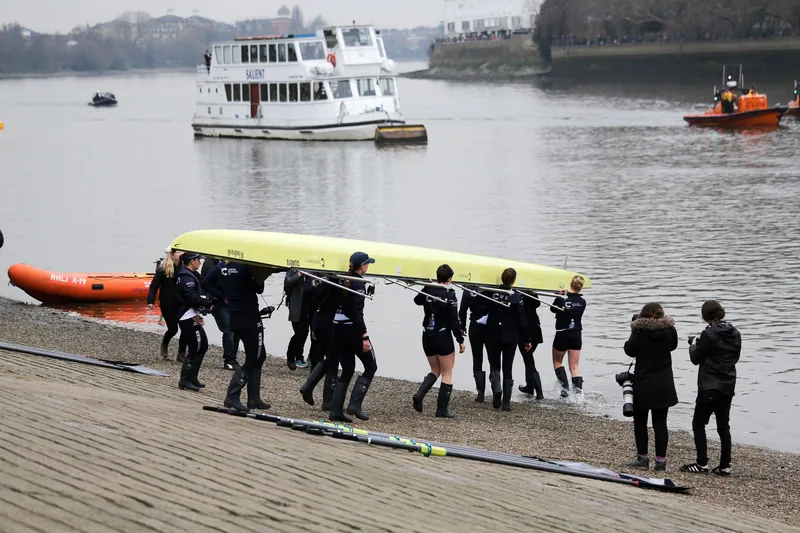
Photo: Katie Chan · CC BY-SA 4.0 · Wikimedia Commons · resized
Where to stand
There are four practical areas, and they offer different things.
| Where | What you get | Nearest station |
|---|---|---|
| Putney Embankment and Bishops Park, Fulham | The start, the boats being carried down, the most atmosphere and the biggest crowd | Putney Bridge |
| Hammersmith riverside | Roughly the middle of the race, riverside terraces, room to move | Hammersmith |
| Barnes and Duke's Meadows | Quieter, green, good for families with space to sit | Barnes Bridge (rail) |
| Chiswick Bridge and Mortlake | The finish, and the result, with a smaller crowd than Putney | Mortlake (rail) |
For a first visit, Putney is the obvious choice. You can watch the crews boat, see the start, and then walk up to a pub or along the towpath. For a calmer afternoon with children, Duke's Meadows on the Chiswick side is far more comfortable.
Hammersmith Bridge is worth knowing about. It has been closed to motor traffic for years, but the main carriageway reopened to pedestrians, cyclists and wheelchair users in April 2025, with separate lanes for each. That makes it one of the better vantage points on the course, and one of the few places where you can cross between banks on the day.
Pick your bank before you leave, not when you arrive. The river has few crossings along the course, and the ones that exist are crowded on race day. Decide which side you want, and travel to a station on that side. Getting across at 15:00 is much harder than it looks on a map.
When to arrive
For the start at Putney, be there by about 14:00 if you want a place at the railings. The embankment fills from lunchtime, and the best stretches near the boathouses go first.
Further along the course you have more time, because the crowd spreads out. At Barnes or Chiswick, arriving an hour before the first race is usually enough.
For the pubs, the answer is earlier than you think. Riverside pubs along this stretch are small, historic and hugely oversubscribed on Boat Race day; the ones with a terrace or a beer garden facing the water are full by late morning and often operate on a one-in, one-out basis by early afternoon. Some take bookings for the day and sell them months ahead. If your plan involves watching from inside a pub, treat it as an event that needs organising rather than a decision you make on the day. Our guide to London's historic pubs covers the type, and pub etiquette for visitors explains how ordering works when it is three deep at the bar.
What you will actually see
A launch or two, a helicopter overhead, a murmur down the bank, and then two boats moving faster than you expect. From one fixed spot the whole thing lasts perhaps twenty seconds for the Women's race and twenty for the Men's.
Between the two races there is an hour, which is the real shape of the afternoon: you arrive, you settle, you watch, you wait, you watch again, and then everyone goes to the pub at the same time.
The organisers usually arrange large screens at the main viewing areas so that the crowd can follow the race between sightings, and they publish the final arrangements on the official site closer to the day. Do not count on one being where you are standing.
Getting there and getting away
Putney Bridge station, on the District line, serves the start. Hammersmith is served by four Tube lines. Barnes Bridge and Mortlake are National Rail stations on the Waterloo line, and both put you within a few minutes of the water.
Leaving is harder than arriving, because thirty thousand people finish watching at the same minute. Putney Bridge station queues badly after the second race. Two things help: walk to the next station along rather than the nearest one, or stay where you are for an hour and let it clear. Our guide to avoiding London's crowds makes the same argument about ordinary weekdays and it applies here.
The Tube map suggests some tempting short cuts that involve crossing the river. On race day, do not. Walking upstream or downstream along the towpath is usually faster than any train.
April on the Thames is colder than April in the city. The wind comes down the river and there is no shelter on the embankment. Bring a windproof layer and something waterproof whatever the forecast says; our guide to London weather and what to pack has the averages, and the riverbank runs several degrees below them.
A short history, and why 2027 matters
The first Boat Race was rowed on 10 June 1829 at Henley-on-Thames, after two school friends, one at Oxford and one at Cambridge, challenged each other. Oxford won. Races were held irregularly for 25 years before the event moved to London in 1836 and eventually settled on the Putney to Mortlake course.
The Women's Boat Race was founded in 1927. At first the crews did not race side by side at all: they rowed separately and were judged on time and style. Head-to-head racing began in 1935, over shorter distances on the Cam, the Isis or occasionally the Tideway at Barnes, and the event ran intermittently for decades before the women's race moved permanently onto the same course, on the same day, as the men's.
That makes 2027 the centenary of the Women's Boat Race, which the organisers have said they intend to mark. If you have any flexibility about which year to go, this is the one.
The two universities themselves make excellent days out from London in their own right, and our guides to Oxford and Cambridge cover how to get to each and what to do when you arrive.
Making a day of it in west London
The stretch of river the race uses is one of the most attractive in London, and it is worth arriving early and walking part of it. The towpath from Putney to Hammersmith is flat, green and lined with boathouses.
If you are at the Mortlake end, Kew Gardens is close by, though it is a full day in itself rather than an hour's filler. Richmond is two stops further on and makes a good place to have dinner once the crowds have gone. And Putney Heath is a twenty-minute walk uphill from the start if you want air rather than more river.
The Boat Race is one of a short list of genuinely free London events that feel like an occasion, alongside the London Marathon later the same month. Our page on free things to do in London has the rest, and for the river itself, see our guide to walking London's bridges and to the September river festival, Totally Thames. April's other events are set out in our month guide to London in April.
Frequently asked questions
When is the Boat Race in 2027?
Sunday 11 April 2027. The Women's Boat Race starts at 15:40 and the Men's Boat Race at 16:40. The times are set by the tide, because the race is rowed with the incoming water, so they change from year to year.
Do I need a ticket to watch the Boat Race?
No. Watching from the riverbank, the towpath and the bridges is free and open to everyone. Paid hospitality packages exist at some venues along the course, but they are not necessary and the free viewing is the traditional way to see it.
Where is the best place to watch?
Putney Embankment for the start and the atmosphere, Hammersmith for the middle of the race and easier transport, Duke's Meadows near Chiswick for space and a calmer crowd, and Chiswick Bridge for the finish. Whichever you choose, arrive at least an hour early and pick your bank of the river before you set out.
How long does the Boat Race last?
Each race takes roughly seventeen to twenty minutes from Putney to Mortlake, but from any one spot on the bank the boats are in sight for well under a minute. With an hour between the two races, plan on being out for most of the afternoon.
Is the Boat Race suitable for children?
Yes, if you choose your spot. The crush at Putney is not ideal for small children, but the green open space at Duke's Meadows and the Barnes stretch works well, with room to sit and something to do between the two races. Dress everyone more warmly than the forecast suggests.
Sources
- The Boat Race - official site (checked September 2026)
- The Boat Race - 2027 date confirmed (checked September 2026)
- The Boat Race - Rules and umpiring (checked September 2026)
- The Boat Race - Origins and history (checked September 2026)
- Hammersmith & Fulham Council - Hammersmith Bridge open to pedestrians and cyclists (checked September 2026)