
Mayfair and St James's are the two wealthiest districts of central London, lying between Oxford Street, Park Lane and St James's Park. You come here for art galleries, luxury shopping, grand hotels, historic shops and quiet Georgian squares, and a surprising amount of it costs nothing to look at.
The two areas sit side by side, divided by Piccadilly. Mayfair lies to the north, between Oxford Street, Regent Street and Park Lane. St James's lies to the south, running down to St James's Park and the royal palaces. Both were built up from the late 17th and 18th centuries as smart addresses for the aristocracy, and they have stayed that way.
For a visitor with a normal budget, the question is how to enjoy places built for the very rich. The answer is to treat them as open-air museums of shop fronts, architecture and history, to use the free galleries, and to choose carefully where you eat. This guide also explains where the areas feel empty or unwelcoming, which is more often than you might expect.
Mayfair and St James's in brief
- Main streets
- Piccadilly, New and Old Bond Street, Savile Row, Mount Street, Jermyn Street, St James's Street, Pall Mall
- Stations
- Green Park, Bond Street, Piccadilly Circus, Hyde Park Corner, Marble Arch
- Free highlights
- Royal Academy free displays, commercial galleries, Burlington Arcade, St James's Church, the squares
- Best time
- Weekday daytime, when shops, galleries and cafés are all open
- Weak spot
- Parts are very quiet on Sundays and in the evening, and eating out is expensive
How two aristocratic districts were built
Mayfair takes its name from the annual May fair that was held on open ground here in the 17th and 18th centuries, until the new residents had it closed down as too rowdy. Over the 18th century, landowners, above all the Grosvenor family, laid out streets and squares of brick houses for the nobility. Grosvenor Square and Berkeley Square date from that time, and the Grosvenor estate still owns a large part of the area.
St James's grew up around St James's Palace, which Henry VIII built in the 1530s. Courtiers wanted to live close to the monarch, and shops, coffee houses and later private clubs followed. Many of the shops that served them are still in business, which is why St James's has more old-fashioned shop fronts than almost anywhere else in London.
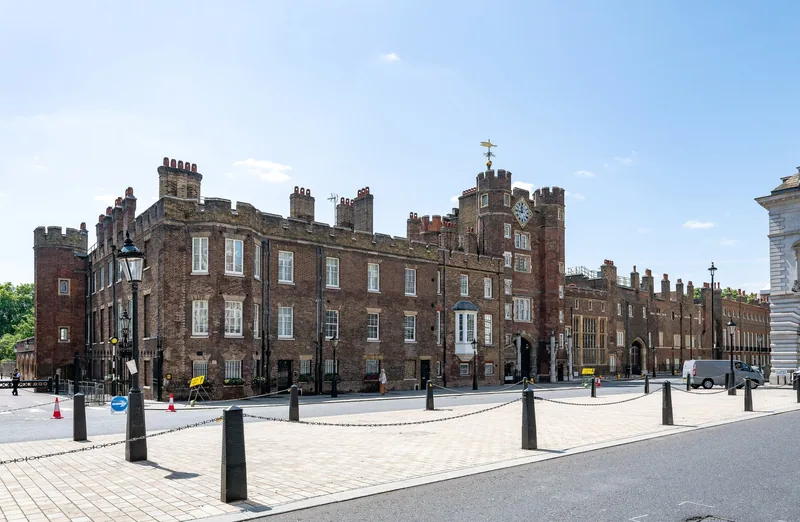
Photo: Tilman2007 · CC BY-SA 4.0 · Wikimedia Commons · resized
Piccadilly: the Royal Academy, Fortnum's and Hatchards
Piccadilly is the main road between the two districts and the easiest place to start. At its eastern end is Piccadilly Circus; from there it runs west past some of London's best-known institutions to Green Park and Hyde Park Corner.
The Royal Academy of Arts occupies Burlington House, a grand mansion set back behind a courtyard on the north side. It is famous for its paid exhibitions, including the Summer Exhibition, open to any artist who submits work, which has been held every year since 1769. Several displays are free, among them the John Madejski Fine Rooms and the RA's collection. The RA is closed on Mondays; from Tuesday to Saturday it opens from 10am to 6pm, staying open until 9pm on Fridays. Until spring 2027 the Burlington Gardens entrance at the back is closed, so use the main Burlington House entrance on Piccadilly. Late openings at galleries across the city are listed in our guide to museum late nights.
On the other side of Piccadilly, Fortnum & Mason has sold food, tea and hampers since the early 18th century. Its ground floor of teas, biscuits and jams is one of the most popular places in London to buy gifts, and it is covered in our list of souvenirs worth taking home. A few doors away, Hatchards, founded in 1797, is one of London's oldest bookshops, with creaking floors and several storeys of shelves; our bookshop guide covers it alongside other favourites.
A little further east on the same side, St James's Church Piccadilly is a Christopher Wren church that has served the area since 1684. Its courtyard hosts an artisan market with food and small makers' stalls on many days, and the church holds lunchtime concerts and talks. It is free to enter and a welcome break from the traffic.
Burlington Arcade and the Bond Street shops
Next to the Royal Academy, Burlington Arcade is a covered passage of small luxury shops that opened in 1819, one of the earliest shopping arcades in Britain. It is patrolled by beadles in top hats and long coats, who traditionally enforce the arcade's old rules on behaviour, including no running or whistling. You can walk through without buying anything; it is a short cut from Piccadilly to Burlington Gardens.
North of Piccadilly, Old Bond Street and New Bond Street form one long street of international fashion houses and jewellers. Most visitors come to window-shop. On a small traffic island near the join of the two streets, a bronze bench shows Winston Churchill and Franklin D. Roosevelt sitting side by side, and people often sit down between them for a photo.
The big auction houses are here too: Sotheby's on New Bond Street and, south of Piccadilly, Christie's on King Street in St James's. Before major sales they usually hold public viewings that anyone can walk into free of charge, which can mean seeing museum-quality paintings, jewellery or furniture at close range. Check their websites for current viewings.
Auction viewings and Cork Street galleries cost nothing. The commercial galleries on Cork Street, Dover Street and around Albemarle Street are free to walk into, and staff do not expect visitors to buy. Combined with the Royal Academy's free rooms and an auction house viewing, they make a full afternoon of art in Mayfair without a ticket. For more ideas, see our list of free things to do in London.
Savile Row, Jermyn Street and the traditional tailors
Savile Row, behind the Royal Academy, has been the home of bespoke men's tailoring since the 19th century. Suits are cut and sewn by hand for each customer, and several shops have workrooms in the basement that you can sometimes see through the pavement-level windows. The street is quiet, and you can look into the shop windows without feeling that you must go in.
South of Piccadilly, Jermyn Street is known for traditional shirtmakers, shoemakers, perfumers and a long-established cheese shop. Near the entrance to Piccadilly Arcade, a statue of the Regency dandy Beau Brummell looks down the street. The shops here tend to be friendlier and less intimidating than the global brands on Bond Street.
St James's Street, running down to St James's Palace, has two remarkable survivors. Berry Bros. & Rudd, the wine merchant, has traded from No. 3 since the late 17th century, and Lock & Co., at No. 6, is one of the oldest hat shops in the world. Along this street and Pall Mall you also pass several gentlemen's clubs in grand buildings. They are private and closed to visitors, but the architecture is worth seeing from the pavement.
St James's Palace and the royal edge of the district
At the bottom of St James's Street is St James's Palace, a red-brick Tudor gatehouse with an octagonal clock tower. It is still a working royal palace and is not open to the public, but soldiers of the King's Guard stand sentry outside, and the guard ceremony at Buckingham Palace also involves St James's Palace. Our guide to the Changing of the Guard explains how the two fit together.
From here, the Mall and St James's Park and Green Park lead to Buckingham Palace. Green Park, between Piccadilly and the palace, has almost no flower beds, only trees and grass, and it is a peaceful place for a picnic. St James's Square, a few minutes east, is a formal square of mansions, now mostly offices and institutions, with a garden in the middle.
Across Pall Mall and down the steps by the Duke of York Column you reach the Mall and Westminster, so St James's makes a natural walking link between the shops of Piccadilly and the government district.
Mayfair's squares, Shepherd Market and Handel's house
Mayfair's squares are its most pleasant public spaces. Berkeley Square has huge old plane trees and is calm on weekdays. Grosvenor Square, the largest, was the site of the US Embassy until 2018 and still has memorials to Franklin D. Roosevelt and to the victims of the attacks of 11 September 2001. Mount Street, nearby, has fine terracotta buildings, upmarket shops and the small Mount Street Gardens behind them, a quiet garden with benches.
Shepherd Market, a small cluster of lanes between Piccadilly and Curzon Street, feels like a village inside Mayfair. It was laid out in the 18th century on part of the old fair site, and today it has pubs, small restaurants and cafés with outdoor tables. It is the best place in Mayfair for a relatively informal drink.
On Brook Street, near Bond Street station, Handel Hendrix House tells two stories under one roof. The composer George Frideric Handel lived at No. 25 for more than 30 years and wrote Messiah there, while the guitarist Jimi Hendrix lived in a flat next door in the late 1960s. It is open from Wednesday to Sunday, 10am to 5pm.
Grand hotels, afternoon tea and eating out
Mayfair and St James's have London's greatest concentration of famous hotels, including The Ritz on Piccadilly, Claridge's and The Dorchester. Even if you are not staying, a formal afternoon tea is the most common way to see inside one; it needs booking well ahead and usually has a dress code. Our guides to afternoon tea in London and London's grand hotels compare the options.
Restaurants in the area range from very expensive to extremely expensive. Many have strict dress rules in the evening, and a discretionary service charge is usually added to the bill; our advice on tipping and service charges explains what is expected. For a cheaper meal, the pubs of Shepherd Market, the cafés in the side streets off Piccadilly and the food counters at Fortnum's are your best options, or walk ten minutes east into Soho, which has a far wider choice at every price.
Weekday lunch is the cheapest way into a Mayfair dining room. Several well-known restaurants in the area offer set lunch menus on weekdays that cost far less than dinner à la carte. Check menus online before you go, book ahead and ask whether a service charge is included.
When to go, and where it feels less welcoming
Mayfair and St James's are at their best on weekdays between about 10am and 6pm, when shops, galleries and cafés are open and office workers keep the streets lively. On Sunday, many of the traditional shops on Jermyn Street and St James's Street close or open only briefly, and the business streets can feel deserted. In the evening, St James's in particular goes very quiet once the offices empty, apart from the hotel bars and a few restaurants.
Some visitors find the areas cold. Doormen, security guards at jewellers and a steady stream of supercars can make you feel you do not belong. You do, of course: the streets, squares, parks, church and galleries are open to everyone, and staff in the traditional shops are used to visitors who only want to look. A little smart-casual dress helps you feel more comfortable; our notes on British etiquette cover the unwritten rules.
Park Lane, the western edge of Mayfair, is a busy multi-lane road lined with big hotels. It is not pleasant to walk along, but it gives quick access to Hyde Park, which is just across the road.
You will probably enjoy it if
- You like art, architecture and old shops
- You want a calm walk between Piccadilly and the royal parks
- You are celebrating with afternoon tea or a special meal
- You prefer quiet streets at night near your hotel
Probably not for you if
- Your budget for food and drink is tight
- You want nightlife, markets or street life
- You are visiting mainly on a Sunday or in the evening
- Luxury shopping does not interest you at all
Getting there and getting around
Green Park station, on the Jubilee, Piccadilly and Victoria lines, is on Piccadilly between the two districts and is the most useful single station. Bond Street, on the Central and Jubilee lines and the Elizabeth line, serves northern Mayfair and Oxford Street, and the Elizabeth line takes you directly to Heathrow. Piccadilly Circus is best for the Royal Academy end, and Hyde Park Corner and Marble Arch serve the Park Lane side.
Both districts are compact and pleasant to explore on foot. Walking from Piccadilly Circus along Piccadilly to Green Park takes about 15 minutes, and from Green Park through Mayfair's squares to Bond Street about the same. Many bus routes run along Piccadilly and Regent Street; a single bus fare is £1.75 with contactless or Oyster, rising to £1.85 on 1 November 2026. North of Oxford Street, the calmer streets of Marylebone make a good next stop.
Frequently asked questions
What is the difference between Mayfair and St James's?
They are neighbouring districts separated by Piccadilly. Mayfair, to the north, has Bond Street, the grand hotels and the big squares. St James's, to the south, is smaller and older in character, with St James's Palace, the gentlemen's clubs and traditional shops on Jermyn Street and St James's Street.
Is it free to visit the Royal Academy of Arts?
Some of it is. The Royal Academy's collection displays and the John Madejski Fine Rooms are free, while its major exhibitions, including the Summer Exhibition, need a paid ticket. It is closed on Mondays and opens until 9pm on Fridays.
Can you go inside Burlington Arcade without buying anything?
Yes. Burlington Arcade is open to anyone walking between Piccadilly and Burlington Gardens, and window-shopping is normal. The beadles in top hats keep order, so avoid running, shouting or large groups blocking the passage.
Is Mayfair a good place to stay in London?
It is safe, central, quiet at night and close to Hyde Park, Oxford Street and several Tube lines, which suits couples and families. Hotels are among the most expensive in London, and nearby dining is costly, so budget travellers usually do better elsewhere.
Is St James's Palace open to the public?
No. St James's Palace is a working royal palace and its interior is not open for visits. You can see the Tudor gatehouse and the sentries from St James's Street and Marlborough Road, and walk past on the way to the Mall and Buckingham Palace.
Sources
- Royal Academy of Arts - Plan your visit (checked September 2026)
- Handel Hendrix House - Opening times (checked September 2026)
- St James's Church Piccadilly - Visit and events (checked September 2026)
- The Household Division - Changing the Guard calendar (checked September 2026)
- Transport for London - Bus and tram fares (checked September 2026)
- GOV.UK - Distributing tips fairly: statutory code of practice (checked September 2026)