
Remembrance Sunday falls on the second Sunday of November. In 2026 that is Sunday 8 November. The National Service of Remembrance is held at the Cenotaph in Whitehall at 11am, it is open to the public without a ticket, and it is a solemn occasion rather than a spectacle.
Remembrance marks the dead of the two world wars and of later conflicts. The date comes from the armistice that ended the First World War at 11am on 11 November 1918. From late October onwards you will see people across Britain wearing a red paper poppy, sold by the Royal British Legion to raise money for serving and former service personnel and their families.
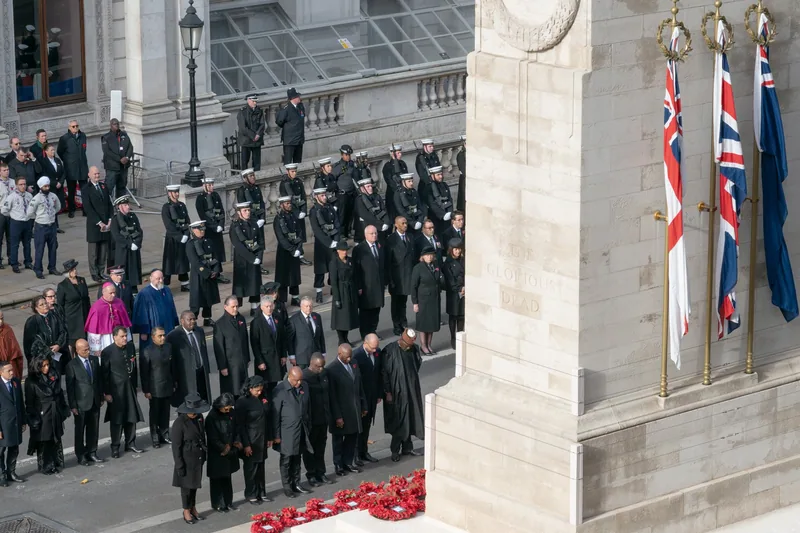
The ceremony centres on the Cenotaph, the stone monument in the middle of Whitehall designed by Edwin Lutyens and unveiled in 1920. It carries no religious symbol and no list of names. The inscription reads only "The Glorious Dead".
If you are in London that weekend, you may attend. This page explains what happens, where you may stand, and how to conduct yourself. Our guide to London in November covers the rest of the month.
Remembrance Sunday 2026
- Date
- Sunday 8 November 2026
- Place
- The Cenotaph, Whitehall, London SW1
- Service
- Begins at 11am, after the two-minute silence. Concludes about 11:25am
- Tickets
- None. The public watch from the pavements, subject to security checks
- Armistice Day
- Wednesday 11 November 2026, two-minute silence at 11am
- Nearest stations
- Westminster, Charing Cross, Embankment
The order of the morning
The Government publishes detailed guidance for the National Service of Remembrance shortly before the day. The pattern has been consistent for many years, and in 2025 the published timings were these.
| Time | What happens |
|---|---|
| 08:00 | Whitehall opens to the public. Space is limited and everyone passes through security |
| 10:30 | Detachments assemble at the Cenotaph |
| 10:50 | Participants process to the Cenotaph |
| 11:00 | The two-minute national silence, marked by guns fired by the King's Troop on Horse Guards Parade. The service then begins |
| About 11:25 | The service concludes and the Royal British Legion detachments begin to disperse |
Within the service, wreaths are laid at the Cenotaph by the Royal Family, the Prime Minister, leaders of the opposition parties, former Prime Ministers, the Mayor of London, High Commissioners of Commonwealth countries, and representatives of the armed forces, the merchant navy and the fishing fleets, and of faith communities. There are prayers, hymns and the sounding of Last Post and Reveille.
Check the current year's guidance on GOV.UK before you go, because timings and arrangements can change. It is normally published a few weeks in advance.
Where the public can stand
No ticket or pass is needed. The public watch from the pavements of Whitehall and Parliament Street. Because space is limited, entry may be stopped once the area is full, which in practice means arriving well before 10:00 if you want to be close.
You will not have a clear view of the Cenotaph itself from most positions, and you should not expect one. Video screens have been provided in recent years at four points: north of the Cenotaph near the statue of Field Marshal Montgomery, in the lay-by outside Dover House, at the junction with Whitehall Place, and south of the Cenotaph at the corner of King Charles Street.
Standing near a screen is the sensible choice for most visitors. You hear the service, you observe the silence with the crowd around you, and you see the wreath-laying.
Great George Street is closed to the public on the day. If you are walking between Victoria Street and St James's Park, the route is via Storey's Gate.
Security, and what to bring
There is a substantial police operation in Whitehall and everyone entering passes through a security check. Large bags are discouraged and slow the queue considerably; if you can come without one, do. Drones are strictly prohibited across the area.
Expect to stand outdoors for two or three hours in early November. Dress for cold and rain. Temporary public toilets have been provided on Whitehall Place, and St John Ambulance staff first aid points along the route.
Anything suspicious should be reported to a police officer on site, or through the ACT service on GOV.UK. In an emergency, dial 999.
How to behave
This is the part that matters most for a visitor, and it is not complicated.
Stand still and stay silent for the full two minutes from 11am. Do not move, do not talk, and do not walk through the crowd. The silence is the central act of the morning and it is observed strictly.
Turn your phone to silent before you arrive, not at 10:59. Photography is permitted, but tripods must not obstruct access, and you are asked to avoid any noise during the silence, which includes camera shutters.
Do not applaud. There is no clapping at any point in the service, including when the veterans march past. Applause has become common at some other national occasions; it is not done here.
Remove hats during the silence and the service if you are wearing one. Wearing a poppy is entirely optional and nobody will mind either way, but if you wear one, wear it on the left.
If you have small children who cannot be expected to stand silently for two minutes, watch from a screen position further from the Cenotaph, where there is more room, or follow the service on television instead. Nobody will think less of you for it. Our page on British etiquette for visitors covers the broader conventions.
The silence is observed across the whole country, not only in Whitehall. At 11am on Remembrance Sunday, and again on 11 November, shops, stations and public buildings across London stop. If you are in a supermarket or on a station concourse at that moment, stand still with everyone else.
The March Past
After the service, veterans and other eligible participants march past the Cenotaph. The Royal British Legion organises it, and it involves around 10,000 people. The column forms on Horse Guards Parade, comes out into Whitehall, passes the Cenotaph and continues to Horse Guards Road, where a member of the Royal Family takes the salute.
Places are allocated through service and unit associations. Eligible participants include ex-service personnel of the United Kingdom and Commonwealth, retired emergency services personnel, the bereaved family members of those who died in service, and representatives of organisations with a role in past conflicts or with the armed forces. Serving personnel do not take part unless they qualify on other grounds.
Veterans who do not belong to an association can register as individuals on a first-come basis; the Legion restricts this to Royal Navy, Army, Royal Air Force and Merchant Navy veterans, and for 2026 the registration deadline was 28 September 2026. Anyone considering taking part should check the Legion's own page well in advance, as the deadline falls more than six weeks before the day.
For spectators, the March Past continues for some time after the service ends, and it is the part of the morning at which the crowd is most visibly moved.
Accessibility
A dedicated space for wheelchair users and others with accessibility needs is set aside on the west side of Parliament Street, near King Charles Street. It operates on a first-come, first-served basis, and one carer per person is admitted with them. Accessible toilets are provided nearby.
Westminster station is step-free, which makes it the practical arrival point. Our guide to step-free transport in London explains how to plan the journey, and it is worth allowing extra time, because the streets around Whitehall are closed and the walking route may be longer than the map suggests.
Armistice Day on 11 November
The eleventh of November is a separate occasion. In 2026 it falls on a Wednesday. A two-minute silence is observed at 11am at war memorials across the country, and there is a short ceremony at the Cenotaph, considerably smaller than the Sunday service.
Many London boroughs hold their own services at local war memorials on both days, and the Royal British Legion publishes a list. If you are not in Westminster that weekend, a local service is often a more affecting thing to attend than the national one, and much easier to reach.
If you want to understand the context
Several places in London deal with the same history and are open on Remembrance weekend.
The Imperial War Museum is the principal collection on the conflicts the day commemorates, and its First World War galleries are free to enter. The Churchill War Rooms, a short walk from the Cenotaph, preserves the underground rooms from which the Second World War was directed. Westminster Abbey holds the Grave of the Unknown Warrior, the only stone in the Abbey floor that is never walked on.
These sites can be very busy that weekend, and the Abbey is closed to sightseeing on Sundays, so plan them for the Saturday or the Monday.
The rest of the day
Whitehall clears gradually through the early afternoon, and the streets around Trafalgar Square and Westminster reopen once the March Past has finished. St James's Park is immediately behind the ceremony and is the quietest place to go afterwards.
Many people go to lunch, and a Sunday roast is the usual choice. Pubs and restaurants in Westminster fill quickly after 12:30 on that particular Sunday, so book if you can.
Road closures around Whitehall last most of the morning. Buses are diverted and Banqueting House and other buildings on Whitehall may have restricted access. If you had planned general sightseeing in Westminster for that morning, move it: our page on what closes and when explains the pattern of November Sundays more broadly. The Lord Mayor's Show falls on the Saturday of the same weekend in most years, which makes it a busy few days in central London.
Frequently asked questions
When is Remembrance Sunday 2026?
Sunday 8 November 2026. Remembrance Sunday is always the second Sunday of November. Armistice Day, 11 November, falls separately on the Wednesday that year, with a two-minute silence at 11am.
Can visitors attend the Cenotaph service?
Yes. No ticket is needed and the public may watch from the pavements of Whitehall and Parliament Street. Everyone passes through a security check, and access may be closed once the area is full, so arrive well before 10:00 if you want a position near the Cenotaph.
What should I do during the two-minute silence?
Stand still and stay completely silent from 11am until the silence ends. Do not walk, talk, or take photographs that make a noise. Turn your phone off or to silent beforehand. Remove your hat if you are wearing one. There is no applause at any point in the ceremony.
Why do people wear red poppies in November?
The paper poppy is sold by the Royal British Legion to raise money for serving and former members of the armed forces and their families. It recalls the poppies that grew on the battlefields of the Western Front. Wearing one is a personal choice and visitors are under no obligation.
Will public transport and shops be affected?
Roads around Whitehall are closed for most of the morning and buses are diverted, so allow extra time and use Westminster, Charing Cross or Embankment stations. Shops and businesses stay open, but many pause for the two-minute silence at 11am, including stations, supermarkets and museums.
Sources
- GOV.UK - National Service of Remembrance: public guidance (checked September 2026)
- Royal British Legion - Remembrance Sunday and the Cenotaph Parade (checked September 2026)
- The Royal Family - Remembrance events (checked September 2026)
- Greater London Authority - Remembrance Service 2026 (checked September 2026)
- Transport for London - Transport accessibility (checked September 2026)