
Bond Street is where London keeps its jewellers, its couture houses and its auction rooms. Almost none of it is aimed at a visitor with a normal budget, and that is precisely why it is worth an hour: the arcades, the gallery windows and the auction previews are free to walk through, and nobody expects you to buy anything.
Our guide to Oxford Street covers the mass-market end of West End shopping, and outlet shopping near London is the honest answer if you are hunting for discounts. This page is about the opposite: an area where looking is the point, and where the buildings and the goods in the windows are the attraction.
First, a piece of geography that confuses everybody. Bond Street station is not on Bond Street. It is on Oxford Street, at the top of the area, and the street itself begins a block south. The street also changes name halfway along: Old Bond Street runs up from Piccadilly, and New Bond Street continues north towards Oxford Street.
Bond Street and Mayfair: orientation
- Bond Street
- Old Bond Street (south, from Piccadilly) and New Bond Street (north, to Oxford Street)
- Stations
- Bond Street for the north end, Green Park for the south, Oxford Circus for the middle
- Free to walk through
- Burlington Arcade, the Royal Arcade, the Piccadilly Arcade, the Cork Street galleries
- Auction viewings
- Open to the public before sales, usually free, no appointment
- Typical hours
- 10:00-18:00 Monday to Saturday; many boutiques close on Sunday altogether
- Dress code
- None, anywhere, despite appearances
The arcades: London's first covered shopping streets
The Georgian shopping arcade was invented for exactly this situation: a covered lane of small shops where wealthy customers could walk without mud, weather or traffic. Three survive within a few minutes of each other, and they are the single best reason to come.
Burlington Arcade, running north from Piccadilly beside Burlington House, opened in 1819. It was built for Lord George Cavendish, and it is still patrolled by beadles in top hats and frock coats, the oldest private police force in the country. They enforce the arcade's rules, which historically included no running, no whistling and no singing. The shops are jewellers, watch dealers, cashmere and leather goods.
The Royal Arcade, between Old Bond Street and Albemarle Street, is shorter, prettier and usually empty, with a glass roof and pale blue and cream decoration.
The Piccadilly Arcade, opposite Burlington Arcade, runs south to Jermyn Street and is lined with small bow-fronted windows. It puts you straight into the shirtmakers' street covered in our guide to Savile Row and Jermyn Street.
All three arcades are public thoroughfares, not shops. You can walk from Piccadilly to Bond Street or to Jermyn Street through them without entering a single shop, and they are the most pleasant covered route in the West End in bad weather. They close in the evening, usually between 18:00 and 19:00.
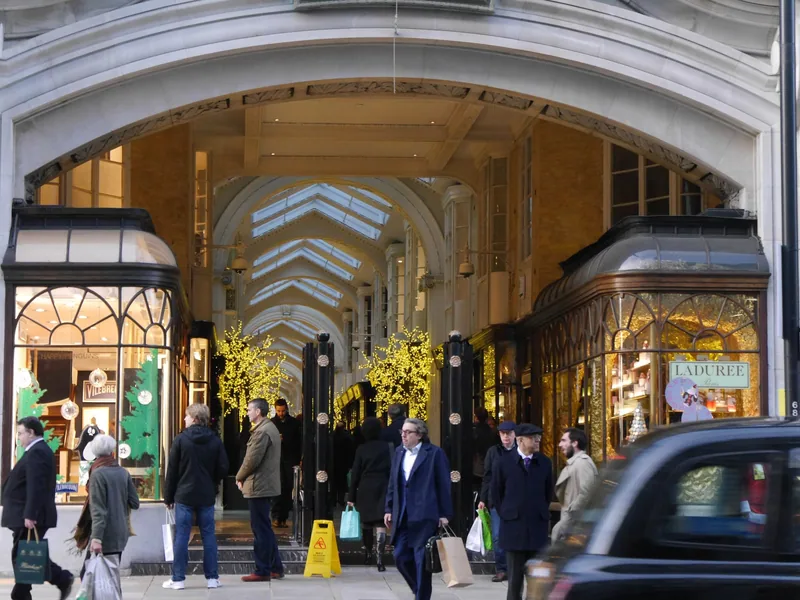
Photo: Edwardx · CC BY-SA 4.0 · Wikimedia Commons · resized
The auction houses, and how to get inside one
This is the part most visitors do not know about. Before an auction, the lots go on public view for several days, in galleries that are open to anyone who walks in. There is no charge, no appointment and no dress code, and for a few days at a time you can stand in front of paintings, jewellery or furniture that will disappear into private hands the following week.
Sotheby's has been at 34-35 New Bond Street since 1917, and the company itself dates from 1744, when Samuel Baker founded it in the Strand. Christie's is a short walk south, on King Street in St James's. Both publish their sale calendars and viewing times on their own websites, and both hold sales almost every week of the season.
Treat it as a free, constantly changing museum. Check the calendar before you go, because between sales the galleries may be closed for installation. This is one of the better entries on our list of free things to do in London.
Cork Street and the commercial galleries
Cork Street, one street west of Bond Street, has been London's street of commercial art galleries for a century. The galleries are shops, they are free, and the staff at the desk are not expecting you to buy. Walk in, look, walk out. Nobody will approach you.
The same applies to the dealers scattered through Mayfair's side streets, who sell everything from Old Master drawings to contemporary photography. Between them they hold more art on public display than several museums, and it changes every few weeks. For the historic-object end of the same trade, see our guide to London's antiques markets.
What is actually sold on Bond Street
| Stretch | What dominates |
|---|---|
| Old Bond Street (Piccadilly end) | Watches and jewellery, the highest concentration in Britain |
| New Bond Street (middle) | International fashion houses and leather goods flagships |
| New Bond Street (Oxford Street end) | Larger fashion stores, slightly more accessible prices |
| Mount Street | Quieter, red-brick, high-end boutiques, galleries and restaurants |
| Dover Street and Albemarle Street | Fashion concept stores, galleries, hotels |
| South Molton Street | Pedestrianised, smaller shops, a link through to Oxford Street |
Bond Street also carries one of London's better-known pieces of public sculpture, a bench on which Winston Churchill and Franklin D. Roosevelt sit in conversation, with a space between them where people sit for photographs. It is free, it is outdoors, and it is the only thing on the street with a queue.
Shopping here without spending anything
Nobody in a Bond Street shop will turn you away for browsing, and the staff are usually better at their job than in a mass-market store. If you do want to go in, three things make it easier:
- Go in the morning. Boutiques are empty then, and staff have time to talk about how something is made.
- Ask a real question. "How is this made?" or "what is the difference between these two?" gets a genuine answer. Silence gets you followed.
- Expect an appointment system at the highest end. Some watch and jewellery houses admit customers by appointment only, and a locked door with a bell is a normal arrangement rather than a judgement on you.
If you are buying, all prices include 20% VAT and visitors cannot reclaim it at the airport. The only remaining route is to have the shop deliver abroad, which is common at this end of the market; ask before you pay. Our page on tax-free shopping and what replaced it has the rules.
Where to stop and rest
Mayfair is expensive for coffee as well as for handbags. Two free options: Green Park, five minutes from the bottom of Old Bond Street, and Mount Street Gardens, a small enclosed garden behind Mount Street with benches and very few people.
For an indoor stop that costs nothing, the Wallace Collection is a ten-minute walk north in Manchester Square: a free museum in a Mayfair townhouse, full of exactly the kind of French furniture and paintings the dealers along Bond Street trade in. Apsley House, at Hyde Park Corner, is the ticketed version of the same idea.
If you want to spend money on the experience rather than on goods, the grand hotels of Mayfair are where London's best-known afternoon teas are served; see our guides to afternoon tea and London's grand hotels.
Sunday is the wrong day for Mayfair. Many boutiques, the galleries and the auction houses close completely, and the arcades keep short hours. The area is at its best from Tuesday to Friday, when the galleries are hanging new shows and the auction rooms are open for viewing.
Fitting it into a West End day
The whole district is about fifteen minutes end to end on foot. A sensible route runs from Fortnum & Mason on Piccadilly, north through Burlington Arcade, up Old and New Bond Street, with a detour west into Cork Street and Mount Street, finishing at Selfridges or at Oxford Circus and Regent Street.
Bond Street station now serves the Elizabeth line as well as the Central and Jubilee lines, which makes the area far easier to reach from Heathrow, Paddington and the east than it used to be. The wider context of the neighbourhood, including the squares, the pubs and the eating, is in our guide to Mayfair and St James's. If you want the other end of London's luxury trade, our page on Harrods covers Knightsbridge.
Frequently asked questions
Is Bond Street worth visiting if I cannot afford anything?
Yes. The arcades, the gallery windows, the sculpture and the auction viewings are all free, and the architecture is the point as much as the shops. Treat it as a walk through a district rather than as a shopping trip and it becomes one of the better free hours in central London.
Can anyone go into an auction house in London?
Yes. Sotheby's on New Bond Street and Christie's in St James's open their galleries to the public for several days before each sale, free and without an appointment. Check the sale calendar first, because the galleries close between sales while the next exhibition is installed.
Where is Bond Street station in relation to Bond Street?
It is on Oxford Street, at the northern end of the area, not on Bond Street itself. Walk south from the station and New Bond Street begins a block away. For the southern, jewellery end of the street, Green Park station is closer.
Is Burlington Arcade free to walk through?
Yes. It is a public thoroughfare running between Piccadilly and Burlington Gardens, open during shop hours and closed in the evening. It opened in 1819 and is still patrolled by beadles in top hats, who enforce long-standing rules against running, whistling and singing.
Do Mayfair shops open on Sundays?
Many do not. Boutiques, galleries and the auction houses commonly close on Sunday, and the arcades keep shorter hours. Tuesday to Friday is the best time to visit, when the galleries are open and the auction rooms are holding public views.
Sources
- Sotheby's - London, 34-35 New Bond Street (checked September 2026)
- Christie's - London, King Street (listed September 2026; the site did not respond to our automated checks)
- GOV.UK - Tax-free shopping (checked September 2026)
- GOV.UK - Bringing goods into the UK for personal use (checked September 2026)
- legislation.gov.uk - Sunday Trading Act 1994, Schedule 1 (checked September 2026)