
The London Marathon is free to watch from any pavement along its 26.2-mile route from Greenwich to The Mall. In 2027 it runs over two days for the first and only time, on Saturday 24 and Sunday 25 April, with 100,000 runners in total.
The race, officially the TCS London Marathon, is one of the world's six Abbott World Marathon Majors and one of the biggest days in the London calendar. Elite athletes, wheelchair racers and tens of thousands of club and charity runners share the same streets, and hundreds of thousands of people come out to cheer them on. You do not need a ticket: you simply find a spot by the barriers and wait for the runners.
Watching well takes some planning, though. Roads close, some stations queue for up to 90 minutes, and your phone signal may disappear in the crowds just when you want to track your runner. This guide explains the route, the stretches that suit different kinds of spectator, how to move around on race day and how to find your runner at the finish.
Marathon weekend 2027 at a glance
- Race days
- Saturday 24 and Sunday 25 April 2027 (one-off two-day format)
- Start times
- Saturday "likely" 09:00, Sunday "likely" 09:30, according to the organisers
- Route
- Greenwich/Blackheath to The Mall, the same on both days
- Cost to watch
- Free, no ticket needed
- Finish line
- The Mall closes at 17:30 on Saturday; on Sunday a second finish in Green Park stays open until midnight
- Also that weekend
- TCS Mini London Marathon (for schools) and the Friday Night Lights event, both planned for Friday 23 April 2027
- Official information
- londonmarathonevents.co.uk
Why 2027 is different: the Double weekend
Until now the London Marathon has always been a one-day race. For 2027 the organisers, London Marathon Events, have split it into two full race days, calling it "The Double". Both days use exactly the same course. Runners were given a place on one day only and cannot swap.
For spectators this means two chances to watch, and slightly different crowds. The Saturday race has a fixed cut-off, because the roads must reopen: the finish on The Mall closes at 17:30, which gives the slowest participants up to 7 hours 45 minutes. On Sunday there is a secondary finish line in Green Park that stays open until 23:59, so walkers and very slow runners will still be on the course in the evening.
The elite races will also be split. The organisers say the men's and women's elite, championship and Good for Age races will take place on separate days, which were due to be announced at the end of September 2026. If you want to see the world's fastest marathon runners, check which day they run before you book a hotel.
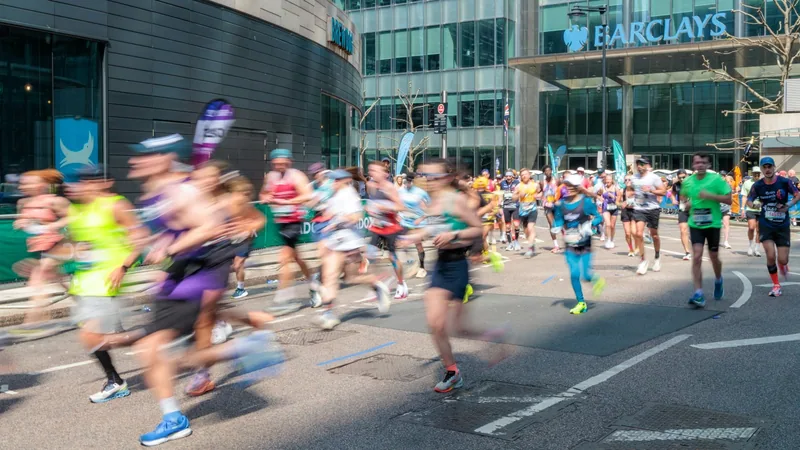
The route from Greenwich to The Mall
The race begins in south-east London at three separate start areas around Greenwich and Blackheath. The three groups merge just before Mile 3 at Woolwich. From there the course heads west through Charlton, Greenwich and Deptford and loops around the Cutty Sark between Miles 6 and 7, one of the loudest places on the whole route.
Runners then pass through Rotherhithe and along Jamaica Road in Bermondsey before crossing Tower Bridge close to halfway. North of the river the route turns east along The Highway to Westferry, loops through Mudchute and the Isle of Dogs and weaves among the towers of Canary Wharf. Just past Mile 21 is Rainbow Row in Limehouse, a 250-metre party stretch celebrating the LGBTQIA+ community.
The last five miles come back along The Highway, past Tower Hill and down Victoria Embankment. Runners turn right near Westminster Bridge with about a mile to go, pass Parliament Square, run along Birdcage Walk and swing round in front of Buckingham Palace to the finish on The Mall.
| Approximate mile | Place | What it is like for spectators |
|---|---|---|
| 6.5 | Cutty Sark, Greenwich | Huge crowds; Cutty Sark DLR can queue up to 90 minutes |
| 9-11 | Rotherhithe peninsula | Often quieter; bands and a community cheer zone |
| 13 | Tower Bridge | The classic view; arrive early for a spot |
| 14 and 22 | The Highway | You can see runners twice, going out and coming back |
| 15-20 | Isle of Dogs, Canary Wharf, Poplar | Lively local crowds; Canary Wharf Tube very busy |
| 21 | Rainbow Row, Limehouse | Party atmosphere; Limehouse station queues up to 90 minutes |
| 25-26 | Victoria Embankment, Westminster | Very busy but reachable from several stations |
The table is based on the organisers' spectator guide for the 2026 race. The route is unchanged for 2027, but station advice can change, so check the official spectator guide in the weeks before the race.
Choosing a spot to suit your day
There is no single best place to watch. The right choice depends on whether you want atmosphere, a good view of one particular runner, or the chance to see them more than once.
For the big-occasion feeling
Tower Bridge and the Cutty Sark are where the noise is greatest and the photographs are best. They are also the hardest places to reach and leave. The organisers suggest London Bridge station rather than Tower Hill or Tower Gateway for the bridge, and walking in from Deptford, Greenwich, Island Gardens or Maze Hill rather than using Cutty Sark DLR station. If you choose one of these places, treat it as the only spot you will see that day.
For seeing your runner twice or more
The Highway, in Shadwell and Wapping, is the obvious choice: runners pass east at around Mile 14 and come back west at around Mile 22. Around the Isle of Dogs loop, a short walk between stretches of the course can also give you more than one sighting. Stations to consider include Shadwell and Wapping on the London Overground and Westferry, Mudchute, Crossharbour, South Quay and Poplar on the DLR. Our guide to the DLR and London Overground explains how both work.
For more space
The Rotherhithe peninsula (Miles 9 to 11) and Poplar High Street (Mile 20) are usually calmer than the famous landmarks, with bands and cheer points but fewer people. These are good choices with children or if you simply want to see faces clearly.
The Highway gives you two looks for one journey. Pick a spot on The Highway near Shadwell and you can cheer your runner heading out at about Mile 14, have lunch nearby, and catch them again on the way back at about Mile 22. For most families this beats chasing across London by Tube.
Getting around on race day
Large parts of south-east London, Docklands, the City and Westminster have road closures on race day, and many bus routes are diverted. Driving is not realistic. Plan to walk, use rail services and accept that journeys will take longer than usual.
- Avoid the stations the organisers flag. In 2026 these were Cutty Sark DLR, Canada Water, Bermondsey, Canary Wharf Underground, Limehouse, Tower Hill and Westminster. For Canary Wharf, use the Elizabeth line or Canary Wharf DLR instead of the Jubilee line station.
- Westminster may be exit-only. In 2026 Westminster station was exit only from 07:00 to 19:00, so you could arrive there but not leave. Charing Cross, Piccadilly Circus, Victoria and Waterloo are the alternatives.
- Use the river. Uber Boat by Thames Clippers ran a pier-to-pier service on race day in 2026 between Woolwich and Westminster, calling at Greenwich, Canary Wharf, Rotherhithe, Tower and Embankment. Boats have toilets and a café bar. See our page on the river bus; note that boat fares do not count towards the daily cap.
- Pay as you go keeps it simple. One contactless card or Oyster per person, used all day, is capped at £8.90 for Zones 1-2 and £10.50 for Zones 1-3 (caps frozen until March 2027). Our comparison of Oyster and contactless has the details.
For step-free travel, the organisers ran five accessible viewing areas in 2026, at the Cutty Sark, Canary Wharf, Rainbow Row, Tower Hill and Victoria Embankment. They are barrier-free and stewarded, with an accessible toilet, and are open to disabled spectators with one carer or companion. All DLR and Elizabeth line stations are step-free; our guide to step-free transport covers the rest of the network.
Tracking and supporting a runner
The official TCS London Marathon app is usually available to download around ten days before the race. It shows each runner's progress in real time, which helps you work out when to be at the barrier. Ask your runner for their bib number and expected pace before the day, and note the times they should reach your chosen spot.
Do not rely on the app alone. The organisers warn that mobile reception can be patchy in crowded areas, and GPS is unreliable among the tall buildings of Canary Wharf. Agree a backup plan in advance: a specific side of the road, a lamp post or shop front, and what you will do if you miss each other.
Runners spot faces more easily than you might think if you stand out. A bright balloon, a large sign with their name, or a flag held high all help, as long as they do not block the view of people behind you. Stand on the side of the road where the runner expects you, and follow marshals' instructions when moving between areas.
Put the runner's name on a sign, not just a slogan. After 20 miles most runners are not reading jokes. A big, clear name in capital letters, held at head height as they approach, is what gets a wave back. Tell them in advance which side of the road you will be on.
Meeting at the finish
The finish area around The Mall is closed to spectators without a pass, and it is not where you should try to meet. The organisers run a Meet and Greet area on Horse Guards Avenue, Whitehall, Horse Guards Road and Horse Guards Parade, with meeting points labelled by letter. Choose a letter with your runner before the race. The organisers say runners take about 30 minutes to reach this area after crossing the line, so do not expect them straight away.
If your runner is raising money for a charity, the charity may hold a reception near the finish. These are for its runners and their families; if you have not had an invitation, check with the charity directly.
From Horse Guards it is a short walk to St James's Park and Green Park, which are quieter places to sit down, and to Charing Cross and Embankment stations.
Where to stay and what to book
Hotels near the route and along the Jubilee line fill up early for marathon weekend, and 2027 has twice the usual number of runners. If you are travelling to support someone, book accommodation as soon as you know which day they run. Areas with direct DLR or Elizabeth line links, such as Greenwich or Canary Wharf, make the morning easier. Our advice on booking safely and avoiding accommodation scams is worth reading, because busy weekends attract fake listings.
You cannot buy a place to run at this late stage through the ballot: the 2027 ballot has already been drawn. The remaining routes are a charity place or an official international tour operator, both explained on the organisers' website.
Weather, crowds and what to bring
Late April in London is mild but changeable. The Met Office long-term averages for Heathrow (1991-2020) give April a mean daily maximum of 15.0°C and a minimum of 6.0°C, with rain of at least 1 mm on about nine days of the month. Standing still for hours feels colder than those figures suggest, especially by the river and between the towers of Canary Wharf, where the organisers say it can get windy.
- A warm layer and a light waterproof; an umbrella blocks the view for people behind you.
- Water and snacks, because cafés near the course have long queues.
- A fully charged phone and a power bank, plus a written note of your runner's bib number and meeting letter.
- Cash is rarely needed, but a contactless card is.
Big crowds attract pickpockets and phone snatchers. The organisers link to Metropolitan Police advice on phone theft, and our page on staying safe in London covers the basics. Toilets along the route are for runners; for spectators, the options are cafés, pubs and stations, and our guide to public toilets in London helps you plan.
If you are staying longer, our month guide to London in April covers what else is on, and the rest of the events calendar lists the city's other big annual occasions.
Frequently asked questions
When is the London Marathon in 2027?
The 2027 TCS London Marathon takes place over two days, Saturday 24 and Sunday 25 April 2027. It is a one-off format for 2027 only, with 100,000 runners in total and the same route on both days.
Do you need a ticket to watch the London Marathon?
No. Watching from the pavement anywhere along the route is free, and there is no ticket. The finish area around The Mall is not open to general spectators. Arrive early for popular places such as Tower Bridge and the Cutty Sark.
What is the best place to watch the London Marathon?
Tower Bridge and the Cutty Sark have the biggest atmosphere but are very crowded. The Highway near Shadwell lets you see runners twice, at about Miles 14 and 22, and the Rotherhithe peninsula and Poplar are usually calmer.
How can I track a runner during the London Marathon?
Download the official TCS London Marathon app, usually released around ten days before the race, and search for your runner by name or bib number. Mobile reception can be poor in crowds, so agree a fixed meeting place as a backup.
Is the London Marathon on TV?
Yes. The organisers say the race is broadcast live on BBC platforms in the UK and in more than 190 countries worldwide, so you can follow the leaders even if you are out on the course.
Sources
- London Marathon Events - TCS London Marathon (checked September 2026)
- London Marathon Events - 2027 Double TCS London Marathon FAQs (checked September 2026)
- London Marathon Events - Spectator Guide (checked September 2026)
- London Marathon Events - The course (checked September 2026)
- London Marathon Events - Event overview (checked September 2026)
- Transport for London - Capping (checked September 2026)
- Met Office - Heathrow climate averages 1991-2020 (checked September 2026)