
The South Bank runs along the southern bank of the Thames from Westminster Bridge down to London Bridge, and it is one of the few places in London where a hotel room can genuinely look at the river. It is in Zone 1, it is quieter at night than the West End, and from a room here you can walk to Westminster, Tate Modern and Shakespeare's Globe. What you pay for is the view and the walk.
The area is longer than most people realise. Its western end, around Waterloo and the Southbank Centre, is arts venues and 1950s and 1960s concrete. The middle, around Blackfriars, is offices. The eastern end, Bankside and Borough, is Victorian warehouses, markets and the streets under The Shard. Our guides to the South Bank and Southwark and Bankside describe what is there; this page is about sleeping there.
As elsewhere in this section, we do not publish nightly rates. What follows is the shape of the area, what a river view really costs you, and which parts are noisy.
The South Bank as a base
- Fare zone
- Zone 1 throughout, from Waterloo to London Bridge. Daily cap £8.90 on Oyster or a contactless card (2026)
- Stations
- Waterloo, Southwark, London Bridge, Blackfriars, Lambeth North, Borough
- To Westminster
- 1 to 2 minutes on the Jubilee line from Waterloo; about 17 minutes on foot across the bridge
- To Oxford Circus
- About 14 to 15 minutes from Southwark, changing at Bond Street
- Noise
- Low after about 23:00 on the riverside; higher near Waterloo's roads and around Borough at weekends
- Best for
- A first trip, families, and anyone whose list is Westminster, the river and the galleries on this bank
Why the South Bank works as a base
The simplest argument is the walk. From a hotel between Waterloo and Blackfriars you can reach the Houses of Parliament, the London Eye, Tate Modern, Shakespeare's Globe, Borough Market and the foot of The Shard without using public transport once. Few other Zone 1 addresses put that much on a single riverside path.
The second argument is the river itself. The walkway is continuous, it is lit and busy in the evening, and it is the best way to see central London's skyline. Crossing to the north bank takes a few minutes by any of several bridges, as our guide to walking London's bridges describes.
The third is price. The South Bank is generally cheaper than the equivalent quality of room in Covent Garden or Mayfair while being just as central, because the address is not as fashionable and because a good part of the accommodation stock is modern rather than historic.
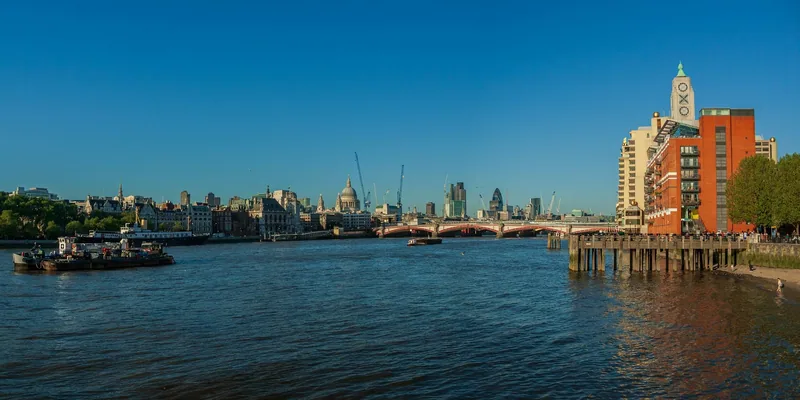
What a river view actually costs and whether it is worth it
River-facing rooms carry a premium in every hotel that has them, and the premium is often substantial. Before paying it, ask two questions.
What exactly will you see? "River view" covers everything from a full sweep of the Houses of Parliament to an angled glimpse between two buildings. Ask for the room category's actual outlook, and ask whether the view is from a window or a small balcony.
How much time will you spend in the room? On a three-day sightseeing trip the answer is usually "sleeping and an hour in the evening". If you are in London for a week, or travelling with a small child who naps, the calculation changes and a view earns its money.
The alternative is free: the riverside walk runs past every one of those hotels, and the view from the path is better than the view from most of the rooms. Our guide to hotel extras and hidden costs covers the other charges that come with a premium address.
The quietest riverside rooms are usually the ones facing away from the water. The Thames path carries people, skateboards and buskers until late, and a low river-facing room hears all of it. Higher floors solve the problem; ground and first-floor river rooms rarely do.
Where within the area to stay
Waterloo and the Southbank Centre end. The best transport, the worst streets. Waterloo is Britain's busiest station and the roads around it, particularly York Road and Stamford Street, carry heavy traffic day and night. Step one block back from the river and the environment is functional rather than pretty. In exchange you get four Underground lines and the fastest access to Westminster.
Blackfriars and the middle. Offices, which means the streets empty at night and the area is calm but a little dead. Blackfriars station is unusual in spanning the river, with entrances on both banks, and Tate Modern is about 300 metres away.
Bankside and Borough. The most attractive streets, the best food and the liveliest evenings, at the cost of weekend noise around the market and the pubs. Borough and Bermondsey extend the same character further east, where prices drop noticeably.
Noise: where it comes from here
The South Bank is not Soho, and most of it is quiet by midnight. The noise sources are specific and predictable.
- The riverside path until roughly 23:00, including buskers, the skate space under the Southbank Centre and large crowds after events.
- Waterloo's road network, which does not stop. This is the main reason to check which way a room faces near the station.
- Borough and Bankside on Friday and Saturday, where the pubs and the market area are busy until closing.
- Event days. A concert at the Southbank Centre, a match at a nearby ground or a river festival puts several thousand extra people on the path at the same moment.
Against that, there is almost no late-night bar industry on the riverside itself, so the 03:00 problem that affects the West End does not exist here.
Getting around, and getting to the airports
Waterloo gives you the Jubilee, Northern, Bakerloo and Waterloo and City lines plus National Rail to the south-west. Westminster is one stop and one to two minutes away on the Jubilee; Bond Street is four stops. Southwark, one stop east, reaches Oxford Circus in about 14 to 15 minutes with a change at Bond Street. London Bridge to Bank takes two minutes.
For airports, London Bridge and Blackfriars are the useful stations: Thameslink runs direct to Gatwick, at a pay as you go fare of £19.20 at peak and £10.70 at other times, and north through the night to Luton. Our guide to Gatwick to central London compares the options. Heathrow is the weak point from here: you will change at least once, and the Elizabeth line means crossing the river first.
Here the river is genuine transport rather than a novelty. Piers at Bankside, London Bridge City and Blackfriars put you on the Uber Boat river bus, which runs east to Greenwich and west to Battersea. River fares sit outside the Tube system and are not included in the daily cap. Our guide to London's main railway stations explains what Waterloo and London Bridge serve.
You can reach four free national museums on foot. Tate Modern is on the path, and Tate Britain is a river bus or a 25-minute walk along the other bank. Add the free galleries across the bridges and a couple staying here can fill three days without paying an admission charge or a fare.
Eating, and the evening problem
The eastern end of the area eats well. Borough Market, and the lanes beside it, hold some of the best food in central London, and Bermondsey Street behind it is full of small restaurants.
The western end, around Waterloo and the arts centres, is thinner than its position suggests. There are chain restaurants along the riverside aimed at theatre and concert audiences, a good street food market under Waterloo's arches, and then not a great deal. If you want variety within five minutes of your door, stay towards Bankside rather than towards the London Eye.
After about 23:00 the choice narrows sharply on the whole South Bank. This is a district that closes, which is part of why it is quiet.
Culture on your doorstep
The BFI, the National Theatre and the Southbank Centre sit in a row along the riverside, and the Globe and Tate Modern are a mile east. If you are in London for concerts or theatre, this is the only base outside the West End that puts several major venues within walking distance of the bed.
Our guides to classical concerts in London and free live music both list things happening within this square mile, much of it in the early evening and much of it costing nothing.
The right base for some trips, the wrong one for others
Stay here if
- Your list is Westminster, the river, Tate Modern and the Globe
- You want Zone 1 without West End noise or West End prices
- You are travelling with children and want to walk rather than ride
- You are going to Gatwick or the south coast and want a direct train
Look elsewhere if
- You are flying from Heathrow and want a single-change journey
- You want a wide choice of restaurants after 22:30 within a few minutes' walk
- You are shopping on Oxford Street and Regent Street rather than sightseeing
- You dislike modern buildings and busy riverside crowds
For families, this is one of the strongest areas in London, and our guide to where to stay with children explains why walkability matters more than a central postcode. To weigh it against the alternatives, see our comparison of the main areas to stay in London.
Frequently asked questions
Should I base myself on the South Bank?
Yes, particularly for a first visit. It is Zone 1, calmer after dark than the theatre district, and lets you walk to Westminster, Tate Modern, the Globe and Borough Market. It is weaker for Heathrow connections and for late-night eating, and the riverside itself is crowded during the day.
Is a river view room worth the extra cost?
It depends on how long you are staying. On a short sightseeing trip you will be in the room mainly to sleep, and the view from the free riverside path outside is better. On a longer stay, or with a small child who naps, it earns its money. Always ask what the room actually looks at.
How far is the South Bank from Westminster?
One stop on the Jubilee line from Waterloo, about one to two minutes, or roughly 17 minutes on foot across Westminster Bridge. The Houses of Parliament are directly opposite the northern end of the South Bank, so the walk is a sight in itself.
Is the South Bank noisy at night?
Much less than the West End. The riverside path is busy until about 23:00 and then empties, and there is little late-night bar trade. The exceptions are the traffic around Waterloo station, which runs all night, and the Borough and Bankside pubs at weekends.
Can I get to Gatwick easily from the South Bank?
Yes. Thameslink runs direct to Gatwick from London Bridge and Blackfriars, at a pay as you go fare of £19.20 at peak and £10.70 at other times. The same line runs north through the night towards Luton. Heathrow is the harder journey from here and needs at least one change.
Sources
- Transport for London - Daily and weekly fare caps (checked September 2026)
- Transport for London - Journey Planner (sample journeys, Tuesday 22 September 2026) (checked September 2026)
- Transport for London - Single fare finder, Gatwick pay as you go fares (checked September 2026)
- Tate Modern - Visit, opening hours and nearest stations (checked September 2026)
- Transport for London - About the River Bus (checked September 2026)