
Covent Garden is a pedestrian-friendly district in the West End built around a 17th-century square and a 19th-century market hall, now filled with shops, cafés, street performers and theatres. It is one of the easiest parts of London to enjoy without spending anything, but around the Piazza it is also one of the most crowded and touristy.
The heart of the area is the Piazza, the large open square in front of St Paul's Church, and the Market Building in its centre. Around it spread streets of shops and restaurants that reach north to Seven Dials, east to the Royal Opera House and the big theatres, and south to the Strand and the river. The whole area is small: you can cross it on foot in ten minutes.
For most visitors Covent Garden is a place to wander rather than a list of sights. You watch a performer in the Piazza, browse the market stalls, have a coffee in a side street and perhaps see an opera, a ballet or a musical in the evening. This guide explains which parts are worth your time, when they are at their best and where you are likely to feel you are paying too much.
Covent Garden essentials
- What it is
- A historic market square turned shopping and entertainment district
- Entry
- Free: the Piazza and Market Building are public space, open day and night
- Market stalls
- Apple Market daily 10am-6pm; East Colonnade Market 10.30am-7pm
- Shop hours
- Usually 10am-8pm Monday to Saturday, about 11am-6pm on Sunday
- Tube
- Covent Garden (Piccadilly line); Leicester Square, Holborn and Charing Cross are all a short walk
From convent garden to London's fruit and flower market
The name is not a spelling mistake. In the Middle Ages this land was a garden belonging to Westminster Abbey, the "convent garden". After the monasteries were closed in the 16th century it passed to the Earls of Bedford, and in the 1630s the architect Inigo Jones laid out a grand square for them, inspired by Italian piazzas. It was London's first formal square, with elegant houses on two sides and a church on the third.
A fruit and vegetable market grew up in the square in the 17th century and slowly took it over. The present Market Building, with its iron and glass roofs, was put up in 1830 to bring order to the trade. For well over a century the area was noisy with porters, carts and flower sellers from the early hours; the opening scene of George Bernard Shaw's Pygmalion, later the musical My Fair Lady, is set under the portico of St Paul's Church among the flower girls.
The wholesale market moved to Nine Elms, south of the river, in 1974. There were plans to demolish much of the area, but local campaigners saved it, and the Market Building reopened as a shopping arcade in 1980. Today the Piazza and many surrounding streets are owned and managed by a property company, Shaftesbury Capital, which chooses the shops and restaurants and runs the performer auditions.
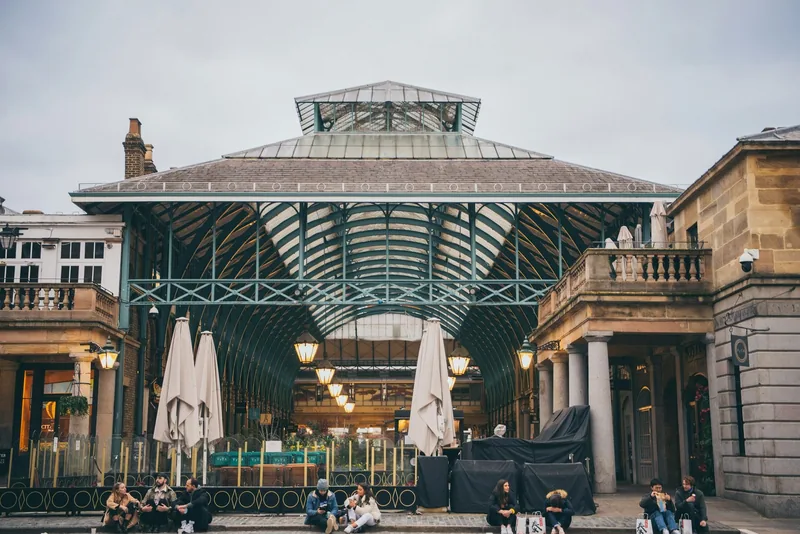
The Market Building and its stalls
The Market Building is a long, open hall divided into covered avenues with shops on both sides, a sunken courtyard in the middle where musicians play, and café terraces on the lower level. The shops are mostly well-known British and international brands, with some smaller names.
Inside the North Hall, the Apple Market is the stall area most visitors mean when they talk about "the market". According to Covent Garden's management, it is open daily from 10am to 6pm; from Tuesday to Sunday it is dedicated to British handmade crafts, and on Mondays to antiques and collectables. The East Colonnade Market, along the eastern side, is open from 10.30am to 7pm. South of the Piazza, the separate Jubilee Market Hall has more stalls, many of them selling souvenirs and cheaper goods.
The quality varies. Some craft stalls sell good jewellery, prints and small gifts made by the people behind the counter; others sell the same London souvenirs you see everywhere. Our list of London souvenirs worth buying helps you tell the difference, and our guide to shopping in Covent Garden and Seven Dials covers the streets beyond the market.
Monday is the day for antiques in the Apple Market. If you enjoy old silver, cutlery, postcards, badges and small collectables, come on a Monday, when the stalls switch from handmade crafts to antiques. Arrive in the morning for the best choice, and ask before you photograph a stall.
Street performers: how the Piazza shows work
Covent Garden has a long history of street entertainment. The diarist Samuel Pepys recorded watching a puppet show here in 1662, which is why Punch and Judy has a special link with the Piazza. Today you will see jugglers, acrobats, escapologists, magicians, living statues, string quartets and opera singers, sometimes several at once.
The performances are not random. Performers who use the two pitches inside the Market Building must pass auditions run by Shaftesbury Capital, overseen by performers' associations. Because the building is listed, some instruments are banned there, including drums, brass, bagpipes and electric guitars, and singers must stay under a volume limit. The West Piazza in front of St Paul's Church, James Street and the area outside the London Transport Museum are managed by Westminster City Council instead.
The big circle shows on the West Piazza often last around half an hour, build up a large crowd and end with a request for money. You are not obliged to pay, but if you watched the whole show, a few pounds in the hat is the normal thing to do.
The tightest crowds at the West Piazza shows attract pickpockets. When everyone is looking at a performer, nobody is watching their bag. Keep phones and wallets in front pockets or a zipped bag, and be wary of anyone pressing close behind you, especially when the crowd breaks up at the end of a show.
St Paul's Church, the actors' church
The plain, temple-like church on the west side of the Piazza is St Paul's Church, built by Inigo Jones and in use since 1633. It is not to be confused with St Paul's Cathedral in the City. The grand portico facing the Piazza is actually the back of the church; the entrance is from the other side, through a quiet churchyard garden reached from Bedford Street, King Street or Henrietta Street.
Because of its long links with the nearby theatres, it is known as the actors' church, and its walls are lined with plaques to actors, playwrights and performers. Admission is free and it is open most days, with a Sunday service at 11am. The churchyard garden is one of the calmest spots in the area, and a good place to sit with a coffee away from the crowds.
The Royal Opera House and theatreland
On the north-east corner of the Piazza, the Royal Opera House is home to the Royal Ballet and the Royal Opera. The organisation now calls itself the Royal Ballet and Opera, but the building on Bow Street is still the Royal Opera House. According to its website it is open daily from 12 noon and closes after the evening performance. The building is cashless, and all bags are checked on entry. Children under five are not allowed in the auditoriums.
Tickets range from very expensive to surprisingly affordable, depending on the seat and production, and some seats with restricted views are much cheaper. Even without a ticket you can go in during opening hours to use the ground-floor café and the shop.
Covent Garden also has several of the West End's big musical theatres, including the Theatre Royal Drury Lane on Catherine Street and the Lyceum on Wellington Street, with more along the Strand. Our introduction to West End theatre explains how to choose a show, and our tips on buying theatre tickets for less include the official discount booth on nearby Leicester Square.
Seven Dials and Neal's Yard
North of Long Acre, the streets change character. Seven Dials is a small junction where seven streets meet around a tall pillar topped with sundials. Covent Garden's management describes it as home to around 90 shops and 50 restaurants, bars and cafés, and the atmosphere is noticeably slower than on the Piazza. Monmouth Street, Earlham Street and Shorts Gardens have independent fashion, beauty and food shops.
Tucked between Monmouth Street and Shorts Gardens, Neal's Yard is a tiny courtyard of brightly painted buildings, window boxes and small cafés. It is one of the most photographed corners of central London, so it can be crowded in the middle of the day; early morning or early evening is better if you want a picture without people in it.
From Seven Dials it is only a few minutes' walk west across Charing Cross Road into Soho, or south-west to Leicester Square and Chinatown.
Covent Garden at different times of day
| Time | What it is like | Good for |
|---|---|---|
| Before 10am | Quiet; shops closed, cleaners and deliveries, a few cafés open | Photos of the Market Building and Neal's Yard, a calm breakfast |
| 10am-1pm | Filling up; stalls open, first street shows | Market browsing before the crowds |
| 1pm-6pm | Busiest, especially on Saturdays and in school holidays | Street performers at their liveliest |
| 6pm-8pm | Pre-theatre rush in restaurants and pubs | An early dinner before a show |
| After 10.30pm | Theatre crowds leave, then much quieter than Soho | A late drink; walking back along the river |
Saturday afternoons are the most crowded time of the week. If you can, visit on a weekday morning, then come back in the evening for a show. In the weeks before Christmas the Market Building is decorated with a giant tree and lights; it looks lovely but is extremely busy, as our guide to Christmas in London explains.
Eating, drinking and what things cost
The restaurants directly on the Piazza and in the Market Building charge for their location. You pay more for a sandwich, a pint or a pizza with a view of the performers than you would two streets away. That is not necessarily a bad deal if you want to sit outside and watch, but for better value walk a few minutes into the side streets, to Seven Dials, or across Charing Cross Road into Soho and Chinatown.
Covent Garden's management highlights Henrietta Street, on the south side of the Piazza, as the street where locals lunch, and Seven Dials has a large indoor food market with many small counters. Pre-theatre set menus between about 5pm and 6.30pm are common across the area and often the best value of the day.
Public toilets are a frequent question. According to Covent Garden's management, the toilets inside the Market Building cost £1.50, and those beside the portico of St Paul's Church, reached from the West Piazza, cost 50p; there is a disabled toilet in Tavistock Court next to Jubilee Market. Our guide to public toilets in London lists free alternatives.
Who Covent Garden suits, and who it does not
Worth your time if
- You are travelling with children who will enjoy the street shows (see our family guide to London)
- You are going to the theatre, opera or ballet
- You like browsing craft stalls and small shops
- You want a central, walkable base for a first visit
Less rewarding if
- You dislike crowds and chain restaurants
- You want bargains: prices around the Piazza are high
- You are hoping for a real working market with fresh food
- You have only a few hours and want major museums
If museums are a priority, combine a morning in Covent Garden with an afternoon at the National Gallery on Trafalgar Square, about ten minutes' walk south-west, or at the British Museum in Bloomsbury, a similar distance to the north.
Getting to Covent Garden
Covent Garden station, on the Piccadilly line, is at the end of James Street, a few steps from the Market Building. It is deep underground: there are 193 steps to street level, so use the lifts. At busy times, especially on Saturday afternoons, the lift queues can be long, so it is often faster to walk from Leicester Square, which is only a few minutes away. Holborn, Charing Cross and Tottenham Court Road (with the Elizabeth line) are all within ten minutes' walk. Our guide to walking between central stations shows why this is often quicker than changing trains.
Travellers who need step-free access should plan ahead; our guide to step-free transport in London explains how to find accessible stations. Around the Piazza itself the cobbles can be hard work for wheelchairs and buggies; the smoothest way into the Market Building is from Russell Street, where there are ramps.
The Piccadilly line runs directly to Heathrow Airport, which takes about 50 minutes from the West End and costs £5.90 with contactless or Oyster at all times. It is a useful option if you are staying in the area and do not have much luggage.
Frequently asked questions
Is Covent Garden free to visit?
Yes. The Piazza and the Market Building are public spaces that anyone can walk around at any time of day or night. You only pay for what you buy, the theatres and museums, and the toilets in the Market Building.
What days is Covent Garden market open?
The Apple Market in the Market Building is open every day from 10am to 6pm, with handmade crafts from Tuesday to Sunday and antiques and collectables on Mondays. The East Colonnade Market opens from 10.30am to 7pm.
When are the street performers in Covent Garden?
Performers appear every day, usually from late morning until early evening, and there are more of them at weekends and in summer. The big circle shows on the West Piazza in front of St Paul's Church draw the largest crowds.
Which is the best Tube station for Covent Garden?
Covent Garden station on the Piccadilly line is closest, but it has 193 steps and relies on lifts, which queue at busy times. Leicester Square is a few minutes' walk away and is often quicker, especially on weekends.
Is Covent Garden a good area to stay in?
It is very central, walkable and lively in the evening without being as loud late at night as Soho. Hotels are expensive, and rooms overlooking the Piazza or main streets can be noisy, so ask for a quieter room.
Sources
- Covent Garden - Frequently asked questions (checked September 2026)
- Covent Garden - Visit the neighbourhood (checked September 2026)
- Royal Ballet and Opera - Visitor information (checked September 2026)
- St Paul's Church, Covent Garden - The Actors' Church (checked September 2026)
- Society of London Theatre - The Official London Theatre Ticket Booth (checked September 2026)
- Transport for London - Tube and rail fares (checked September 2026)