
Tate Britain, on the river at Millbank in Pimlico, is the national gallery of British art from the 1500s to today, and it holds the world's largest collection of works by J.M.W. Turner. Entry to the collection is free with no need to book, it is open daily from 10:00 to 18:00, and a river boat links it with Tate Modern.
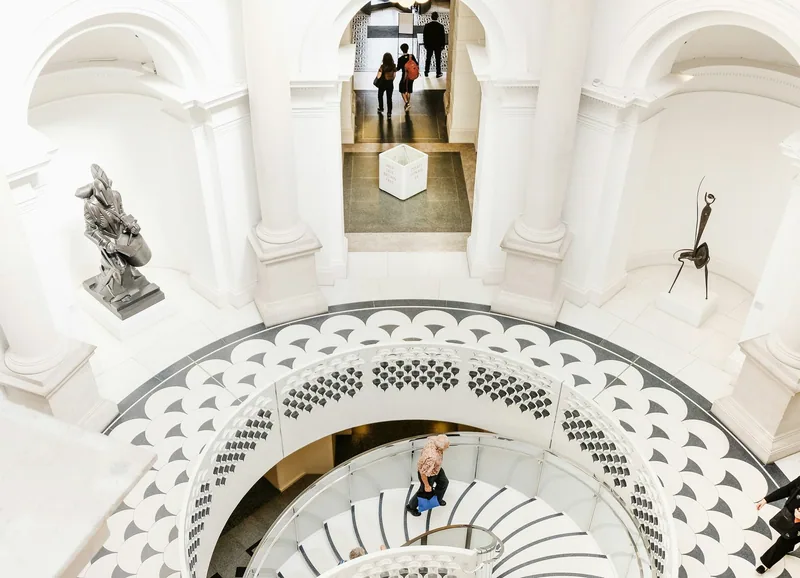
If the National Gallery is where you see Europe's great painters, Tate Britain is where you see Britain's. The rooms run in date order, from stiff Tudor portraits through Hogarth, Gainsborough and the Pre-Raphaelites to Francis Bacon, David Hockney and artists working now. It is calmer and smaller than the big national museums, and in our view it is one of the most pleasant free galleries in the city.
The gallery opened in 1897 as the National Gallery of British Art, paid for by the sugar merchant Henry Tate, and was known as the Tate Gallery until 2000, when the modern collection moved to Bankside. The Turner collection has its own wing, the Clore Gallery, at the side of the main building.
Tate Britain in brief
- Price
- Free; some exhibitions are paid
- Booking
- No need to book for the collection
- Hours
- Daily 10:00-18:00; last entry 17:30
- Entrance until 2027
- Manton Entrance, Atterbury Street (the Millbank steps are closed)
- Address
- Millbank, London SW1P 4RG
- Nearest station
- Pimlico (Victoria line), about 600 m
- River pier
- Millbank Pier, in front of the gallery
- Bags
- Nothing larger than cabin-bag size (55 x 40 x 20 cm)
Five hundred years of British art, room by room
The free collection is split into two main routes. Historic and Early Modern British Art traces the story from the Tudors to the Second World War. Modern and Contemporary British Art covers 1940 to the present. Because the rooms are arranged by period, you can walk through several centuries in an hour and watch British painting change from formal court portraits to landscapes, Victorian storytelling and then abstraction.
Tate picks out its own top ten, and these are a good spine for a first visit. The room numbers below are those listed by Tate in September 2026.
| Work | Room | Why look |
|---|---|---|
| Unknown artist, The Cholmondeley Ladies (c.1600-10) | 1 | Two women of one family, born, married and giving birth on the same day, painted almost as twins |
| John Singer Sargent, Carnation, Lily, Lily, Rose (1885-6) | 8 | Two girls lighting paper lanterns at dusk |
| John William Waterhouse, The Lady of Shalott (1888) | 8 | Tennyson's doomed heroine drifting downriver in a boat |
| Jessica Dismorr, Abstract Composition (c.1915) | 13 | Early British abstraction by a woman artist |
| Francis Bacon, Three Studies for Figures at the Base of a Crucifixion (1944) | 16 | Disturbing, unforgettable and bright orange |
| David Hockney, A Bigger Splash (1967) | 19 | The Californian swimming pool that became a pop icon |
| Chris Steele-Perkins, Blackpool Beach (1980-9) | 20 | Photographs of British leisure in the 1980s |
| Allison Katz, Portrait of the artist as a young girl(s) (2022) | 28 | Recent work in the display of art from 2000 to now |
| J.M.W. Turner, Peace - Burial at Sea (exhibited 1842) | 32 | Turner's dark tribute to a fellow painter, in the Turner wing |
Also look for Sir John Everett Millais's Ophelia (1851-2), the drowned heroine from Hamlet floating among flowers, which Tate names as one to seek out in the historic displays.
The Turner collection in the Clore Gallery
Joseph Mallord William Turner (1775-1851) left the contents of his studio to the nation, and most of it is here. Tate describes this as the world's largest free display of his paintings, spread over about eight rooms on the main floor of the Clore Gallery, with some works on paper as well as oil paintings. You do not need a ticket or a time slot.
The displays follow his career and his obsessions. JMW Turner: Rise to Fame shows how he became the star of his generation. Turner and his Critics looks at how his paintings were praised or mocked when first shown. Another room brings together late, experimental canvases that were unknown in his lifetime but now look astonishingly modern, and Toil and Terror at Sea gathers storms and shipwrecks, including Snow Storm - Steam-Boat off a Harbour's Mouth. Tate uses Norham Castle, Sunrise, a late painting of a castle dissolving into light, as the face of the display.
See the Turners first if you are short of time. The Clore Gallery is the one part of Tate Britain you will not find anywhere else. If you only have an hour, go there first and spend any time left in the Victorian rooms. Two of Turner's most famous paintings, The Fighting Temeraire and Rain, Steam and Speed, are not here but at the National Gallery.
Exhibitions and free commissions in autumn 2026
Tate Britain's main exhibitions are ticketed, and booking is recommended, although some tickets may be available at the door. In September 2026 the retrospective James McNeill Whistler was in its last days, running until 27 September 2026; check the price on the Tate website if you want to catch it.
Two major works are free. The Tate Britain Commission 2026 by the British-French-Algerian artist Zineb Sedira fills the long neo-classical Duveen Galleries in the centre of the building, until 17 January 2027. On the North Stairs, near the Atterbury Street entrance, Chris Ofili's Requiem pays tribute to the artist Khadija Saye, who died in the Grenfell Tower fire in 2017; Tate recommends viewing it from the top of the staircase.
Exhibition discounts work in the same way as at Tate Modern: up to four children aged 11 and under go free with each parent or guardian, family tickets for 12-18 year olds cost £5, and 16-25 year olds can join Tate Collective for £5 tickets. Members see every exhibition at both galleries free.
Getting in: the Atterbury Street entrance and bag rules
The grand entrance with the steps on Millbank, facing the river, is closed until 2027 while a new garden, the Clore Garden, is built. Use the Manton Entrance on Atterbury Street, around the corner. It has step-free access with automatic doors and a ramp.
Bags are checked on arrival. Nothing larger than a cabin bag (55 x 40 x 20 cm) is allowed in the building. There is a cloakroom, but space is limited, so if you are carrying a suitcase use the left luggage at Victoria station, which Tate itself suggests; see our guide to storing luggage in London for other options.
The riverside steps on Millbank are closed until 2027. Older maps may still point you to the front of the building. Walk round the corner to Atterbury Street to reach the Manton Entrance, which is the public entrance during the garden works.
The boat between the two Tates
Tate Britain and Tate Modern stand on the same stretch of river, a few kilometres apart, and a boat trip between them is a pleasant way to see two galleries in one day. Uber Boat by Thames Clippers boats call at Millbank Pier, directly in front of Tate Britain, and at Bankside Pier, next to Tate Modern.
Tate's own website still describes this as a direct "Tate to Tate" boat. In practice, according to the Thames Clippers timetable (June 2026 edition), it is the regular river bus: boats from Millbank stop at Westminster, the London Eye and Embankment before reaching Bankside, and the trip takes around 25 to 30 minutes. On weekdays boats call at Millbank roughly every 20 to 30 minutes between mid-morning and early evening; at weekends the service starts earlier and runs later. Always check the current timetable before you go.
| River bus, Millbank to Bankside | Detail (September 2026) |
|---|---|
| Fare zone | Central zone only |
| Adult fare with contactless or Oyster | £9.90 or £11.90, depending on the time of travel; fares valid until 31 October 2026 |
| With a Travelcard on Oyster | £9.60 or £10.95 |
| Children | 4 and under free (up to two per paying adult); 5-15 half price with the right card |
| Daily cap | River bus fares do not count towards the TfL daily cap |
| Accessibility | Millbank Pier was temporarily not step-free in September 2026; Thames Clippers suggests Westminster or Vauxhall instead |
For a couple, a one-way trip between the galleries costs about £20 to £24 on contactless, which is far more than the Tube but includes a river view of Parliament and the South Bank. If you need help or want to pay in cash, Thames Clippers says tickets can be bought at Tate Britain. Fares change after 31 October 2026, so check the ticket information page; our guide to the Uber Boat river bus explains how touching in and out works on the piers.
The cheaper alternative is the Tube: Pimlico to Victoria on the Victoria line, then the District or Circle line to Blackfriars, for Tate Modern. Or walk: the Thames Path from Millbank past the Houses of Parliament to Bankside takes about an hour, and our page on walking in London explains when that beats public transport.
Getting to Pimlico by Tube and bus
Pimlico station on the Victoria line is about 600 metres away, a walk of around ten minutes through quiet residential streets. Vauxhall (Victoria line and mainline trains) is about 850 metres, across the river, and Westminster (Jubilee, District and Circle lines) about 1,200 metres, a pleasant walk along the embankment past Victoria Tower Gardens. Bus 87 stops on Millbank, buses 88 and C10 on John Islip Street, and buses 2, 36, 185 and 436 on Vauxhall Bridge Road.
Santander Cycles docking stations are at Millbank Tower and on Rampayne Street near Pimlico station; see our guide to hire bikes and cycling in London if you want to ride along the river.
Free tours, food and families
Volunteer guides lead free 45-minute tours most days at 12:00, 13:00 and 14:00, starting at the top of the Rotunda Stairs; you can call +44 (0)20 7887 8888, option 1, to check they are running. Free Family Tours for children aged 5-11 start at 14:30 on selected dates, and on weekends and in school holidays the Learning Gallery and Manton Studio run family workshops. The Tate Draw digital drawing desks, on the Lower Floor next to the café, are a hit with children too.
The Djanogly Café on the Lower Floor serves salads, pastries and drinks. Pimlico has little in the way of big-name sights, but the streets behind the gallery hold small cafés and pubs that are quieter and cheaper than those at Westminster.
Combining Tate Britain with Westminster
Tate Britain works well at the start or end of a Westminster day. Walk north along the river for 10 to 15 minutes and you reach the Houses of Parliament, with Westminster Abbey across the road and the Churchill War Rooms a few minutes further on. Our guide to the Westminster neighbourhood puts them all on one route.
For a full art day, pair it with Tate Modern by boat, or with the National Gallery on Trafalgar Square to see Turner's other masterpieces. Going west, the elegant streets of Chelsea start about 20 minutes' walk along the river. Every one of these galleries is free to enter, as are many others on our list of London's free museums.
Who will enjoy it most
Anyone who likes landscape painting, Victorian art or Turner should put Tate Britain high on the list. It is also a good choice for visitors who find the National Gallery or Tate Modern too crowded. If you prefer contemporary art only, Tate Modern will suit you better, though the modern rooms here, with Bacon, Hockney and Bridget Riley, are strong.
Frequently asked questions
Is Tate Britain free?
Yes. Entry to Tate Britain's collection is free for everyone and you do not need to book. That includes the Turner rooms in the Clore Gallery and, until 17 January 2027, Zineb Sedira's commission in the Duveen Galleries. Only some temporary exhibitions charge an entry fee.
Is there a boat between Tate Britain and Tate Modern?
Yes. Uber Boat by Thames Clippers river buses call at Millbank Pier outside Tate Britain and Bankside Pier beside Tate Modern, stopping at Westminster, the London Eye and Embankment on the way. The trip takes about 25-30 minutes, and a central-zone adult fare costs £9.90 or £11.90 with contactless.
Where is the entrance to Tate Britain?
Until 2027 the entrance is the Manton Entrance on Atterbury Street, because the Millbank steps facing the river are closed for building work on the new Clore Garden. The Atterbury Street entrance has step-free access with automatic doors and a ramp.
Where can I see Turner's paintings in London?
Tate Britain has the world's largest collection of Turner's work, shown free in the Clore Gallery. The National Gallery on Trafalgar Square has several of his most famous paintings, including The Fighting Temeraire and Rain, Steam and Speed, in Room 40.
What is the nearest Tube station to Tate Britain?
Pimlico on the Victoria line is the nearest, about 600 metres or ten minutes on foot. Vauxhall is about 850 metres away across the river, and Westminster is about 1,200 metres along the embankment.
Sources
- Tate - Visit Tate Britain (checked September 2026)
- Tate - See great art for free at Tate Britain (checked September 2026)
- Tate - JMW Turner display at Tate Britain (checked September 2026)
- Tate - Tate Britain Commission 2026: Zineb Sedira (checked September 2026)
- Uber Boat by Thames Clippers - Route map (checked September 2026)
- Uber Boat by Thames Clippers - Timetable, June 2026 (PDF) (checked September 2026)
- Uber Boat by Thames Clippers - Millbank Pier (checked September 2026)
- Uber Boat by Thames Clippers - Ticket information (checked September 2026)