
Bloomsbury is the calm, bookish district just north of the West End, home to the British Museum, the University of London and a grid of leafy Georgian squares. It is one of the best-placed areas in central London to stay in, usually at lower prices than Covent Garden or Mayfair, and it is at its best on foot.
The name covers the streets between Tottenham Court Road in the west and Gray's Inn Road in the east, and between Euston Road in the north and New Oxford Street and High Holborn in the south. Most of it was built as a planned estate of terraced houses around garden squares in the 18th and early 19th centuries, and a surprising amount of that layout survives. Walk ten minutes from the crowds of Oxford Street and the noise drops away.
Today the area belongs largely to students, academics, publishers, hospitals and museums. That gives it a daytime energy during term and a quieter, almost residential feel in the evenings. Visitors come for the British Museum, the literary history and the independent bookshops, and many stay because the transport links are excellent and the hotels are good value for Zone 1.
Bloomsbury at a glance
- Where
- Central London, north of Covent Garden and Holborn, south of Euston and King's Cross
- Main sights
- British Museum, Russell Square, Foundling Museum, Charles Dickens Museum, Wellcome Collection
- Nearest Tube stations
- Russell Square, Holborn, Tottenham Court Road, Goodge Street, Euston Square
- Fare zone
- Zone 1
- Best for
- Museum lovers, readers, first-time visitors wanting a central base, anyone who likes quiet evenings
- Less good for
- Nightlife and late-night dining (Soho and Covent Garden are a short walk away)
What Bloomsbury feels like from morning to night
On a weekday morning Bloomsbury is busy but not crowded. Students cross Gower Street and Malet Street between lectures, hospital staff head to Great Ormond Street and University College Hospital, and the cafés around the squares fill with laptops. The squares themselves are at their most pleasant at this time: benches, plane trees and the occasional runner.
From about 10:00 the crowds gather around one building, the British Museum on Great Russell Street. The pavement outside can be packed with tour groups by late morning, especially in summer and during school holidays. Step one street away, into Bedford Square or Montague Street, and it is calm again.
Evenings are quiet. There are pubs, restaurants and a few late cafés, especially around Lamb's Conduit Street, the Brunswick Centre and the streets near Russell Square station, but Bloomsbury is not a nightlife area. That is a real advantage if you want to sleep well and still walk to the theatres of the West End in 15 to 20 minutes. For bars and clubs, see our guide to going out in London.
Weekends are different again. University buildings close, the office workers disappear, and some sandwich bars and cafés near the campus stay shut. The museums, the squares and the pubs remain open, so it is still a good place for a slow Saturday.
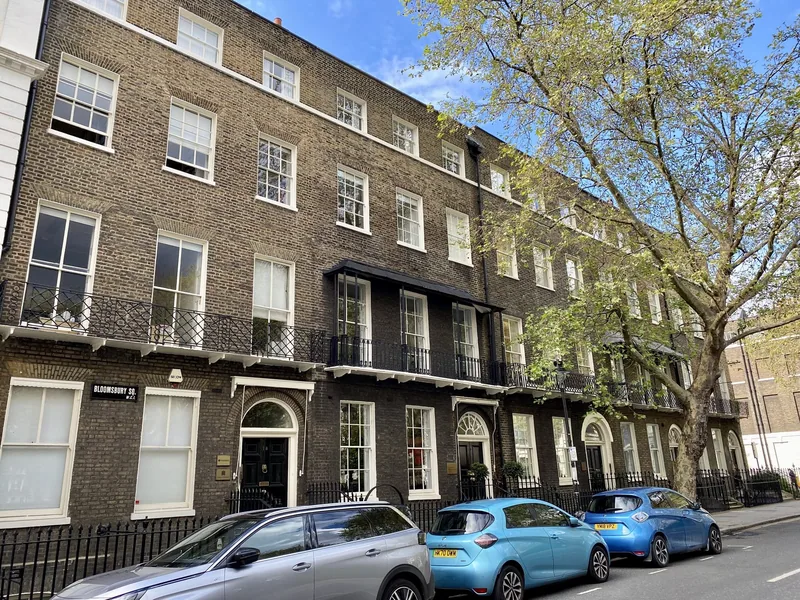
Photo: No Swan So Fine · CC BY-SA 4.0 · Wikimedia Commons · resized
The British Museum and the other museums on your doorstep
The British Museum is the reason most people come to Bloomsbury, and it deserves a full morning or afternoon. Entry to the permanent collection is free; special exhibitions are paid. The museum's own map places the Rosetta Stone in Room 4 on the ground floor and the Parthenon sculptures in Room 18. Some galleries have limited hours: the official map says Rooms 7, 9, 10, 19, 20, 57 and 58 open only from 11:00 to 15:00 each day, and some galleries can close at short notice. Our full British Museum guide covers the highlights, queues and the best times to go.
Bloomsbury has several smaller museums that are much calmer and give a better sense of the area's past.
- The Foundling Museum on Brunswick Square tells the story of the Foundling Hospital, London's first home for abandoned children, founded in the 18th century. An adult ticket is £14.50, or £13.50 online, and visitors aged 21 and under go free. It is open Tuesday to Saturday 10:00-17:00 and Sunday 11:00-17:00, and closed on Mondays.
- The Charles Dickens Museum at 48 Doughty Street is the house where Dickens lived as a young writer and wrote Oliver Twist. It is open Wednesday to Sunday, 10:00-17:00, with last entry at 16:00. Check prices on its website before you go.
- Wellcome Collection on Euston Road is a free museum and library about health, medicine and the human body. The galleries open Tuesday to Sunday, 10:00-18:00, and are closed on Mondays. Its exhibitions are often thought-provoking and sometimes unusual, which makes it a good choice for adults and older teenagers.
- Sir John Soane's Museum sits just south of Bloomsbury on Lincoln's Inn Fields, five minutes from Holborn station. It is free, with no need to book, and open Wednesday to Sunday, 10:00-17:00.
If you like this kind of place, our list of London's best small museums has more ideas across the city, and many of the big ones are covered in our guide to museums you can visit for free.
Plan Monday around the British Museum. The Foundling Museum and Wellcome Collection are closed on Mondays, and the Charles Dickens Museum and the Soane are closed on Mondays and Tuesdays. If you only have a Monday in Bloomsbury, spend it at the British Museum and save the smaller museums for later in the week.
Garden squares and the literary history behind them
Bloomsbury's squares are its signature. Russell Square is the largest and the busiest, with a café and a fountain. Bedford Square is the best-preserved Georgian square in the area, a complete ring of brick terraces around a private garden. Gordon Square and Tavistock Square are quieter and full of university buildings. Tavistock Square has a statue of Mahatma Gandhi and a memorial to conscientious objectors. Some squares are open to the public during the day, and others are private gardens for residents; follow the signs at the gates.
In the early 20th century a group of writers, artists and thinkers who lived around Gordon Square became known as the Bloomsbury Group. Its members included Virginia Woolf, her sister the painter Vanessa Bell, the economist John Maynard Keynes and the writer E. M. Forster. Blue plaques on the houses mark where many of them lived. Earlier residents included Charles Dickens, and the area has been home to publishers and booksellers for more than a century.
A good way to see it all is a slow loop: start at Bedford Square, walk up Gower Street past the grand front of University College London, cross to Gordon and Tavistock Squares, then go east to Brunswick Square and Coram's Fields and finish on Lamb's Conduit Street. It takes about an hour without stops. If you prefer a guide, our overview of walking tours in London includes literary walks.
Bookshops, markets and Lamb's Conduit Street
Bloomsbury is one of the best areas in London for books. The London Review Bookshop on Bury Place, near the British Museum, is a well-known independent with a small cake shop. Gay's the Word on Marchmont Street is one of the oldest LGBTQ+ bookshops in the country. The Brunswick Centre, a striking 1970s concrete housing and shopping complex near Russell Square, has a large second-hand bookshop in its basement, a supermarket and chain restaurants. For a wider list across the city, see our guide to London's best bookshops.
Lamb's Conduit Street, on the eastern edge of the district, is a short, mostly pedestrianised street of independent clothes shops, small restaurants and a traditional pub. It feels like a village high street and is a good place for lunch after the Foundling or Dickens museums. Marchmont Street, near Russell Square, has cafés, launderettes and cheap places to eat that serve the student population.
Bloomsbury is not a major shopping area. For department stores and big brands, Oxford Street is a 10-minute walk from Tottenham Court Road, and Covent Garden is just to the south.
Eating and drinking in Bloomsbury
Food in Bloomsbury is practical rather than showy. You will find many chain cafés and sandwich shops, simple Italian and Asian restaurants, and a handful of traditional pubs. Prices near the British Museum are higher and quality is mixed, so walk a few streets north or east for better value. The university area has plenty of inexpensive lunch options on weekdays.
For a pint in historic surroundings, the old pubs of Bloomsbury and nearby Holborn are part of the experience; our guide to London's historic pubs explains which are worth the detour. If your budget is tight, our tips on eating well for less in London apply here too.
Staying in Bloomsbury: who it suits and what to expect
Bloomsbury has a long row of mid-range hotels on and around Russell Square, many in converted terraced houses, plus larger chain hotels and a number of simple guesthouses on Gower Street and the streets near Euston. It is generally better value than Covent Garden, Soho or Mayfair, while still being in Zone 1 and within walking distance of the West End.
Reasons to stay here
- Walking distance to the British Museum, Covent Garden and the theatres
- Direct Piccadilly line from Heathrow to Russell Square and Holborn
- Quiet streets at night compared with Soho
- Close to King's Cross and St Pancras for Eurostar and trains to the north
Things to weigh up
- Rooms in older terraced buildings can be small, with steep stairs and no lift
- Euston Road on the northern edge is noisy and polluted
- Limited nightlife and fewer good restaurants than the West End
Bloomsbury suits first-time visitors, couples and solo travellers who plan to spend their days at museums and their evenings at the theatre. Families appreciate the green squares and the playground at Coram's Fields. Our guide to the best areas to stay in London compares it with other districts, and our budget hotel advice explains what to check before you book a cheap room.
Getting to and around Bloomsbury
Bloomsbury is well served by the Tube. Russell Square is on the Piccadilly line, which runs directly to Heathrow. Holborn is on the Central and Piccadilly lines. Tottenham Court Road, on the western edge, has the Central and Northern lines and the Elizabeth line, which gives fast connections to Paddington, Liverpool Street, Canary Wharf and Heathrow. Goodge Street (Northern line) and Euston Square (Circle, Hammersmith & City and Metropolitan lines) cover the north-west corner.
Everything in Bloomsbury is in Zone 1. A pay-as-you-go journey within Zone 1, for example from Oxford Circus to Russell Square, costs £3.10 at peak times and £3.00 off-peak with contactless or Oyster (fares from July 2026). The daily cap for Zones 1-2 is £8.90. Our guide to Oyster, contactless and daily caps explains how to pay.
Many buses run along Southampton Row, Gower Street and Tottenham Court Road. A bus journey costs £1.75 with contactless or Oyster, rising to £1.85 on 1 November 2026, and you can change buses free within an hour. Distances in Bloomsbury are short, so walking is often quicker than taking the Tube one stop.
Russell Square to Heathrow needs no change. The Piccadilly line runs straight from Russell Square and Holborn to Heathrow in under an hour, for £5.90 with contactless or Oyster from Zone 1. It is slower than the Elizabeth line from Tottenham Court Road but saves carrying bags through a change, and many Bloomsbury hotels are only a few minutes' walk from the station.
Families, accessibility and safety
Coram's Fields, on Guilford Street, is a large park and playground for children under 16, with farm animals, sports pitches and play areas. It is free and open daily. Adults cannot go in without a child, which keeps it safe and relaxed. Russell Square and the other public gardens are good for a picnic after the British Museum. For more ideas, read our guide to London with children.
The pavements are mostly flat and wide, which makes Bloomsbury one of the easier central areas for wheelchair users and people with pushchairs, although older hotels and guesthouses may have steps at the entrance and no lift. Check step-free access at your nearest station before you travel.
Bloomsbury is generally considered a safe area. As in the rest of central London, watch your phone and bag around busy stations and the British Museum crowds, and be aware that the streets around Euston and King's Cross can feel rougher late at night.
Combining Bloomsbury with neighbouring areas
Bloomsbury sits between several of London's most interesting districts, so it is easy to combine. Walk north for 15 minutes to reach King's Cross and its canal-side squares. Head south-west for 10 minutes to the shops and street performers of Covent Garden, or west across Tottenham Court Road into the restaurants of Soho. To the south-east, Holborn leads to the legal quarter and the edge of the City of London.
Frequently asked questions
Is Bloomsbury a good area to stay in London?
Yes, for most visitors. It is central, in Zone 1, well connected by the Tube and quieter at night than Soho or Covent Garden. Hotels are usually cheaper than in the West End. The main drawbacks are small rooms in some older buildings and limited nightlife.
How far is the British Museum from Covent Garden?
About 10 to 15 minutes on foot. The walk from Covent Garden piazza north through Seven Dials and across New Oxford Street is easy and flat, and it is usually quicker than taking the Tube for such a short distance.
What is Bloomsbury famous for?
Bloomsbury is famous for the British Museum, the University of London and its Georgian garden squares. It also gave its name to the Bloomsbury Group, the circle of writers and artists including Virginia Woolf and John Maynard Keynes who lived here in the early 20th century.
Which Tube station is best for Bloomsbury?
Russell Square (Piccadilly line) is the most central station for the squares and many hotels. Tottenham Court Road and Holborn are best for the British Museum, and Tottenham Court Road is also on the Elizabeth line, which helps if you are travelling to Paddington or Heathrow.
Is Bloomsbury safe at night?
Bloomsbury is generally regarded as one of the calmer parts of central London in the evening. Use normal city care: keep valuables out of sight, stick to lit streets and take extra care around Euston Road and the big stations late at night.
Sources
- British Museum - Museum map (checked September 2026)
- Foundling Museum - Visit us (checked September 2026)
- Charles Dickens Museum - Home page and opening times (checked September 2026)
- Wellcome Collection - Opening times (checked September 2026)
- Coram's Fields - Home page (checked September 2026)
- Sir John Soane's Museum - Your visit (checked September 2026)
- Transport for London - Single fare finder (checked September 2026)