
The Science Museum in South Kensington is free to enter and open daily from 10:00 to 18:00, with spacecraft, historic aircraft and hands-on galleries spread over several floors. The museum recommends booking a free timed ticket; Wonderlab, the IMAX cinema and the Power Up gaming gallery cost extra.
Think of it as two museums in one building. The free part is a national collection of objects that changed the world, from steam engines to the Apollo 10 command module. The paid part is a set of interactive experiences, mostly aimed at children, where you press, pull, race and experiment. Many families combine the two, and the price of the paid extras is what decides how expensive the day becomes.
The museum says an average visit lasts about two hours, but families with a Wonderlab ticket often stay much longer. This guide covers what is in each gallery, what has moved or closed in 2026, the ticket system, and how to plan a day with children without running out of energy or money.
Science Museum essentials
- Price
- Free; Wonderlab, Power Up, IMAX and some exhibitions are paid
- Tickets
- Free timed ticket recommended; walk-up entry is possible when the museum is not full
- Opening hours
- Daily 10:00-18:00, last entry 17:15; closed 24-26 December
- Autumn 2026 closures
- Closed all day Wednesday 11 November; closes 17:00 on Thursday 26 November
- Time needed
- About two hours on average; half a day with Wonderlab
- Nearest Tube
- South Kensington, about 5 minutes on foot
- Address
- Exhibition Road, London SW7 2DD
Free tickets, walk-ups and the rules at the door
The museum asks visitors to book a free general admission ticket online and choose an arrival slot. Your arrival time is printed on the ticket, and you scan it yourself at the entrance from your phone. The museum's FAQ also says that walk-up entry is available each day for people without a booking, but when visitor numbers are very high they may wait longer. In practice, a free ticket costs nothing and removes the risk, so we would always book one. Book through the official visit page; the museum says it does not sell priority or queue-jump tickets and is not linked to anyone who claims to.
There are a few other rules worth knowing before you go:
- Enter through the main entrance on Exhibition Road.
- Children under 12 must be accompanied by an adult aged 18 or over.
- If you have a paid ticket for Wonderlab, Power Up or IMAX, you still need the free admission ticket as well. Allow at least 15 minutes to walk from the entrance to Wonderlab or the IMAX cinema.
- You may leave and come back on the same day by showing your e-ticket at the main entrance.
- Bags may be searched on arrival or at exhibitions.
Self-service lockers on level -1 take card payment only: £3 for a coat-sized locker, £5 for a rucksack and £7 for a jumbo locker that fits carry-on luggage (September 2026). The museum still advises leaving suitcases elsewhere. Buggies are allowed in most galleries, and there is free buggy parking on level -1.
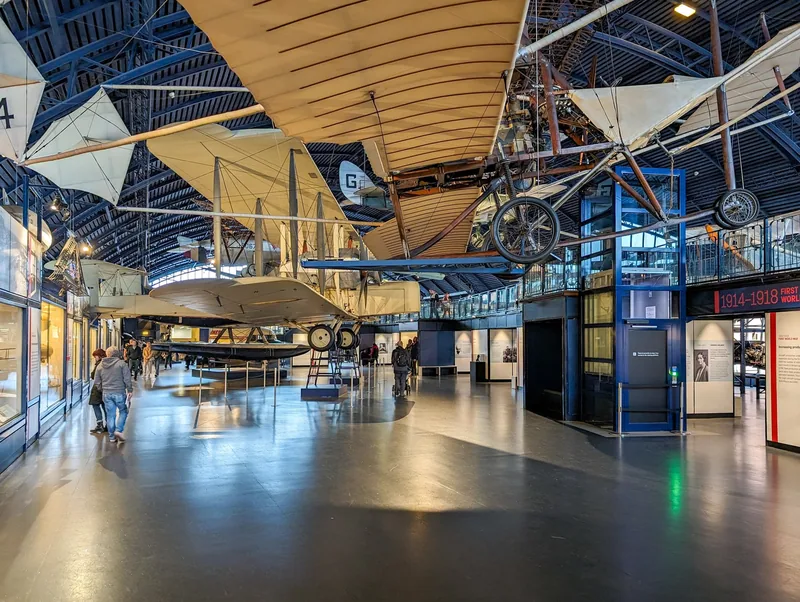
Photo: The wub · CC BY-SA 4.0 · Wikimedia Commons · resized
The Space gallery has moved to the West Hall
If you last visited years ago, the famous space gallery is no longer where it was. The new Space gallery is on level 0 at the back of the museum in the West Hall, next to the IMAX: The Ronson Theatre ticket desk. To reach it, walk through the corridor on level 0 near Lifts/Stairs C and follow the signs. It is free.
The highlight is a world first: two spacecraft that carried people, the Apollo 10 command module that orbited the Moon in 1969 and a Soyuz capsule that travelled to the International Space Station in 2015, displayed side by side. You can also see an RL10 rocket engine, the radio headset Neil Armstrong used on Apollo 11, the Sokol spacesuit worn by Helen Sharman (the first Briton in space, whose mission was 35 years ago in 2026), a piece of the Moon brought back by Apollo 15 and a tiny grain collected from the asteroid Ryugu by Japan's Hayabusa2 probe.
The museum runs a free family science show on a space theme as part of its "Destination Space" programme, and space-themed Astronights sleepovers for children on selected dates.
Flight, Making the Modern World and the other free galleries
Several large free galleries are worth your time even if you have no children with you.
Flight (level 3)
Aircraft hang from the ceiling, and walkways let you look at them from above. Look for the 1909 Antoinette monoplane, Amy Johnson's Gipsy Moth "Jason", which she flew to Australia in 1930, and the Vickers Vimy of Alcock and Brown, the first non-stop flight across the Atlantic in 1919. There is also a complete slice of a Boeing 747 and the Hawker P1127 that led to the Harrier jump jet. The museum lists Flight as closed all day on 19 and 20 October and 19 November 2026.
Making the Modern World (level 0)
This long gallery traces 250 years of science and technology through famous objects, including Babbage's Difference Engine No. 1, Crick and Watson's DNA model, the first Apple computer, penicillin from Fleming's laboratory and a clock designed to tell the time for 10,000 years. Some sections have been closed since 30 June 2026 while objects move ahead of a new gallery, Ages of Invention, due later this decade.
Engineers, Technicians and more
Engineers (level 1) tells the stories behind the first digital camera, a surgical robot arm and a tiny atomic clock of the kind the GPS system depended on. Technicians: The David Sainsbury Gallery is an interactive space about the jobs behind science. Other free galleries include Information Age, on communication, and Who Am I?, on genetics and identity; the museum lists a few dates when they open late or close early, so check the visit page.
New galleries are being built around you. The museum warns that construction may cause extra noise, and gallery moves mean some routes are signposted differently from older maps. Download the current museum map before you go, or ask staff at the Energy Hall ticket desk near the entrance.
Wonderlab, Power Up and IMAX: the paid extras
These three experiences need a separate paid ticket, and all three are cheaper when you book ahead. They are the part of the museum most children remember, so decide in advance which one (if any) fits your group.
| Experience | What it is | Ages and details |
|---|---|---|
| Wonderlab (level 3) | 50 hands-on exhibits in seven zones, giant slides, a Tesla coil, a Chemistry Bar and live science shows | Recommended for 7-14; day pass from £13.50, same price for all ages; children aged 3 and under free; open 10:00-17:40; most visitors spend 1-2 hours |
| Power Up (level -1) | More than 160 games consoles from five decades, multiplayer games and virtual reality | Ages 5+; under-16s must be with an adult; open 10:00-17:30; most visitors spend about 90 minutes |
| IMAX: The Ronson Theatre (level 0) | A large-screen cinema showing documentaries, several in 3D | Prices and times vary by film; see the museum's IMAX listings |
For a family of two adults and two children aged 8 and 11, Wonderlab costs from about £40 in total. Day passes start at £13 and cost the same for adults and children, but a family day pass for three to five visitors with no more than two adults takes £3 off each one. Prices vary by date, so check the official Wonderlab page. Power Up day pass prices also vary, and the museum does not publish a single figure; family discounts apply.
Wonderlab is shut all week from 14 to 18 September 2026. The museum lists Wonderlab as closed all day on those dates, and closing early at 16:00 on 14 October and 8 December 2026. If Wonderlab is the main reason for your trip, check the closures list before booking.
Wonderlab uses magnets in some exhibits that may affect pacemakers and other medical devices; warning signs are placed next to them. The museum also offers Power Up evening sessions for adults only, with games not shown in the day.
Planning a day at the Science Museum with children
The museum is big, the galleries are spread over several floors, and children usually want to go straight to anything with buttons. A plan helps. This is a realistic day for school-age children with a Wonderlab ticket:
- 10:00, arrive and head for the Space gallery. It is on your level, at the back, and quieter early in the day.
- 10:45, Making the Modern World on the way back towards the front.
- 11:30, Wonderlab (book this time slot in advance). Take the lift up to level 3; allow 15 minutes.
- 13:00, lunch. The museum has cafés and picnic areas; you can also pre-order a lunch to collect in the Energy Café on level 0.
- 14:00, Flight, on the same floor as Wonderlab, then leave or move on to another museum.
For children aged 7 and under, the museum runs a family show called Bubble Explorers on weekends in term time and every day in school holidays. There are also dedicated areas for young children, such as the Pattern Pod on level 0 and The Garden on level -1, a family room on level -1 and baby-changing facilities throughout. Our guide to London with children has more family ideas across the city, and our page on children's fares explains when kids ride free on the Tube and buses.
The museum's own advice for a quieter visit is to come on a weekday afternoon in term time. Weekends, school holidays and rainy days are the busiest; see our tips for wet-weather days in London if the forecast is poor.
Getting there through the South Kensington tunnel
The museum is on Exhibition Road, a five-minute walk from South Kensington station (Piccadilly, District and Circle lines). The station is not step-free, and Piccadilly line upgrades may cause closures in 2026 and 2027, so check TfL before travelling. A long pedestrian subway runs from the station towards the museums, which keeps you out of the traffic and the rain; follow the signs for the museums. Our step-free transport guide lists stations with lifts.
Accessibility is generally good inside: there are lifts, accessible toilets throughout and a Changing Places toilet on level 0. Free Wi-Fi is available across the building on the network "Free Museum Wi-Fi".
Combining it with its neighbours
The Science Museum shares Exhibition Road with two other free national museums. The Natural History Museum is directly next door, and the dinosaurs make an easy pairing with the Space gallery for a children's day. The V&A is across the road and suits adults who want design, fashion and architecture. Seeing all three in one day is too much for most people.
Our guide to South Kensington covers the area's cafés and streets, and Hyde Park and Kensington Gardens are a short walk north for a run-around after a morning indoors. If you are travelling on a tight budget, free museums like this one are the backbone of a cheap London trip; see how to see London on a budget and the full list of free museums in the capital. For every other museum we cover, go to the museums and galleries section.
Frequently asked questions
Is the Science Museum in London free?
Yes. Entry to the museum and its main galleries, including Space, Flight and Making the Modern World, is free. You pay only for Wonderlab, Power Up, IMAX films and some exhibitions and events. The museum recommends booking a free admission ticket in advance.
Do you need to book the Science Museum in advance?
The museum asks visitors to pre-book a free timed ticket, and it is the safest choice. Its FAQ says walk-up entry is available each day, but when the museum is very busy people without tickets may wait longer or not get in until there is space.
How much does Wonderlab cost?
Wonderlab day passes start from £13.50 and the price varies by date, with cheaper prices when you book ahead. One price applies to all ages, and children aged 3 and under go free. You also need a free museum admission ticket.
What age is the Science Museum best for?
The free galleries suit all ages, and adults interested in history or engineering can easily spend a day. Wonderlab is designed for children aged 7 to 14, Power Up for ages 5 and up, and there are shows and play areas for under-7s.
Where is the Space gallery in the Science Museum now?
The new Space gallery is on level 0 in the West Hall at the back of the museum, next to the IMAX cinema ticket desk. Walk through the corridor near Lifts/Stairs C on level 0 and follow the signs for Space.
Sources
- Science Museum - Visit (opening times, closures and gallery moves) (checked September 2026)
- Science Museum - Visit FAQs (tickets, walk-up entry, lockers, facilities) (checked September 2026)
- Science Museum - Wonderlab (checked September 2026)
- Science Museum - Space gallery (checked September 2026)
- Science Museum - Flight gallery (checked September 2026)
- Science Museum - Making the Modern World (checked September 2026)
- Science Museum - Power Up (checked September 2026)