
Imperial War Museum London, in Lambeth south of the Thames, tells the story of war from the First World War to the present day through the experiences of the people who lived through it. Entry is free, you do not need to book, and the museum recommends allowing at least three hours.
The museum was founded in 1917, while the First World War was still being fought, to record the war effort and the sacrifice of people across the British Empire. Today it is part of Imperial War Museums (IWM), a group of five museums that also includes Churchill War Rooms and HMS Belfast in London. IWM London is the one to choose if you want the full story, from 1914 to today.
This is not a museum of weapons for their own sake. There are tanks, aircraft and guns, but the focus is on ordinary people: soldiers, civilians, children and victims. Some of the content is upsetting, and the Holocaust Galleries in particular are not recommended for younger children. This guide explains what is on each floor, what to expect emotionally, and how to plan your visit.
IWM London key facts
- Price
- Free; no booking needed
- Opening hours
- 10:00-18:00 daily, except 24-26 December
- Early closing
- Closes at 16:00 on Thursday 1 October 2026
- Time needed
- At least three hours, the museum advises
- Holocaust Galleries
- Not recommended for children under 14
- Nearest stations
- Lambeth North (7 minutes), Elephant & Castle (10 minutes), Waterloo (14 minutes)
- Address
- Lambeth Road, London SE1 6HZ
The building and the atrium
The museum occupies the central part of a grand 19th-century building with a dome, which was once the Bethlem Royal Hospital, a psychiatric hospital. IWM moved here in 1936. As you walk up to the entrance through the park you pass two huge naval guns pointing towards the road, a good place for a first photograph.
Inside, the museum is built around a tall central atrium, with large objects on display and the galleries arranged over six floors around it. The information desk is on level 0. Volunteers in red uniforms can tell you what is happening that day, including talks and family activities.
The atrium is where you get your bearings. Download the museum map from the official website before you go, or ask at the desk; it is easy to spend all your time in one gallery and run out of energy for the rest.
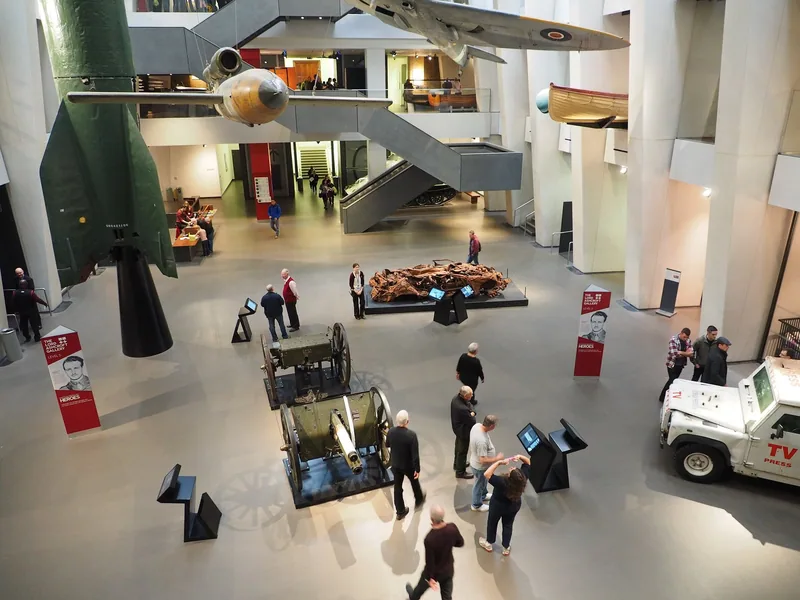
Photo: Nick-D · CC BY-SA 4.0 · Wikimedia Commons · resized
The First World War Galleries: the trench and the Somme
The First World War Galleries tell how the "Great War" of 1914-1918 began, how it was fought and won, and how it changed lives at home and on the front line. More than 1,300 objects are on display, from weapons and uniforms to diaries, keepsakes, film and art. The museum's intention is that each object speaks for the person who made, used or cared for it.
The best-known part is a walk-through trench lined with sandbags. You look through a periscope into no man's land, hear the sound of shells, and see a Mark V tank and a Sopwith Camel fighter plane overhead. A section on the Battle of the Somme (1 July to 18 November 1916) explains why it remains the most painful episode of the war for many people in Britain.
Allow at least an hour here. The galleries follow a chronological route, so it is best to start at the beginning and not dip in halfway.
A three-hour plan for adults
If you have one afternoon, this order works well. Spend the first hour in the First World War Galleries. Take a short break in the café off the atrium. Then give the Second World War and Holocaust Galleries at least an hour and a half, and finish with 20 or 30 minutes in the Blavatnik art galleries or whichever temporary exhibition interests you. Arrive by 14:30 at the latest, since the museum closes at 18:00 and three hours goes quickly.
The Second World War and the Holocaust Galleries
Opened in 2021, these galleries span two floors. IWM describes itself as the first museum in the world to house Second World War Galleries and Holocaust Galleries under the same roof. The aim is to show the connection between the course of the war and the Holocaust, through the stories of real people from many communities.
The Second World War Galleries
These cover the war from its causes to its consequences, including the Blitz and life on the home front in Britain. Look for small objects with big stories: the museum highlights, for example, a fashionable leather handbag with a built-in gas mask compartment, carried by the founder of the Women's Voluntary Service, and a "utility" dress from the years when clothes were rationed in Britain (1941 to 1949).
The Holocaust Galleries
The Holocaust Galleries tell the story of the murder of six million Jewish people through more than 2,000 photographs, books, artworks, letters and personal objects, from jewellery and clothing to toys and musical instruments. Among them is the rare birth certificate of Eva Clarke, one of only three babies born in the Mauthausen concentration camp who survived past liberation.
The Holocaust Galleries are for visitors aged 14 and over. IWM says the galleries are not recommended for children under 14 and that some sections contain highly graphic content. Families with younger children can visit the rest of the museum and leave these galleries for another time; school groups must book a Holocaust Learning Session to enter.
These are, in our view, the most affecting galleries in any London museum. Give them time, go early in your visit while you still have energy, and plan a quiet break afterwards. The museum café and the park outside are both close by.
Art, film and conflict up to the present day
IWM London covers conflict up to the present day, including the Cold War. A newer set of spaces, the Blavatnik Art, Film and Photography Galleries, shows how artists, film-makers and photographers have responded to war, and the tension between creativity and destruction.
To mark 25 years since the attacks of 11 September 2001, a new permanent photography installation about 9/11 went on display from 4 September 2026. There is also a changing programme of temporary exhibitions, some free and some paid; check the official IWM London page for what is on during your visit.
Visiting with children
IWM London works well for families with school-age children, as long as you plan around the Holocaust Galleries. The museum runs free children's activities every weekend and in school holidays, aimed at ages 5 to 12.
Until 28 February 2027 there is also a free family exhibition, Childhood in War: Family highlights (from 31 July 2026). It shows how children have lived through conflict from 1914 to today, with hands-on activities and interactive displays. It is designed for families with children aged 8 and over, although younger visitors are welcome too.
With children, we would start with the First World War trench, which tends to hold children's attention, then the family exhibition, then lunch. Our guide to London with kids has more family ideas across the city.
Bring a £1 coin for the IWM lockers. The lockers are coin-operated and the coin is returned after use. The largest take a bag of about 55 x 33 x 43 cm, roughly airline cabin size, but the museum cannot store suitcases or large luggage at all.
Practical details: food, bags, photos and access
The café, inspired by traditional East London eateries, is off the main atrium and open 10:00-17:30 daily. At weekends a lunchroom on level 1 (past the exit of the Second World War Galleries) is open to all visitors for eating food you bring from home.
Large luggage and suitcases are not allowed in the galleries, and lockers are for smaller bags only. If you are carrying cases, use one of the services in our guide to left luggage in London first. Allow time for security checks at the entrance, and do not bring prohibited items, which will be confiscated.
You may take photos and video for personal use, but not with flash or a tripod, and the museum asks you not to film other people without permission. Signs show where photography is not allowed. Step-free access is through the West Entrance: facing the front of the museum, it is on the right-hand side, just past the café entrance.
Getting to Lambeth Road
The nearest Tube station is Lambeth North on the Bakerloo line, about seven minutes' walk. Elephant & Castle (Bakerloo and Northern lines) is about ten minutes, and Waterloo, a major rail and Tube station, about 14 minutes. Our Underground guide explains the lines if you are new to the Tube.
Buses stop close by: routes 344 and 360 on Lambeth Road, and routes 3, 59 and 159 on Kennington Road. See our guide to London buses for how to pay. Cycleway 6 runs past the museum from Elephant & Castle, and the nearest Santander Cycles docking stations are at Geraldine Street and Kennington Road; our page on cycling in London explains the hire bikes. There is no general car parking; a few Blue Badge spaces can be reserved by phone at least three days ahead.
Combining IWM London with Westminster and the South Bank
The museum is about 15 minutes on foot from the river. Walk west along Lambeth Road to Lambeth Bridge, and you can cross to Westminster for the Houses of Parliament and the Abbey. Walk north instead and you reach Waterloo and the South Bank, with its riverside walk and the London Eye.
If the Second World War is your main interest, pair this museum with Churchill War Rooms in Westminster, the underground bunker from which Winston Churchill and his government directed the war. Unlike IWM London, it charges admission: an adult ticket costs £34 (price period from 2 September 2026 to 31 March 2027). Doing both in one day is possible but heavy; we would split them.
For more museums that cost nothing to enter, see our free museums list, and for everything else in this section, go to London's museums and galleries. If you are fitting IWM into a short stay, our three-day London itinerary shows how a half-day museum visit fits in.
Frequently asked questions
Is the Imperial War Museum in London free?
Yes. Entry to IWM London is free and you do not need to book. Some temporary exhibitions, events and private tours are paid. Churchill War Rooms, run by the same organisation in Westminster, is a separate paid attraction.
How long does it take to go round the Imperial War Museum?
The museum recommends at least three hours. That gives you time for the First World War Galleries, the Second World War and Holocaust Galleries and a look at the art galleries or a temporary exhibition. With children, two to three hours with a break is usually enough.
Is the Imperial War Museum suitable for children?
Much of it is, and there are free activities for 5 to 12-year-olds at weekends and in school holidays, plus the free Childhood in War family exhibition until 28 February 2027. The Holocaust Galleries, however, are not recommended for children under 14.
What is the nearest station to IWM London?
Lambeth North on the Bakerloo line is the closest, about seven minutes on foot. Elephant & Castle is about ten minutes away and Waterloo about 14 minutes. Several bus routes also stop on Lambeth Road and Kennington Road.
Can I take a suitcase to the Imperial War Museum?
No. The museum cannot store suitcases or large items of luggage, and they are not allowed in the galleries. Coin lockers take smaller bags up to about airline cabin size, subject to availability.
Sources
- Imperial War Museums - IWM London (opening times and entry) (checked September 2026)
- Imperial War Museums - What's here at IWM London (visit length, café, lockers, access) (checked September 2026)
- Imperial War Museums - The Holocaust Galleries (checked September 2026)
- Imperial War Museums - First World War Galleries (checked September 2026)
- Imperial War Museums - Getting to IWM London (checked September 2026)
- Imperial War Museums - Families at IWM London (checked September 2026)
- Imperial War Museums - Churchill War Rooms booking (checked September 2026)