
The Victoria and Albert Museum (the V&A) in South Kensington is the world's great museum of art and design: sculpture, furniture, fashion, jewellery, ceramics and architecture from thousands of years and every continent. General admission is free, you do not need to book, and it is open daily from 10:00 to 17:45, until 22:00 on Fridays.
Where the British Museum tells the story of civilisations and the National Gallery shows paintings, the V&A is about how things are made and why they look the way they do. Its collection grew out of the Great Exhibition of 1851, and Queen Victoria gave the museum its present name when she laid the foundation stone of the Cromwell Road building in 1899. The museum describes its South Kensington galleries as "seven miles" long.
That makes it easy to get lost, and the V&A is also changing: its permanent fashion gallery is closed for several years, as is the South Asia gallery. This guide explains which rooms to see first, where fashion can still be found in 2026, how the cafés and garden work, and what to expect at the door.
V&A South Kensington at a glance
- Price
- Free general admission; some exhibitions and events are paid
- Booking
- Not needed for general admission
- Opening hours
- Daily 10:00-17:45; Fridays 10:00-22:00 (some galleries close after 17:45); closed 24-26 December
- Entrances
- Cromwell Road and Exhibition Road, both step-free
- Nearest Tube
- South Kensington (5 minutes), Gloucester Road (10 minutes); step-free: Knightsbridge (14 minutes)
- Address
- Cromwell Road, London SW7 2RL
- Closed galleries
- Fashion (Room 40) until autumn 2028; South Asia (Rooms 41 and 47b) until spring 2028; Korea (Room 47g) until December 2026
The Cast Courts: Michelangelo's David and Trajan's Column
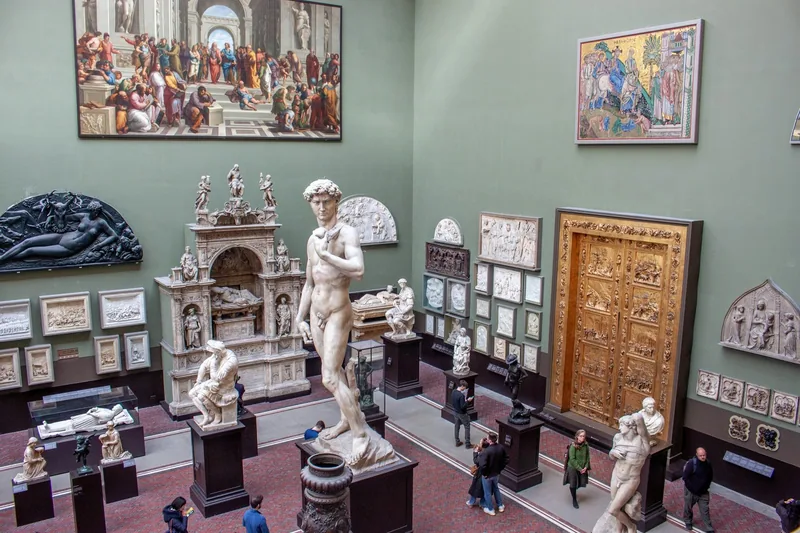
If you see only one part of the V&A, make it the Cast Courts (Rooms 46a and 46b) on the ground floor. These two enormous halls were purpose-built in 1873 to show full-size copies of famous sculpture and architecture, made in plaster so that people who could not travel could study them in London. The museum notes that many similar collections in other European museums have since been destroyed or dispersed, which makes this one rare.
Two objects dominate. Trajan's Column, a plaster copy of the Roman monument that stands in Rome, is so tall that it had to be displayed in two halves; the museum calls it the biggest object in its collection, with 155 scenes of battles fought between AD 101 and 106 winding around it. Nearby stands a full-size plaster cast of Michelangelo's David, made in Florence in the 1850s and sent to Queen Victoria as a gift. The courts were restored in 2018, and the painted walls and mosaic floor are worth a look too.
Stand at the far end of the Cast Courts for the scale. The two halves of Trajan's Column only make sense from a distance, so walk to the opposite side of the court before you go close to the carvings. Look down too: the mosaic floor of the central gallery was made in the 1870s by women prisoners at Woking, and staff nicknamed it Opus Criminale.
Where to start: the rooms worth seeing first
The V&A is not arranged as one long route. Galleries are grouped by material (ceramics, glass, silver, textiles), by place (China, Japan, the Islamic Middle East) and by period (medieval and Renaissance, Europe 1600-1815). A good first visit picks a handful of spaces and accepts that the rest can wait.
Raphael Cartoons
Seven huge designs for tapestries, painted by Raphael and commissioned in 1515 by Pope Leo X for the Sistine Chapel in the Vatican. They show the lives of Saint Peter and Saint Paul. The Cartoons have been on loan to the museum from the monarch since 1865, and the V&A calls them one of the greatest treasures of the Renaissance.
Medieval and Renaissance galleries
Room 50a is laid out like a Renaissance courtyard, full of sculpture, with a 15th-century octagonal fountain from Padua guarded by four lions. It is one of the calmest spaces in the museum.
Japan, China and the Islamic Middle East
On the ground floor, the Japan gallery (Room 45) shows samurai armour and a carved wooden Bugaku mask, the China gallery (Room 44) has an imperial throne carved with dragons, bats and fish, and the Islamic Middle East gallery (Room 42) displays a mosque lamp made in Egypt around 1320-30.
Europe 1600-1815
These galleries on level -1 show the rooms, objects and fashions of the 17th and 18th centuries, including a portrait of Marie Antoinette and an interactive film that takes you into a Venetian carnival.
The Ceramic Staircase
Completed in 1869, it is one of the most richly decorated parts of the Victorian building, with painted tiles on the ceiling and shiny ceramic reliefs. At the time of writing only the level 0 part is accessible.
The museum publishes free self-guided trails, including one on its architecture and one for families, on its website; they are a good way to give a first visit some shape.
Fashion at the V&A in 2026: what is open and what is not
The V&A is famous for its dress collection, and many visitors come for it. However, the Fashion Gallery (Room 40), the domed gallery where historic dress used to be shown, is closed for redevelopment and will reopen in autumn 2028.
The permanent Fashion Gallery stays shut until autumn 2028. Room 40 is closed for redevelopment. If fashion is the reason for your visit, look at the current exhibitions and free displays instead, and check the official closures list before you travel.
There are still ways to see fashion at the museum this autumn. The paid exhibition Schiaparelli: Fashion Becomes Art runs until 8 November 2026, with tickets at £28 on weekdays and £30 at weekends (September 2026). From 21 September 2026 a free display, The Burberry Trench: Crafting an Icon, looks at the famous coat. Later in the season come Constantinople to Istanbul (from 7 November 2026) and, in spring 2027, Punk to Pop. Check the official What's On page for current dates and prices.
A couple visiting Schiaparelli on a Saturday pays £60 for two exhibition tickets; the rest of the museum costs nothing. Other paid exhibitions running this autumn include The Music is Black: A British Story and Rising Voices: Contemporary Art from Asia, Australia and the Pacific (£17), both until 10 January 2027.
The garden, the cafés and the historic refreshment rooms
The John Madejski Garden is the courtyard at the heart of the building, open 10:00-17:00 (staff begin closing it from 16:40). The terracotta and mosaic decoration of the buildings around it took nearly 50 years to complete. It is a good place to rest, and you may eat a packed lunch here, in the Exhibition Road Courtyard or in the Learning Centre lunchrooms outside school visiting hours.
In summer the pond in the garden is normally used for paddling. In September 2026, however, the museum says the pond is closed until further notice because of the Thames Water hosepipe ban.
The Main Café is on the north side of the garden, in the museum's original Victorian refreshment rooms, three richly decorated rooms that are an attraction in their own right. The museum lists these opening times:
| Place to eat | Normal hours | Friday |
|---|---|---|
| Main Café | 10:00-17:00 | 10:00-21:00 |
| Patisserie | 10:00-17:00 | 10:00-19:00 |
| Garden Café | 11:00-15:30 | 11:00-15:30 |
A packed lunch in the V&A garden costs nothing. The museum allows picnics in the John Madejski Garden, and bottled water is permitted in the galleries. Buy a coffee or a cake from the Garden Café if you want one and bring the rest from a supermarket on the way.
Bags, cloakrooms and access
Luggage with wheels, and any bag larger than 56 x 45 x 21 cm (a typical cabin bag), is not allowed in the galleries. Cloakrooms at both the Cromwell Road and Exhibition Road entrances are open 10:00-17:30 (Fridays to 21:30) and charge per item: £3 for coats, small bags, umbrellas and children's scooters, £5 for a cabin bag and £7 for larger bags, folding bikes and adult scooters. E-bikes, e-scooters and drones are not allowed anywhere on the premises. Bags may be searched. If you are between hotels, our left-luggage guide lists alternatives.
Both main entrances are step-free and wheelchair accessible, and there are 13 accessible toilets in the building. South Kensington station is not step-free; the nearest step-free Tube stations are Knightsbridge and Earl's Court. Wheelchairs and walking sticks can be borrowed if you apply at least 24 hours ahead. Our guide to step-free journeys on London transport helps with the route.
Friday Lates and quieter times
On Fridays the museum stays open until 22:00, although some galleries close after 17:45. On selected Fridays, usually towards the end of the month, the V&A runs a Friday Late with events, talks and music; the museum advises checking with staff to confirm the date. Our comparison of evening openings at London museums shows how it fits with other late events.
Weekday mornings are usually the calmest time, especially outside school holidays. Staff begin clearing the galleries 30 minutes before closing, so do not arrive at 17:00 expecting a full visit. The Simon Sainsbury Gallery (Room 64b) is closed from 21 to 23 September and from 1 to 7 October 2026 for maintenance.
Getting there and what is nearby
South Kensington station (Piccadilly, District and Circle lines) is five minutes' walk, and Gloucester Road ten. The museum warns that planned Piccadilly line upgrades in 2026 and 2027 may disrupt journeys, so check before you travel. Bike hire is available on Exhibition Road and at Thurloe Place, and several bus routes stop nearby.
The V&A stands opposite the Natural History Museum and a short walk from the Science Museum; adults interested in design often pair the V&A with one of them. See our guide to South Kensington for the rest of the area. Harrods is about 15 minutes' walk east along Brompton Road, and Hyde Park and Kensington Gardens lie to the north.
The other V&A sites: Young V&A and V&A East
The V&A has three more free sites in London. Young V&A in Bethnal Green, east London, is a museum of design for children and families, open daily 10:00-17:45. In Stratford, V&A East Museum opened on 18 April 2026 on the East Bank of the Olympic Park, and the V&A East Storehouse, opened on 31 May 2025, lets you walk among open shelves of the stored collection. Both are free and open daily 10:00-18:00, until 22:00 on Thursdays and Saturdays. Our guide to the Olympic Park today explains how to combine them with the rest of the park.
For more free culture across the city, see our list of free museums in London, or browse the full museums and galleries section.
Frequently asked questions
Is the V&A free to visit?
Yes. General admission to V&A South Kensington is free and you do not need to book. Some special exhibitions and events have a charge, such as Schiaparelli: Fashion Becomes Art, which costs £28 on weekdays and £30 at weekends until 8 November 2026.
Is the fashion gallery at the V&A open?
No. The permanent Fashion Gallery (Room 40) is closed for redevelopment and will reopen in autumn 2028. In autumn 2026 you can see fashion in the paid Schiaparelli exhibition and a free display about the Burberry trench coat from 21 September 2026.
How long do you need at the V&A?
Two to three hours is enough for the Cast Courts, the Raphael Cartoons, a few galleries and a break in the garden. The building is very large, so choose a small number of rooms rather than trying to see everything in one visit.
Can you eat your own food at the V&A?
Yes. The museum allows packed lunches in the John Madejski Garden, the Exhibition Road Courtyard and the Learning Centre lunchrooms outside school visiting hours. Bottled water may be carried in the galleries, but other eating and drinking should stay in these areas.
Is the V&A open late?
Every Friday the museum is open until 22:00, although some galleries close after 17:45. On selected Fridays, usually towards the end of the month, there is also a Friday Late with special events.
Sources
- V&A - Plan your visit to V&A South Kensington (hours, closures, cloakrooms, cafés, garden) (checked September 2026)
- V&A - What's On (exhibitions and displays) (checked September 2026)
- V&A - Trail: Architectural wonders (checked September 2026)
- V&A - Trail: Explore as a family (checked September 2026)
- V&A - Raphael Cartoons (checked September 2026)
- V&A - Visit V&A East Museum (checked September 2026)