
London Museum tells the story of the city itself, from Roman settlement to the present day, and entry to its permanent galleries is free. The old museum at London Wall closed in December 2022; the new main museum opens in Smithfield's restored General Market on 28 November 2026, and until then London Museum Docklands at Canary Wharf is the only site you can visit.
Most big London museums collect the world. This one collects London: its archaeology, its fashion, its disasters, its protests and its ordinary daily life. Until 2024 it was called the Museum of London, and many maps, guidebooks and taxi drivers still use that name. It is the same organisation, now known simply as London Museum.
For a visitor in autumn 2026 the practical question is timing. If you are in London before 28 November, you can see the Docklands branch, which covers the river, the port and the people who worked there. From 28 November the much larger museum in the City of London opens its doors, and it will almost certainly be one of the busiest new attractions of the winter.
London Museum: key facts for 2026
- New main museum
- General Market, Smithfield, London EC1 9AG. Opens 28 November 2026, with free galleries
- Open now
- London Museum Docklands, No. 1 Warehouse, West India Quay, London E14 4AL
- Docklands hours
- 10:00-17:00 every day; galleries start clearing 20 minutes before closing
- Docklands price
- Free, no need to book; some exhibitions, events and the Mudlarks family gallery are ticketed
- Docklands stations
- West India Quay (DLR), about 3 minutes; Canary Wharf, about 7 minutes
- Smithfield stations
- Farringdon (Elizabeth line, Thameslink and Underground), a few minutes' walk
- Old London Wall site
- Closed to the public since December 2022
From London Wall to the Smithfield markets
The museum's roots go back a long way. The Guildhall Museum opened in the City in 1826, with a strong focus on archaeology, and a separate London Museum opened at Kensington Palace in 1912. The two were combined as the Museum of London, which Queen Elizabeth II opened in 1976 in a purpose-built concrete building at 150 London Wall, next to the Barbican.
That building served for more than 45 years, but it was hard to find, set above a busy road junction and reached by walkways. In December 2022 it closed so that the collection could be moved to a new home. The London Wall building is now used only for venue hire, so do not follow an old guidebook there expecting galleries.
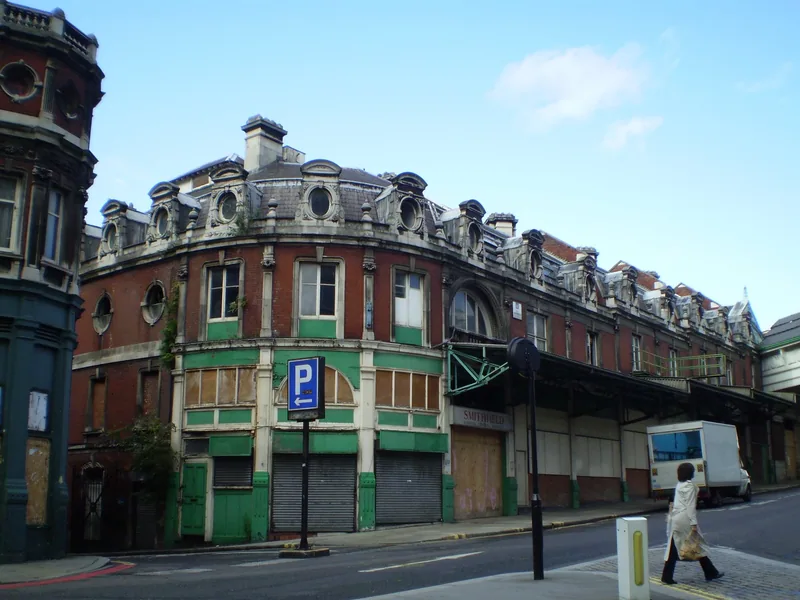
The new home is a pair of Victorian and post-war market halls at Smithfield, on the north-west edge of the City. The museum describes the project as costing £437 million, paid for through a partnership between the City of London Corporation, the Mayor of London and a range of donors. The opening date, 28 November 2026, also marks the museum's 50th anniversary at its old site.
What will be inside the new museum at Smithfield
The museum has published a clear outline of the opening displays. They are spread across three linked spaces, which it calls Real Time, Our Time and Past Time. The idea is that you begin with the city today and work backwards, rather than starting with flint tools and walking forward through the centuries.
- Real Time is the entrance area, with large animated screens that tell the story of present-day London through data. Banksy's Piranhas sentry box is shown here.
- Our Time sits under the restored dome of the market and holds 13 large installations rooted in living memory, including the Lord Mayor's Coach and Syd's Coffee Stall, a well-known East End street stall. It also doubles as a social space with events from day into night.
- Past Time is below ground, in vaults at the level of the Roman streets. This is the long history: prehistory, Roman London, the Great Fire, the Blitz and more recent milestones such as the 2012 Olympic and Paralympic Games.
Objects the museum has named as highlights
Some of the objects announced for the opening give a good sense of the museum's range. In the Goldsmiths' Gallery the Cheapside Hoard, a buried stash of Elizabethan and Jacobean jewellery, takes centre stage. Roman writing tablets preserve some of the earliest surviving words written in London, and a Roman floor mosaic and a painted wall fresco go on show for the first time.
The darker side of the city is there too, with a display on the Great Fire of 1666 and, yes, a chunk of the Whitechapel Fatberg, the solid mass of fat and waste pulled out of the sewers. Among the personal objects are Queen Victoria's mourning dress, a chair that belonged to Charles Dickens, the vest believed to have been worn by Charles I at his execution, Tom Daley's diving trunks from the 2012 Games, Anna Pavlova's Dying Swan costume and a smashed bass guitar lent by Paul Simonon of The Clash. The museum's suffragette collection, including Emmeline Pankhurst's hunger strike medal, will also be on display.
The window onto the Thameslink line
The most unusual feature is in the old salt store below ground. A six-metre viewing window looks straight onto the working railway, so you can watch Thameslink trains pass through while passengers look back at you. The museum calls it a world first, and the space was once a goods depot of the Great Northern Railway.
The market buildings themselves
Even without the collection, the building is worth a look. The General Market opened in 1883 and was designed by Sir Horace Jones, the City architect who also designed Tower Bridge and Leadenhall Market. It traded for more than a century before closing in the 1990s, and it stood empty and decaying for over 30 years.
The restoration was led by the architects Stanton Williams and Asif Khan, with conservation architects Julian Harrap. The museum says around 10,000 square metres of brickwork were cleaned and a network of forgotten vaults was dug out. Next door, the 1960s Poultry Market will open in 2028 with two temporary exhibition spaces, a learning centre and a collection store, so the site will keep growing after the 2026 opening.
Smithfield has been a place of trade, execution and fairs for almost a thousand years. The meat market that gave the area its modern reputation still operates in the neighbouring buildings, so do not be surprised by early-morning lorries. The streets around it are part of the historic City of London, with old churches and narrow lanes worth a slow walk.
Opening week at Smithfield may need planning. The museum had not published day-to-day opening hours or entry arrangements for the new site when we checked in September 2026. A free museum opening on a Saturday in late November is likely to draw crowds, so check the official London Museum website shortly before you go to see whether timed entry tickets are being used.
Visiting London Museum Docklands now
The Docklands branch opened in 2003 in a Grade I listed warehouse on West India Quay, a short walk from the towers of Canary Wharf. It is free, open every day from 10:00 to 17:00, and there is no need to book. The museum suggests allowing at least an hour, and we would allow two if you like reading labels.
There are nine free galleries, and each deals with a different period or theme of the port's history:
| Gallery | What it covers |
|---|---|
| No. 1 Warehouse | The story of the building itself, one of the few survivors of the old docks |
| Trade Expansion: 1600-1800 | Merchants, sailors and pirates as London grew into a trading port |
| London, Sugar & Slavery: 1600-present | London's role in the transatlantic slave trade and its legacy |
| City and River: 1800-1840 | New docks, bridges and tunnels that changed the city |
| Sailortown: 1840-1850 | A walk-through recreation of a Victorian street in Wapping |
| First Port of Empire: 1840-1880 | London at the centre of world trade |
| Warehouse of the World: 1880-1939 | The docks at their busiest |
| Docklands at War: 1939-1945 | The Blitz and the war effort, from Dunkirk to D-Day |
| New Port, New City: 1945-present | Decline, dereliction and the rebuilding that created Canary Wharf |
Sailortown is the part most visitors remember: dim lighting, narrow alleys and the sounds of a riverside street in the 1840s. The sugar and slavery gallery is serious and well researched, and it explains why so much of London's wealth passed through these very warehouses. The café on the ground floor is open 10:00-16:00 and the shop 10:00-17:00.
Mudlarks for younger children
Mudlarks is the family gallery, named after the people who searched the Thames mud for things to sell. General admission to the museum is unticketed, but the museum recommends booking Mudlarks online in advance to guarantee entry, as it has its own tickets. Check the current price and session times on the ticketing information page. For more ideas, our guide to London with children lists museums that work well for different ages.
Getting to each site
Docklands. West India Quay station on the DLR is about three minutes away, and Canary Wharf is about seven minutes on foot. Canary Wharf is served by the Jubilee line, the DLR and the Elizabeth line, so it is easy to reach from central London. All DLR stations are step-free from street to train; our page on the DLR and the Overground explains how the network fits together. A slower, more scenic option is the Uber Boat to Canary Wharf pier; see our guide to the Thames river bus for fares, which are not included in the daily cap.
Smithfield. The museum points visitors to Farringdon, a few minutes' walk away, where the Elizabeth line, Thameslink and the Circle, Hammersmith & City and Metropolitan lines all meet. Barbican station is also close. If you are staying in the West End or near Paddington or Heathrow, the Elizabeth line is the quickest way to reach Farringdon. Both sites are within the pay as you go daily cap for Zones 1-2, which is £8.90 in September 2026.
Combining a visit with nearby sights
The two sites suit very different days out.
Around Smithfield. St Paul's Cathedral is roughly a ten-minute walk south, and the church of St Bartholomew the Great, one of the oldest in London, is on the edge of the market. The area has some of the City's most atmospheric old taverns; our round-up of historic London pubs covers several nearby. If you want another big free museum on the same day, the British Museum in Bloomsbury is a short Tube or bus ride away.
Around Docklands. The museum sits in the middle of Canary Wharf, where glass office towers stand around old dock basins, with shopping malls underneath and plenty of places to eat. From here, Greenwich is a short DLR ride south, so you could pair the museum with the Royal Observatory and the Cutty Sark for a full maritime day. The Observatory closes on 2 November 2026 for a major transformation and its Meridian Courtyard is due to reopen in summer 2027, so after that date swap it for the free National Maritime Museum and the Queen's House.
Docklands is the quiet alternative on a wet weekend. The big South Kensington museums fill up fast when it rains. The Docklands branch is free, rarely crowded and a short DLR ride from Greenwich, which makes it an easy choice for a rainy day in London.
Is London Museum worth your time?
If you are curious about how London became the city it is, yes. The British Museum and the V&A tell you about the world; this museum tells you about the streets you are walking through, and it does so without charging for entry. First-time visitors with only a couple of days may prefer the headline national museums, but anyone on a second or longer trip will get a lot from it.
The Docklands branch is best for people interested in ships, trade, the slave trade or the Second World War, and for families with young children. The new Smithfield museum will have much wider appeal and, based on what has been announced, will be the one to see from 28 November. It is one of many museums in the city that cost nothing to enter; see our list of London's free museums for others, or browse the full museums and galleries section.
Frequently asked questions
Is the Museum of London still open at London Wall?
No. The museum at 150 London Wall closed in December 2022 and the building is now used only for venue hire. The museum changed its name to London Museum in 2024. Its new main site at Smithfield opens on 28 November 2026, and London Museum Docklands is open in the meantime.
When does the new London Museum at Smithfield open?
The new museum in the restored General Market at Smithfield opens on 28 November 2026. The permanent galleries are free. The neighbouring Poultry Market building, with temporary exhibitions and a learning centre, is due to open later, in 2028.
Is London Museum free?
Yes, the permanent galleries are free at both sites. At Docklands you do not need to book general admission. Some temporary exhibitions, events and the Mudlarks family gallery have their own tickets, so check the official website for those.
How do I get to London Museum Docklands?
Take the DLR to West India Quay, about three minutes' walk, or go to Canary Wharf on the Jubilee line or Elizabeth line and walk about seven minutes. The museum is in No. 1 Warehouse, West India Quay, London E14 4AL, and opens daily from 10:00 to 17:00.
How long should I spend at London Museum Docklands?
The museum recommends at least an hour. Two hours is more comfortable if you want to walk through Sailortown, read the sugar and slavery gallery properly and stop at the café. Families using the Mudlarks gallery may want longer.
Sources
- London Museum - London Museum in Smithfield opens 28 November (checked September 2026)
- London Museum - About London Museum (checked September 2026)
- London Museum - Our locations (checked September 2026)
- London Museum - Our history (checked September 2026)
- London Museum - Plan your visit to London Museum Docklands (checked September 2026)
- London Museum - Ticketing info (checked September 2026)
- Transport for London - Capping (checked September 2026)