
The Royal Courts of Justice is the vast Gothic building on the Strand where England's most senior civil courts sit. Anyone can walk in, go through airport-style security and sit at the back of a real case, free of charge. It is open Monday to Friday, 9am to 4.30pm, and no ticket or booking is needed.
This is not a tourist attraction dressed up as a court. It is a working building where the High Court, the Court of Appeal and other civil jurisdictions hear cases every weekday, and the people in the corridors are lawyers, litigants and journalists. What makes it open to you is the principle of open justice: as HM Courts & Tribunals Service puts it, hearings in England and Wales usually take place in public, so you can observe whether you are a journalist, an academic or a member of the public.
It is also one of the most interesting free hours in central London and almost nobody does it. Our guide to free things to do in London lists the usual candidates; this one needs a little more nerve and a little more preparation.
Visiting the Royal Courts of Justice
- Address
- Strand, London WC2A 2LL
- Open
- Monday to Friday, 9am–4.30pm; closed at weekends and on bank holidays
- Cost
- Free; no booking
- What sits here
- Court of Appeal, High Court, civil and bankruptcy business
- Security
- Everyone and every bag is searched; there is a security archway
- Cafeteria
- Open to the public, Monday to Friday 9am–3pm
- Facilities
- Lifts to all floors, public toilets, wi-fi, a quiet room for prayer or contemplation
- General enquiries
- 020 7947 6000, answered 9am–5pm
What you may and may not do
The rules are short and they are not negotiable.
- You may sit in the public seating in most courtrooms and listen for as long as you like. You may come and go, though it is polite to enter and leave between items rather than in the middle of an argument.
- You may take a notebook and write. You may take your phone in.
- You may not record, broadcast or photograph any hearing, by any means, in any court in England and Wales. This is the one rule that matters most, and breaking it is a serious matter.
- The judge decides how each hearing is held. If a judge decides it is necessary for the proper administration of justice, the hearing can be held in private with no observers at all.
Note the distinction between having a phone and using it. Phones are allowed into the building; taking a picture of proceedings is not. Our guide to photography rules in London covers the wider position on filming in public buildings.
Family cases are the main thing you cannot watch. Hearings in the Family Court and the Family Division of the High Court are held in private. Accredited journalists and legal bloggers may attend, subject to the judge's power to exclude them, and even then may not report what was said without the court's permission. Court of Protection hearings, by contrast, are normally in public, though the court can sit in private.
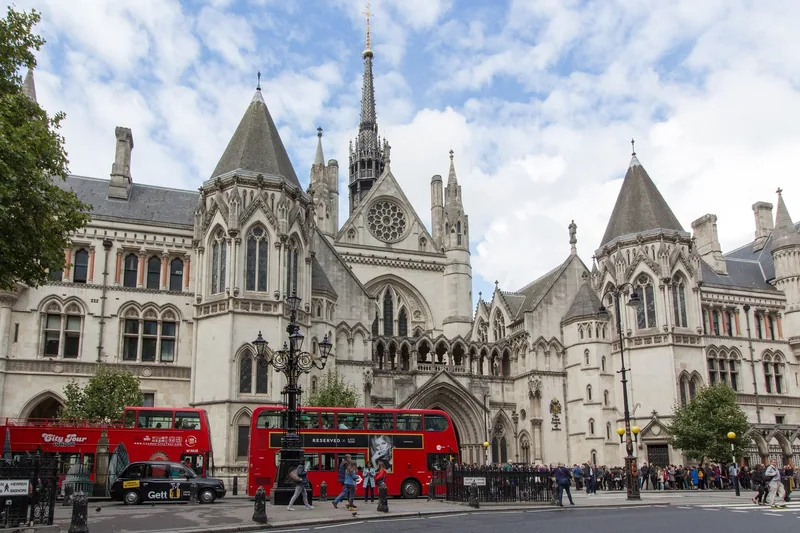
Photo: The wub · CC BY-SA 4.0 · Wikimedia Commons · resized
Getting through security
The search is like an airport, and the official guidance says to allow extra time because there is often a queue between 9am and 10am on weekdays. Expect to empty your pockets into a tray, to be asked to take off your shoes, coat, gloves or hat, possibly to open your belt, and to walk through an archway detector followed by a hand search or a handheld scanner.
If you wear a head covering for religious or cultural reasons, you can ask for it to be checked with a handheld scanner instead of removing it. If you have a pacemaker, tell the security team on arrival so they can make other arrangements.
The list of things you cannot bring in is longer than people expect. Alongside the obvious weapons, it includes scissors, penknives, razors, knitting needles, darts, glass bottles, metal cutlery, syringes without a prescription, tools, ropes and chains, alcohol, toy guns, crash helmets and full-length umbrellas. Liquids that are not drinks or prescription medicine, such as perfume, oils and lighter refills, are also refused, and e-bikes and e-scooters cannot come into the building at all.
Drinks are allowed if they are unopened cartons or cans, or in a bottle, flask or cup with a lid and not made of glass; you may be asked to take a sip to show it is harmless. Prescription medicines are fine with the pharmacist's label showing your name and the date.
Items you cannot bring in are kept for you, with one exception. Security will hold the item and give you a receipt to collect it on the way out. A knife is not returned: you have to write to the court within 28 days with your name, address, the date and time it was taken, a description and the receipt number, and you may need photo identification when it is delivered. Leave anything doubtful at your hotel.
Finding a case worth watching
Do not just wander in and open doors. There are two reliable ways to see what is on.
The first is the court and tribunal hearings service on GOV.UK, which publishes listings for the Royal Courts of Justice and the Rolls Building along with other courts. Lists are free for the public, though some require registration. The second is simpler: court and tribunal buildings display their hearing lists in the public waiting areas, so you can read the boards when you arrive.
Some lists are also published on GOV.UK for specific courts, including the Court of Appeal Criminal Division's fixed hearings, the Commercial Court, the King's Bench trial dates and the Chancery Division's trial windows. If the list for a particular court is not published, HMCTS says to contact that court directly.
For a first visit, the Court of Appeal Civil Division is often the most rewarding: three judges, barristers arguing points of law, and no witnesses, so you are dropped into an argument rather than a procedural morning. If you cannot get to the Strand at all, the Court of Appeal Civil Division, the Supreme Court and the Competition Appeal Tribunal stream some hearings online.
What it is like inside
The building is enormous and easy to get lost in, with a great hall, stone staircases and long corridors of courtrooms behind heavy doors. Lifts run to all floors and there are public toilets throughout, which is more than can be said for most of the Strand.
Courtrooms vary from panelled Victorian rooms to plain modern ones. The public seats are at the back, usually behind the lawyers. Nobody will explain what is happening, so pick a case with a subject you can follow rather than the most famous name on the list.
Behaviour matters more than dress. There is no dress code, but you should stay quiet, turn your phone to silent, stand when the judge enters and leaves, and follow what everyone else does. Our guide to British etiquette for visitors covers the wider habits; in a courtroom, the safe approach is to copy the people around you.
Practical facilities
The cafeteria is open to the public from 9am to 3pm on weekdays, and there are places to eat immediately outside on the Strand and in the side streets towards Lincoln's Inn. Baby-changing facilities are in the accessible toilets on the ground floor of the Queen's Building. A quiet room is available for prayer or contemplation; ask at the main reception desk or the security team.
Wi-fi is available throughout the building, with notices explaining how to connect; see free wi-fi in London for the wider picture. Hearing enhancement is available and mobile loops can be obtained through the listing offices. The building supports the Hidden Disabilities Sunflower scheme and lanyards are available on request.
Assistance dogs are welcome. Parking on site is limited to disabled access only and must be arranged in advance through the Disability Contact Office; visitors who need help entering the building can contact the security team on 020 7947 6260 beforehand.
Ignore anyone who telephones demanding a court payment. HMCTS warns that scammers copy genuine court phone numbers and email addresses and demand money, sometimes claiming to be from HMRC or enforcement officers. If you are unsure, pay nothing and report it to Action Fraud. Our guide to common tourist scams covers the ones aimed at visitors.
Getting there, and what else is nearby
The Royal Courts stand on the Strand where it becomes Fleet Street, at the boundary of the City of London. Temple station, on the Circle and District lines, is the closest; Chancery Lane on the Central line and Holborn on the Central and Piccadilly lines are each a short walk north. Charing Cross and Blackfriars are the nearest main rail stations. See our Underground guide for the lines.
Five minutes west is Somerset House, whose courtyard is free and open until 11pm. Ten minutes north is Sir John Soane's Museum on Lincoln's Inn Fields, which is also free. The Inns of Court between them are quiet, walkable and largely unvisited, and several of the places in our guide to London's historic pubs are within five minutes of the building.
If watching public institutions at work appeals, the other free option is Parliament: anyone, including overseas visitors, can watch debates and committee hearings in both Houses free of charge, with Prime Minister's Questions at noon on Wednesdays. See Houses of Parliament tours for how that works and what the paid tours cost.
Both are indoor, free and unaffected by weather, which makes them useful on a bad day; see what to do in London on a rainy day. Covent Garden is ten minutes west for lunch, and Trafalgar Square fifteen.
Frequently asked questions
Can anyone watch a court case at the Royal Courts of Justice?
Yes. Hearings in England and Wales usually take place in public, and HMCTS states that you can observe them whether you are a journalist, an academic or a member of the public. It is free and no booking is needed. A judge can decide to hold a particular hearing in private.
Do you need a ticket for the Royal Courts of Justice?
No. Entry is free and there is no ticket or timed slot. The building is open Monday to Friday from 9am to 4.30pm and closed at weekends. Everyone is searched on entry, and there is often a queue between 9am and 10am.
Which cases can you not watch?
Family Court and Family Division hearings are held in private; accredited journalists and legal bloggers may attend subject to the judge's power to exclude them, and cannot report what is said without permission. Any judge may also direct that a hearing is held in private if it is necessary for the administration of justice.
Can you take photos in the Royal Courts of Justice?
No. You cannot record, broadcast or photograph any hearing, however you are observing it. Phones and cameras may be brought into the building but must not be used for that purpose. Photographs of the exterior from the street are a different matter.
What can you not take into a court building?
Weapons of any kind, plus blades such as scissors, penknives and razors, sharp items such as knitting needles and darts, glass, metal cutlery, syringes without a prescription, tools, ropes and chains, alcohol, toy guns, crash helmets, full-length umbrellas and liquids that are not drinks or prescription medicine. E-bikes and e-scooters are not allowed in the building.
Sources
- GOV.UK - Observe a court or tribunal hearing (checked September 2026)
- GOV.UK - Going through security at a court or tribunal building (checked September 2026)
- HMCTS - Royal Courts of Justice (checked September 2026)
- GOV.UK - HMCTS hearing lists (checked September 2026)
- Courts and Tribunals Judiciary - The Family Division and the Family Court (checked September 2026)
- Courts and Tribunals Judiciary - Court of Protection (checked September 2026)