
The Monument is a stone column in the City of London built to commemorate the Great Fire of 1666. You climb 311 spiral steps to a viewing platform about 48 metres up, it costs £7 for an adult, and everyone who makes it to the top is given a certificate on the way out.
It stands 202 feet high, which is also the distance from its base to the bakery on Pudding Lane where the fire started in September 1666 and burned for four days. Robert Hooke designed it in consultation with Sir Christopher Wren: a fluted Doric column of Portland stone with a golden orb on top. Building began in 1671 and took six years. It is listed Grade I, the highest designation there is.
For £7 it is the cheapest serious view in central London, and the most physically demanding. There is no lift, no re-entry and no way to see anything without climbing. If that rules you out, our guide to the best free viewpoints in London has level alternatives a few minutes away.
The Monument at a glance
- Adult ticket
- £7.00 (ages 16 and over)
- Child 5–15
- £3.50; under-5s free; children under 16 must be with an adult
- Concessions
- £5.30 for students, over-65s and disabled adults; £2.60 disabled child; one companion free
- Opening hours
- Daily 9.30am–1pm and 2pm–6pm; last entry 12.30pm and 5.30pm
- Closed
- 24–26 December; opens at 10am on 1 January
- Steps
- 311, spiral, no lift
- Buying tickets
- At the ticket office, on the day. Prices held until 31 March 2027
- Address
- Fish Street Hill, London EC3R 8AH
The lunch break most visitors do not expect
The Monument closes in the middle of the day. It opens at 9.30am, shuts at 1pm with last entry at 12.30pm, reopens at 2pm and closes at 6pm with last entry at 5.30pm. People arriving at 1.15pm on a sunny afternoon find a locked door.
There is a second timing trap. During term time the column is busy with school groups on Monday to Thursday mornings between 10am and 11.30am, and the official advice is blunt: this may prevent ordinary admission during that period. If you cannot queue for long, avoid that window entirely.
That leaves two good slots. Between 11.30am and 12.30pm on a weekday, once the school groups have gone, or the last hour of the afternoon, when the light is better and the City has emptied out. The Monument limits how many people are inside at once, so at busy times you may wait at the bottom while others come down.
Tickets are sold at the column itself, on the day. The official ticketing page says tickets are available for purchase at the attraction on the day of the visit, and the ticket terms describe the same arrangement. Do not go looking for a timed slot to book in advance, and do not pay a third party for one. The current prices are published on the Monument’s own ticket page.
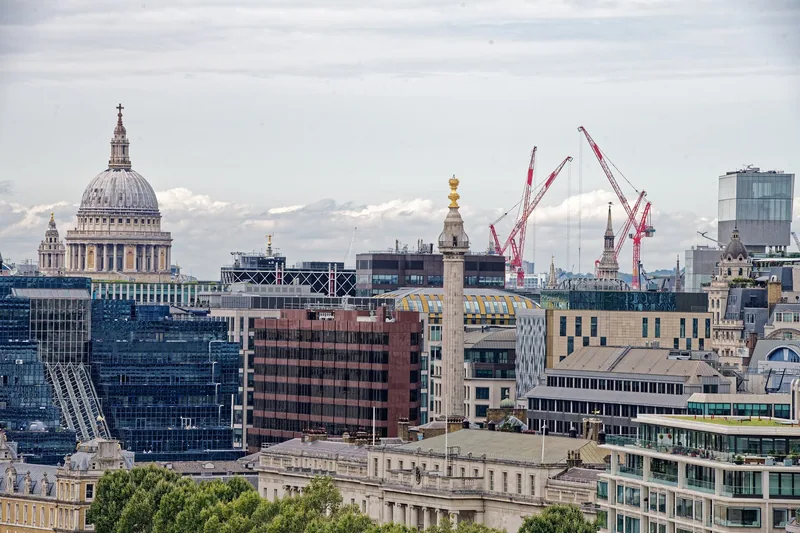
Photo: Tilman2007 · CC BY-SA 4.0 · Wikimedia Commons · resized
What the joint ticket with Tower Bridge is worth
A combined Monument and Tower Bridge ticket is widely mentioned by other guides. When we checked both official websites in September 2026, neither the Monument's own ticket page nor Tower Bridge's own pages listed one, and the Monument's full ticket terms describe only single-attraction tickets bought at its ticket office.
So budget for two separate tickets: £7 at the Monument and £18 for an adult at Tower Bridge. If a joint ticket has returned by the time you visit, the Monument's ticket office is the place to ask. We would rather tell you this than print a price we could not confirm.
The climb itself
The staircase is a stone spiral, narrow in places, that winds up inside the column with a handrail on the outer wall. Most reasonably fit adults manage it in five to ten minutes with a pause. There is nowhere to sit on the way up, and people are coming down past you the whole time.
The viewing platform sits about 48.7 metres above the street, behind a metal cage. The cage means the view is good but the photographs are compromised: you will be shooting through metal mesh. Bring a phone rather than a camera with a large lens, and accept the mesh rather than fighting it.
What you see is the City at close range rather than a panorama over London. The river and London Bridge are directly south, the Shard fills the skyline across the water, and the towers of the City crowd in from the north. Because the Monument is now so much lower than its neighbours, the view is of buildings rather than over them, which some visitors find disappointing and others find more interesting.
The certificate is not a souvenir shop upsell. The Monument states that everyone who makes the climb is given a certificate to mark the occasion, and it is included. Children treat it as the point of the whole exercise, which makes the 311 steps considerably easier to negotiate on the way up.
The bag rules, in centimetres
These are stricter than at most London attractions and they are enforced, because the staircase and platform are narrow and the stonework is easily damaged.
- Wheeled suitcases and any bag larger than 45 x 35 x 20 cm cannot come inside the Monument at all.
- Only bags no larger than 35 x 25 x 15 cm may be carried upstairs. Staff may ask you to hold them at your side or on your front so they do not scrape the walls as you pass other visitors.
- Anything between those two sizes must be left in the bag storage area at the bottom of the staircase, at your own risk. Do not leave valuables there.
- There is a 100% search policy: every visitor's bag is searched on arrival, so allow extra time.
Open drink containers that cannot be sealed, including takeaway coffee cups, are on the prohibited list. Finish the coffee outside.
Access: the honest answer
The Monument says directly that, because the top is reached by 311 steps, it is not suitable for people with mobility difficulties or wheelchair users, and that as a historic building its options are limited. There is no partial visit and no viewing gallery at ground level.
Concessionary prices are still set out for disabled visitors at £5.30 for an adult and £2.60 for a child, with one companion free, for those who can make the climb. If the steps are not possible, Sky Garden is free, has lifts and is a four-minute walk away, and our comparison of London's viewing platforms sets out which ones are step-free.
The telescope hidden under the column
The Monument was built with a second purpose that almost nobody notices. Hooke and Wren designed it to double as a scientific instrument: a zenith telescope for gravity and pendulum experiments, connected to a small laboratory beneath the column. The plan was soon abandoned, because the surrounding area was simply too busy.
The carved frieze on the west face of the pedestal, facing Fish Street Hill, is the other thing worth stopping for, and it costs nothing. It is an allegory: the destruction of London on the left, the rebuilding on the right. The seated woman with a sword above a dragon is the City itself, Father Time helps her to her feet, and on the right Charles II, dressed as a Roman emperor, gestures towards a figure of Architecture holding the plans for the new City.
The sculptor was the Dane Caius Gabriel Cibber. He carved it while serving a prison sentence for gambling debts, released during the day to work on the stone and returned to his cell at night.
Getting there, and the Bank connection
Monument station, on the District and Circle lines, is a few steps away and takes its name from the column. Bank station, with the Central, Northern and Waterloo & City lines and the DLR, is about five minutes' walk and is connected to Monument underground, so you can enter at one and leave at the other. Our guide to the Underground explains how that interchange works.
London Bridge, on the Northern and Jubilee lines, is a seven to ten minute walk across London Bridge itself, which is a pleasant approach; see the bridges of London. Cannon Street, Fenchurch Street and Tower Gateway DLR are all within walking distance. Buses 17, 21, 35, 40, 47, 48, 133, 141, 149, 344 and 521 serve the area.
By river, Tower Pier and London Bridge City Pier are each about ten minutes away on foot. By car, the nearest car park is NCP Thames Exchange on Bell Wharf Lane, off Upper Thames Street, about ten minutes' walk, and the whole area sits inside the Congestion Charge zone.
Half a day around the Monument
The Monument is a twenty-minute visit, which makes it a component rather than a destination. The obvious route east takes you past St Dunstan in the East, the bombed church now used as a public garden, and on to the Tower of London and Tower Bridge.
North takes you into the financial district: Leadenhall Market is about four minutes away, the cluster of towers covered in our guide to the Gherkin and the City's skyscrapers is just beyond, and the free Guildhall Art Gallery and Roman amphitheatre ten minutes further. West is St Paul's Cathedral.
For a cheap day that covers a lot of ground, the Monument at £7, the free viewpoints and the free City museums add up well; see London on a budget and our guide to the City of London.
Frequently asked questions
How much does it cost to climb the Monument?
An adult ticket is £7.00 and a child aged 5 to 15 pays £3.50, with under-5s free. Students, over-65s and disabled adults pay £5.30, a disabled child £2.60, and one companion per disabled visitor goes free. These prices are held until 31 March 2027.
How many steps does the Monument have?
311 spiral stone steps lead to the public viewing platform, which is about 48.7 metres above the street. There is no lift and no alternative route, so the climb is the only way up. Most people take five to ten minutes.
Do you need to book the Monument in advance?
No. Tickets are sold at the ticket office at the Monument on the day of your visit. The number of people inside at any one time is limited, so you may have to wait a short while for others to come down, particularly on weekday mornings in term time.
Is the Monument worth it?
At £7 for an adult, yes, if you can manage the stairs and you want to see the City close up. The view is of the surrounding buildings rather than a wide panorama, and the platform is caged, which spoils photographs. If you want a distant view over London, the Shard or Sky Garden give you that instead.
What time does the Monument close?
It opens 9.30am to 1pm and again from 2pm to 6pm, with last entry at 12.30pm and 5.30pm. It closes entirely for an hour in the middle of the day, which catches people out. It is shut from 24 to 26 December and opens at 10am on 1 January.
Sources
- The Monument - Plan your visit (checked September 2026)
- The Monument - How to buy tickets (checked September 2026)
- The Monument - Ticket terms and conditions (checked September 2026)
- The Monument - About (checked September 2026)
- The Monument - Getting here (checked September 2026)
- The Monument - The Frieze (checked September 2026)
- Tower Bridge - Plan your visit (checked September 2026)