
The National Army Museum in Chelsea is free to enter, including its temporary exhibitions, and opens Tuesday to Sunday from 10am to 5.30pm. Its five galleries cover 350 years of the British Army: how it was formed, what soldiering is actually like, and what the Army did around the world. The children's play floor is the one thing that costs money.
It stands on Royal Hospital Road next to the Royal Hospital Chelsea, home of the Chelsea Pensioners, and it is one of the least-visited free national museums in London. That is partly geography, because Chelsea is a walk from any Tube station, and partly the assumption that a military museum means rows of rifles. It is not that.
Our guide to free museums in London places it among the national collections that charge nothing. This page covers what each gallery actually does, how the paid play sessions work, and why the ticket for a family is not quite free after all.
National Army Museum at a glance
- Address
- Royal Hospital Road, Chelsea, London SW3 4HT
- Open
- Tuesday to Sunday, 10.00 to 17.30. Closed Mondays, and on 24–26 December and 1 January
- Price
- Free, including all temporary exhibitions. No booking needed
- Play Base
- £7.50 per child aged 0–8; adults free. One-hour sessions, booked online or in person
- Café and shop
- Café 10.00–16.00; shop 10.00–17.30; both closed Mondays
- Nearest station
- Sloane Square, a 10-minute walk. Bus 170 stops outside the door
The five galleries, and what each is for
The museum was reorganised around themes rather than a march through the centuries, which is why a visitor who expects a chronological war story can find the first ten minutes disorienting. There is no single route and no numbered order, and the galleries sit on different floors rather than in a line. Once you know the plan, it works well, and you can take the five rooms in whatever order suits the time you have.
Formation explains where the British Army came from: its origins, how it is organised, its regiments and traditions, and the values that have held it together through more than 350 years of unbroken service. Start here if you know nothing about the subject.
Soldier is the gallery most people remember. It follows what it is like to serve, from signing up as a recruit to coming home, told through soldiers' own words and their personal possessions, the small, ordinary things people carried rather than the medals.
Global Role deals with the Army's deployment around the world, from the age of empire to the present day. Much of what is on display was collected by soldiers themselves and reflects their encounters with other cultures, which makes it a gallery about the act of collecting as much as about campaigns. This is the part visitors most often say they did not expect.
Conflict in Europe covers the Army's role on the Continent from the 1700s onwards, and how fighting there shaped what happened in Britain.
Army at Home is the one that is genuinely unusual: the Army's service inside Britain since the 1600s, from national emergencies to the way garrison towns shaped local identity and landscape.
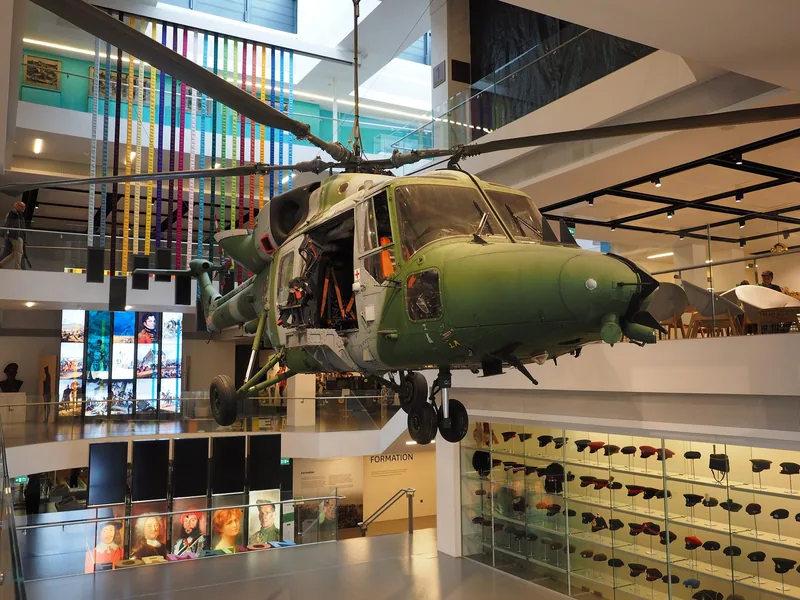
Photo: Nick-D · CC BY-SA 4.0 · Wikimedia Commons · resized
Play Base: the bit that is not free
The short version of this museum (free, with a good play area) is only half right. Play Base, the immersive play space for children aged eight and under, costs £7.50 per child. Accompanying adults go free.
It runs in five one-hour sessions a day: 10.00–11.00, 11.30–12.30, 13.00–14.00, 14.30–15.30 and 16.00–17.00. Tickets are sold online and in the building, with a £1 booking fee per online transaction and no fee if you buy at the desk.
The ratio rules are strict, because capacity is tight. One adult may enter with one child. Two adults may enter with two to four children. A maximum of four children's tickets can be bought per customer per session. If a child needs an extra adult for specialised support, email the museum in advance and they will arrange it.
Inside there is a soft-play assault course, a command liaison vehicle to climb into, a cookhouse with a camp kitchen and mess hall, a quartermaster's store and a fieldcraft area for building dens and shelters. It can also be hired exclusively for up to 30 children on Tuesday to Friday in term time, at £260 a session, with discounts for schools and registered charities.
Two adults cannot take one child into Play Base. The session rules allow one adult with one child, or two adults with two to four children. A couple with a single toddler has to send one parent round the galleries. Book with that in mind.
What a family actually spends
For two adults and two children aged five and seven, a visit costs £15 in Play Base tickets, plus £1 if you book online, and nothing at all for the museum itself. Add lunch in the café and you are at perhaps £45 for a morning, still among the cheapest family days in central London, but not free.
The alternative is to skip Play Base entirely and use the galleries, which are free for everyone and work reasonably well for children from about eight upwards. Our guide to London with kids compares the paid play spaces across the city, and city farms and playgrounds covers the free outdoor options.
Talks, tours and the study centre
The museum runs a programme of gallery tours and talks, some free and some ticketed at around £12.50. Curator-led tours on narrow subjects (military embroidery, the history of the tank) are the sort of thing a national museum does well and nobody knows about. The What's On page is worth a look the week before you visit.
Behind the public galleries sits the Templer Study Centre, the museum's research collection, open Tuesday to Friday from 10.00 to 16.30 and closed at weekends. If you are tracing a relative's service, that is where to start, and it keeps different hours from the museum itself.
Practical details
There is a cloakroom, which is more than most free museums offer, along with accessible toilets, baby changing and feeding areas and free wi-fi throughout. The museum says there is full access to the galleries and a range of services for disabled visitors; see also our guide to accessible London.
The café closes at 4pm, an hour and a half before the museum, which catches out visitors who plan a late coffee. The shop stays open to closing time.
Remember that everything here shuts on Mondays, including the Play Base and the café, and the museum also closes from 24 to 26 December and on 1 January.
Route 170 stops directly outside the museum. That is unusually convenient for a building ten minutes from the nearest Tube, so it is a genuine alternative to walking down the King's Road if the weather is against you.
Getting to Royal Hospital Road
Sloane Square, on the District and Circle lines, is about ten minutes' walk down the King's Road and then left. Victoria is a twenty-minute walk. The 170 bus stops outside the door. The nearest cycle docking station is at Ormonde Gate, and Battersea Power Station Pier is fifteen minutes away on foot, which makes the river bus a scenic approach. Our guide to Uber Boat by Thames Clippers explains the fares.
There is no museum car park, and Chelsea parking is expensive and heavily restricted.
What else is within walking distance
The Royal Hospital Chelsea is next door, and its grounds host the Chelsea Flower Show each May, when this whole area changes character. Five minutes west along the river, the Chelsea Physic Garden is Britain's oldest botanic garden and charges admission. Ten minutes further on, The Carlyles' House opens on Wednesdays only.
Across Chelsea Bridge, Battersea Park has the best playgrounds in the area and Battersea Power Station the shops and restaurants; both are covered in our Battersea and Nine Elms guide. For shopping, see the King's Road, and for the neighbourhood as a whole our Chelsea guide.
If military history is the reason you came, four other collections go further: the free Imperial War Museum in Lambeth, the paid Churchill War Rooms in Westminster, HMS Belfast on the Thames, and the free RAF Museum in north London. On a wet day, see our rainy-day ideas.
How long to allow, and who it suits
Two hours covers the five galleries at a steady pace, and three is comfortable if you stop for lunch or join a tour. Because entry is free and unbooked, it also works as a shorter visit: an hour in Soldier and Global Role on a wet afternoon is a perfectly good use of the museum, and there is no ticket wasted if you leave early.
Go if
- You want a serious national museum without the South Kensington crowds
- You have children aged eight or under and can book a Play Base session
- You are interested in how ordinary soldiers lived rather than in battle strategy
- You are already in Chelsea and want somewhere free to spend two hours
Skip it if
- It is Monday, when the whole building is closed
- You expect vehicles and aircraft in quantity; this is not that kind of collection
- Your children are nine or ten — too old for Play Base, sometimes too young for the galleries
- You are trying to cover central London on foot and cannot spare the walk from Sloane Square
Frequently asked questions
Is the National Army Museum free?
Yes. Entry to all the galleries and to temporary exhibitions is free, and no booking is needed. The only charges are for the Play Base sessions for young children, some ticketed talks and tours, and anything you buy in the café or shop.
How much does Play Base cost?
£7.50 per child aged 0 to 8, with accompanying adults free. Sessions last one hour and there are five a day. Online booking adds a £1 fee per transaction; buying at the desk does not. One adult may bring one child, or two adults may bring two to four children.
Which days is the museum closed?
Every Monday, and 24 to 26 December and 1 January. The Templer Study Centre also closes at weekends, and the café closes at 4pm rather than at the museum's 5.30pm closing time.
Does the museum cover the British Empire?
Yes. The Global Role gallery deals with the Army's deployment around the world from the age of empire to the present, largely through objects that soldiers themselves brought back. It is the gallery visitors most often single out as more searching than they expected.
How do you get to the National Army Museum?
Sloane Square Tube station is a ten-minute walk and Victoria a twenty-minute one. The 170 bus stops directly outside. Battersea Power Station Pier is fifteen minutes away for anyone arriving by river bus, and there is a cycle docking station at Ormonde Gate.
Sources
- National Army Museum - Plan your visit (checked September 2026)
- National Army Museum - Galleries (checked September 2026)
- National Army Museum - Play Base (checked September 2026)
- National Army Museum - Facilities (checked September 2026)