
The District line is green and the Circle line is yellow, they share track and trains across most of central London, and between them they are the easiest pair on the Underground to board in the wrong direction. The District has one eastern end and five western ones. The Circle has not been a circle since 2009: it is a spiral that starts at Hammersmith, goes round the loop once and stops at Edgware Road.
The good news first. These are sub-surface lines, dug in shallow cuttings in the 1860s rather than bored deep, so the tunnels are wide, the trains are air-conditioned and you see daylight for long stretches. If you are going somewhere both lines reach, take one of these in preference to a deep line in summer. The network basics, the map and the fares are in our guide to using the Underground; this page is about the two lines and their traps.
The two lines side by side
- District line stations
- 60, more than any other Underground line
- District line ends
- Upminster in the east; Ealing Broadway, Richmond, Wimbledon, Kensington (Olympia) and Edgware Road in the west
- Circle line stations
- 36
- Circle line route
- Hammersmith to Edgware Road, one lap of the loop on the way
- Circle line end to end
- 72 minutes
- Trains an hour, Circle
- 6, at every hour of every day
- Trains an hour, District through Westminster
- 18 off-peak, 21-23 at the peak
- Trains
- Seven-car S7 stock, air-conditioned, walk-through
- Step-free District stations
- About 26 of 60, several of them in one direction only
Reading a westbound District train before you get on it
Eastbound is simple: everything runs towards Tower Hill, and most trains continue to Upminster. Westbound is where people lose twenty minutes. A train at Westminster or Victoria may be signed Ealing Broadway, Richmond, Wimbledon or Edgware Road, and those four go to genuinely different parts of London.
The split happens at Earl's Court, which is why that station has the old-fashioned illuminated destination indicator on the platform rather than a simple next-train display. Trains for Wimbledon peel off south through West Brompton and Fulham Broadway. Trains for Ealing Broadway and Richmond run west through Hammersmith to Turnham Green and divide again at Acton Town. Trains for Edgware Road turn north through High Street Kensington.
A worked example. Wimbledon to Westminster is 30 minutes if you board a through train and 33 minutes if you change at Earl's Court, and in the middle of the morning only one departure in three is a through train. That is a small penalty. Boarding a Richmond train when you wanted Wimbledon is not: you will be at Turnham Green before you notice.
Kensington (Olympia) has almost no District line service on a weekday. TfL's timetable gives it seven trains in the whole of a Monday to Friday, clustered before 08:00 and around 20:00, against three an hour all day on Saturday and Sunday. It is a weekend railway. If you are going to Olympia midweek, use the Overground from Shepherd's Bush or Clapham Junction instead.
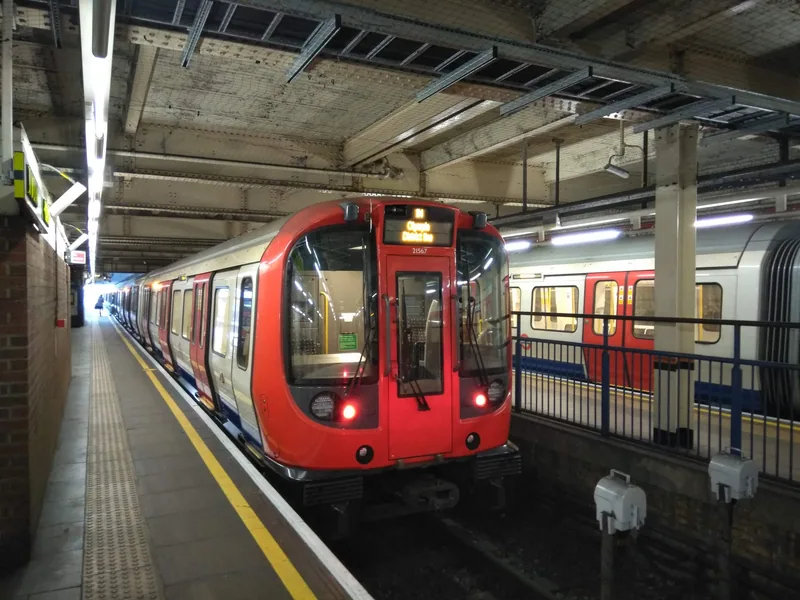
Photo: Hammersfan · CC BY-SA 4.0 · Wikimedia Commons · resized
The Circle line is a spiral, and Paddington appears twice on it
Until December 2009 Circle line trains went round and round. They now start at Hammersmith, run east along the Hammersmith & City route through Ladbroke Grove and Paddington, join the loop at Edgware Road, go all the way round it clockwise or anticlockwise, and finish back at Edgware Road. End to end that is 72 minutes.
Two consequences matter for a visitor. First, there is no such thing as staying on a Circle line train indefinitely; at Edgware Road everybody gets off. Second, and this genuinely confuses people, a single Circle line journey calls at Paddington twice, 58 minutes apart, on two different sets of platforms: the Hammersmith & City platforms early in the trip and the Circle and District platforms at the other end of the station near the end of it. If your phone says "Paddington" and the platform looks wrong, it probably is the wrong one. Our guide to Paddington station explains which is which.
The Circle runs six trains an hour, and that figure never changes: six at 08:00 on a Tuesday, six at 14:00 on a Sunday. It is the only line on the Underground with no peak service at all, which means a ten-minute wait is normal and a twelve-minute wait is not a fault. If a District or Hammersmith & City train comes first and goes your way for the next few stops, take it.
The trains: the reason to choose these lines in July
Both lines run seven-car S7 stock, part of a fleet of 192 trains shared with the Hammersmith & City and Metropolitan lines. They walk through from end to end with no doors between cars, they have wide double doorways, and they are air-conditioned, which is possible here only because the tunnels are shallow enough to get rid of the waste heat. Roughly two out of five Underground trains are cooled, and every one of them is on one of these four lines. Our page on which Tube lines have air conditioning has the temperature figures and the roll-out for the rest of the network.
The seats are arranged along the sides, so there is room to stand with a case, and the walk-through interior means you can move away from a crowded doorway. For anyone travelling with a pushchair or a heavy bag this is the most forgiving pair of lines in central London, which is the practical point of our guide to getting around London with a pushchair.
Interchanges where the walk is the journey
- Hammersmith is two stations with one name, 520 metres apart. The District and Piccadilly platforms are in the building attached to the shopping centre and bus station; the Circle and Hammersmith & City platforms are in a separate building across a very busy road. In TfL's station data the step-free link is 520 metres long. If your connection is here, allow ten minutes and use the subway rather than the surface crossing.
- Edgware Road is also two stations, and only one is on these lines. Edgware Road (Circle Line) serves the District, Circle and Hammersmith & City. Edgware Road (Bakerloo), a few minutes away on the far side of the Marylebone Road flyover, does not. They are separate stations with separate gatelines, and no sign inside one will send you to the other.
- Paddington, for the Bakerloo line. The Circle and District platforms sit at the Bishop's Bridge Road end of the station and the Bakerloo platforms are beneath Praed Street at the other. The change means walking the length of the concourse and down a long subway. Allow eight minutes rather than the two the map implies.
- Kensington (Olympia). The step-free route between the District platform and the main-line platform is 600 metres in TfL's own data, which is a long way for a station with two platforms.
Several one-stop hops on these lines are quicker on the pavement than through a ticket barrier, Aldgate to Aldgate East and Blackfriars to Mansion House among them. The timed list is in Tube stations it is quicker to walk between, and Earl's Court and West Brompton covers the district around the junction itself.
Step-free access, and the platforms that work in one direction only
About 26 of the District line's 60 stations have step-free access from the street to a platform, which is a better share than any deep line, but it is patchy in the centre. Westminster, Victoria, Tower Hill, Blackfriars, Earl's Court and Whitechapel are step-free; South Kensington, Sloane Square, Embankment, Monument, Temple, St James's Park, Gloucester Road and High Street Kensington are not. The absence that costs visitors most is South Kensington, where three national museums sit a subway ride from a platform with stairs, among them the V&A.
At the western end the picture improves sharply: Hammersmith, Acton Town, Ealing Broadway, Richmond, Fulham Broadway, Southfields, Wimbledon Park and Wimbledon all have a step-free route, which makes the Wimbledon branch the most accessible part of either line.
Then there are the stations that only work one way. Cannon Street has step-free access to the westbound District platform and not the eastbound. West Brompton is step-free eastbound only. Paddington is step-free to the eastbound Circle and District platform only. Barbican and Euston Square, both on the Circle, are step-free to the westbound platform alone. If you are planning a return trip you have to check both halves of it, and TfL's Journey Planner will do that if you set the step-free option; our guide to step-free and accessible transport in London explains the turn-up-and-go help that needs no booking.
Weekends, and why these two are worse than most
The sub-surface network is one interlinked railway with flat junctions, so a closure on one line drags in the others. A weekend shutdown between Aldgate and Tower Hill takes out part of the Circle and part of the District at once; work at Earl's Court can leave the Wimbledon branch running as a shuttle. Neither line has a night service on any night of the week.
The saving grace is that shallow lines are usually shadowed by something. For the central section, buses along the Embankment and Kensington High Street cover most of the route in daylight. For Richmond and Kew, the Overground's Mildmay line uses the same tracks, and our page on the Overground's six line names explains which one that is. For Wimbledon, South Western Railway from Waterloo is faster than the District line even when the District is running. Check the Friday status on TfL's status page.
The journey these lines own: Westminster to Kew Gardens in daylight
Every other line page on this site has to admit there is nothing to see. This one does not. Board a westbound District train signed Richmond at Westminster and the train is in tunnel as far as Earl's Court, and then out in the open for the rest of the way: Hammersmith, the river at Barnes, Chiswick, Kew Bridge. It takes about 40 minutes and costs one Tube fare, and it ends a few hundred metres from the gates of Kew Gardens.
| Westbound from Westminster | Roughly | Why get off |
|---|---|---|
| Victoria | 4 minutes | Gatwick trains and the coach station |
| South Kensington | 12 minutes | Three free national museums, by subway from the platform |
| Earl's Court | 16 minutes | Where the line divides; check the indicator |
| Hammersmith | 25 minutes | Buses west, the Riverside Studios, the Thames Path |
| Turnham Green | 30 minutes | Chiswick High Road |
| Kew Gardens | 37 minutes | The Botanic Gardens, straight across Kew Green |
| Richmond | 42 minutes | The riverside, the park and the hill |
Those are TfL Journey Planner times sampled over several consecutive weekday late-morning departures, not a single lucky train. The neighbourhood at the far end is covered in our guide to Chiswick and Kew, and the other branch ends at Wimbledon, where the same one-fare logic applies.
The cheapest river view in London is a Circle line platform. Blackfriars station is built across the Thames, and the platforms on the Circle and District have full-length windows facing downstream towards St Paul's and the Millennium Bridge. Get off, look, and take the next one.
Frequently asked questions
Is the Circle line actually a circle?
Not since December 2009. Trains run from Hammersmith east to Edgware Road, once round the loop, and terminate back at Edgware Road, a trip of 72 minutes. You cannot stay on board for a second lap, and the line calls at both Paddington and Edgware Road twice on the way.
Do the District and Circle lines have air conditioning?
Yes. Both run seven-car S7 trains with air conditioning and a walk-through interior, as do the Hammersmith & City and Metropolitan lines. Those four lines account for about 40 per cent of Underground trains and all of the cooled ones, because their tunnels are shallow enough to vent the heat.
Which District line train do I need for Wimbledon?
One signed Wimbledon. The line divides at Earl's Court, where an illuminated indicator on the platform shows each train's destination. Wimbledon trains run south through West Brompton and Fulham Broadway; Ealing Broadway and Richmond trains run west through Hammersmith. A through train from Westminster takes about 30 minutes.
How often do Circle line trains run?
Six an hour, every day, at every hour the line is open, so about one every ten minutes. It is the only Underground line with no extra trains at the rush hour. If a District or Hammersmith & City train arrives first and goes your way, it is usually quicker to take it.
Which Circle and District line stations are step-free?
About 26 of the District's 60, including Westminster, Victoria, Tower Hill, Blackfriars, Earl's Court, Whitechapel, Hammersmith, Richmond and Wimbledon. Several are step-free in one direction only, among them Cannon Street, West Brompton, Paddington, Barbican and Euston Square, so check the return leg as well as the outward one.
Sources
- Transport for London - Circle line working timetable data (Unified API) (checked September 2026)
- Transport for London - District line route sequence (Unified API) (checked September 2026)
- Transport for London - Kensington (Olympia) District line timetable data (checked September 2026)
- Transport for London - Stations, platforms, lifts and step-free data (checked September 2026)
- Transport for London - Four Lines Modernisation (checked September 2026)
- Transport for London - Step-free access (checked September 2026)
- Transport for London - Tube, DLR and Overground status (checked September 2026)