
Brompton Cemetery is free to walk into every day from 7am, and it is the only cemetery in the country owned by the Crown and managed by The Royal Parks. Its long central avenue runs between lime trees to a domed chapel, through a ring of colonnades with catacombs beneath; the catacombs open on just three tour days a year.
It covers 39 acres between Old Brompton Road and Fulham Road in west London, opened in 1840, and holds more than 205,000 burials. It is still a working cemetery, with new burials since 1996, so families come to visit graves here every day. Our page on London's Magnificent Seven cemeteries sets it alongside the other six, and our guide to Earl's Court and West Brompton covers the streets outside. This page is about the cemetery itself.
Brompton Cemetery at a glance
- Entry
- Free, daily
- Opening
- Pedestrian gates open at 7am every day. Closing moves through the year, from 4pm in midwinter to 8pm in high summer
- Current hours
- 7am to 4pm until 31 December 2026 (checked November 2026)
- Gates
- North Gate on Old Brompton Road, SW5; South Gate on Fulham Road, SW10
- Sunday tour
- 2pm from the North Lodge Information Centre, about two hours; suggested donation £10
- Catacomb tours
- Three times a year, including the Friends' Open Day; book ahead
- Dogs
- Allowed on a lead, on designated paths only
- Nearest station
- West Brompton (District line and London Overground), two minutes from the North Gate
An open-air cathedral laid out on a brickworks
The site was flat and unpromising: a brickworks and market garden, half a mile long and narrow. The architect Benjamin Baud turned that shape into a church plan without a roof, as the Friends of Brompton Cemetery describe it. The North Gatehouse on Old Brompton Road, built like a triumphal arch, is the west door. Central Avenue is the nave, about 600 metres long. The domed chapel at the far end is the high altar, and the smaller paths running parallel to the avenue are the aisles.
Between the avenue and the chapel lies the Great Circle, about 92 metres across and enclosed by colonnades. The Friends say it is said to have been inspired by the piazza of St Peter's in Rome, which is where the comparison with St Peter's comes from: it is the circle and its colonnades, not the chapel, that echo Rome. The chapel itself is octagonal, in stone with a lead dome and Roman Doric pilasters, and is listed at Grade II*, as are the four quarters of the arcading.
The limes along Central Avenue have been dated by tree-ring analysis to 1838, so they are older than the cemetery. They are at their best in early autumn, when the weeping silver limes turn; our page on autumn colour in London names them among the trees worth a special trip.
Walk Brompton from north to south. Enter at the North Gate on Old Brompton Road, two minutes from West Brompton station, and walk Central Avenue as Baud intended, from the arch through the Great Circle to the chapel. Leave by the South Gate on Fulham Road, about 600 metres on, and you are a short walk from Fulham Broadway station.
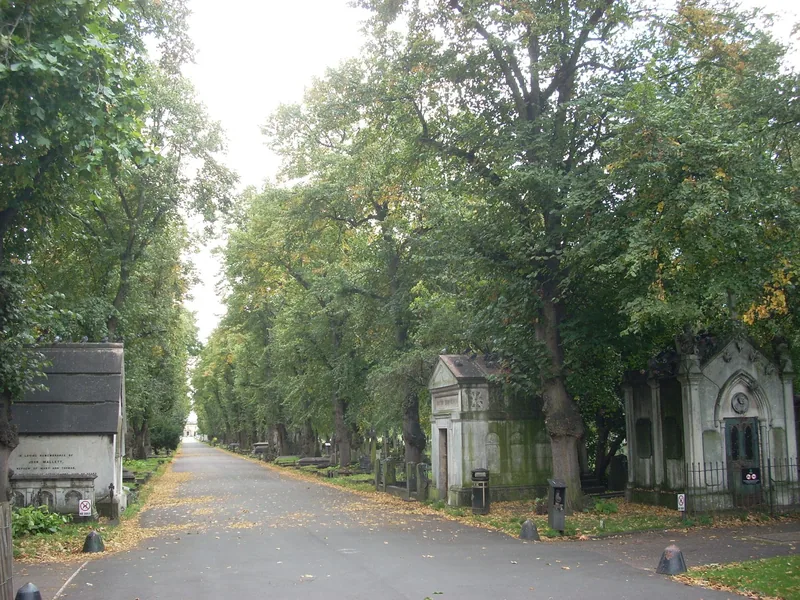
Photo: Simon Burchell · CC BY-SA 4.0 · Wikimedia Commons · resized
The catacombs under the colonnades
Beneath the colonnades of the Great Circle and along Central Avenue run the catacombs, entered through heavy cast-iron doors decorated with snakes and inverted torches, both Victorian symbols of death. The Royal Parks say that although there was room for thousands, only about 500 people chose to be interred there; the Friends add that 500 places were sold, that many remain empty and that the true number is not known.
Inside, coffins rest on shelves, and The Royal Parks note that some of the original Victorian funeral flowers left by mourners can still be seen. Part of the original plan has gone: a catacomb with a promenade above it once ran the whole length of the western wall, looking over the Kensington Canal, until a railway replaced the canal and much of it was taken down.
The Friends of Brompton Cemetery open the catacombs three times a year, one of them on their annual Open Day. These tours start from the chapel, are very popular and need booking in advance; dates appear on the Friends' website, on Eventbrite and at the Information Centre. Filming and photography in the catacombs are not allowed without written permission from The Royal Parks.
Brompton's catacombs open only on three days a year. Turning up on an ordinary Sunday will get you the general tour, not the vaults. If the catacombs are the reason for your trip, find the next date before you book anything else, and book that tour as soon as it is listed.
The names on the stones, and the Beatrix Potter story
Beatrix Potter grew up in Bolton Gardens, a short walk east of the North Gate, and a story has grown up that she took some of her characters' names from Brompton's headstones. The Friends' own list of notable graves includes "Nutkins", described as a family name used for a Beatrix Potter character. Other guides add McGregor, Brock, Tod and Fisher to the list.
Treat it as a pleasing possibility rather than a fact. The names are real and the headstones are there, but there is no evidence that Potter ever said she used them, and some of the names were common enough in Victorian London to turn up in any large cemetery. If you go looking, remember that the families on those stones are real families too.
Who to look for, and what the monuments mean
The two graves most visitors ask for are those of Emmeline Pankhurst, the leader of the suffragette movement, marked by a simple Celtic cross, and Dr John Snow, who showed that cholera spread through contaminated water. Snow's grave carries a veiled urn, which The Royal Parks explain as a symbol of the thin boundary between life and death.
The Royal Parks' guide to the cemetery's symbols turns a walk into a reading exercise. A broken column means a life cut short: the racing driver Percy Lambert, who broke the 100 miles per hour record, has one. A portrait medallion signalled status, as on the grave of the actor Henry Pettitt. The writer George Borrow has a chest tomb, and the writer Lady Sydney Morgan a table tomb on pillars. The oil magnate James McDonald has the most ornate mausoleum on Central Avenue, its door guarded by two angels.
The Friends count about 35,000 monuments, 28 of them listed. The finest is the chest tomb of the shipowner and art collector Frederick Leyland, designed by Edward Burne-Jones and listed at Grade II*. The champion sculler Robert Coombes lies under an upturned rowing boat. Sir Henry Cole, who drove the Great Exhibition and founded what became the V&A, is here, and so is John Wisden of the cricketers' almanack.
The Friends sell a Top 100 leaflet with four self-guided walks at the Information Centre in North Lodge, where volunteers will also help you look for a specific grave. The Royal Parks run an online burial search for family history.
Why the Crown owns a cemetery
Brompton was a commercial venture that went wrong. The founder, Stephen Geary, had his own designs rejected and left the board; Baud was later dismissed after rows over defects; and the grand scheme cost £61,000 by 1841 against an estimate of £30,000. When the Metropolitan Interments Act of 1850 gave the state powers to buy private cemeteries, the small shareholders pressed for a sale.
The result, the Friends explain, is that Brompton became the only private cemetery bought under that Act and the first ever nationalised. It closed to new burials in 1952, reopened to them in 1996, and is now looked after by The Royal Parks, the charity that also runs Hyde Park and Kensington Gardens. A restoration costing just over £6 million between 2014 and 2018 repaired the chapel dome and colonnades, built the café and Information Centre beside North Lodge, and secured the western catacombs.
From 1854 until 1939 Brompton was also the London District's military cemetery, and the Royal Hospital Chelsea bought its own plot near the north-west corner; our page on the Royal Hospital Chelsea explains who the Chelsea Pensioners are.
The Sunday tour, the café and the rules
The Friends run a general guided tour at 2pm every Sunday from March to November, and fortnightly from December to February, starting outside the North Lodge Information Centre. A donation of £10 is suggested; you can book on Eventbrite or simply turn up and pay by card or cash. Group tours on other days can be arranged with the Friends.
Café North Lodge, beside the North Gate, has the public toilets and was rated 5 for food hygiene at its inspection in June 2025. There is nowhere suitable for a picnic inside, The Royal Parks say, and no sport, though running is allowed if you give others room.
Cycling is permitted only along Central Avenue, with pedestrians having priority. Dogs must stay on a lead and on the signed paths. Personal photographs and phone video need no permit; anything else needs one from The Royal Parks. No vehicles are allowed except on cemetery business, and there is no visitor parking.
Getting there, and the football next door
West Brompton station is on the Wimbledon branch of the District line and on the London Overground's Mildmay line; turn right out of the station and the North Gate is within two minutes. Earl's Court, which adds the Piccadilly line, is about ten minutes' walk. Buses 74 and 430 run along Old Brompton Road, and the 14, 211 and 414 along Fulham Road.
The South Gate on Fulham Road is close to Stamford Bridge, Chelsea Football Club's ground; the club's founder, Henry Mears, is buried in the cemetery. On a home match day the Fulham Road end and Fulham Broadway station fill with crowds, so use the North Gate and West Brompton. Our guide to Premier League football in London has the stadium details.
If you want a second cemetery on the same trip, Kensal Green, the oldest of the seven, is about 25 minutes away by Overground from West Brompton, changing at Willesden Junction, and runs tours into its own smaller catacombs. Brompton is the easier visit of the two: it opens earlier and allows dogs. For a longer stay in this part of town, see our guide to staying in Earl's Court and west London.
Frequently asked questions
What time does Brompton Cemetery open and close?
The pedestrian gates open at 7am every day. Closing time changes through the year, from 4pm between November and late January to 8pm from April to early September. The Friends of Brompton Cemetery publish the full list of dates, and The Royal Parks post any temporary closures on their Brompton page.
Can you visit the catacombs at Brompton Cemetery?
Yes, but only on the catacomb tours run by the Friends of Brompton Cemetery three times a year, including their annual Open Day. Tours start from the chapel and must be booked in advance. Photography in the catacombs needs written permission from The Royal Parks.
Did Beatrix Potter take character names from Brompton Cemetery?
It is often said, and the Friends' list of notable graves includes the name Nutkins, but there is no evidence that Potter herself said so. She grew up nearby in Bolton Gardens, and several names on the headstones resemble her characters' names. Present it to children as a story, not a fact.
Is Brompton Cemetery free to visit?
Yes. There is no charge to enter, and The Royal Parks manage it like their other parks. The Friends' Sunday tours ask for a suggested donation of £10, and the catacomb tours are ticketed through the Friends.
Who is buried in Brompton Cemetery?
More than 205,000 people, including the suffragette leader Emmeline Pankhurst, the physician John Snow, Sir Henry Cole of the Great Exhibition, the shipowner Frederick Leyland under a tomb by Burne-Jones, John Wisden of the cricket almanack and Henry Mears, the founder of Chelsea Football Club.
Sources
- The Royal Parks - Brompton Cemetery FAQs (checked November 2026)
- The Royal Parks - The history of Brompton Cemetery (checked November 2026)
- The Royal Parks - Eight things to spot at Brompton Cemetery (checked November 2026)
- The Friends of Brompton Cemetery - The cemetery (checked November 2026)
- The Friends of Brompton Cemetery - Tours and walks 2026 (checked November 2026)
- The Friends of Brompton Cemetery - Events and opening times 2026 (checked November 2026)
- Historic England - Church of England Chapel, Brompton Cemetery, list entry 1266241 (checked November 2026)
- Food Standards Agency - food hygiene rating for Cafe North Lodge, Brompton Cemetery, SW5 9JE (checked November 2026)