
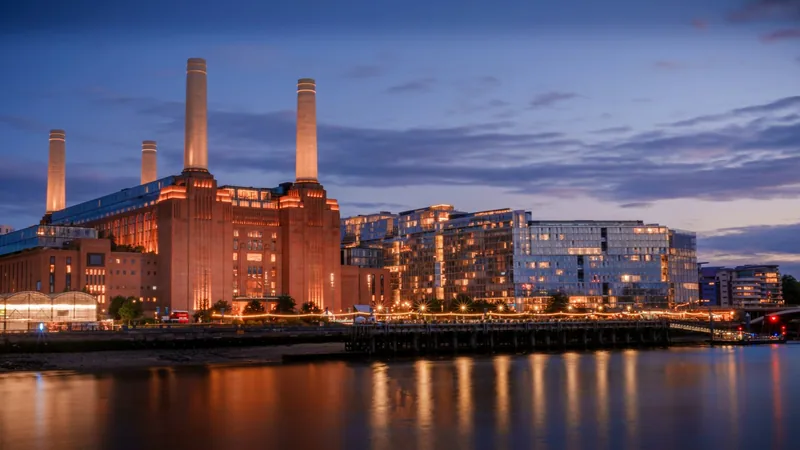
Battersea Power Station is the 1930s brick power station on the south bank of the Thames, rebuilt as a shopping and entertainment centre and reopened to the public on 14 October 2022. Walking in is free. The glass lift that takes you 109 metres up inside one of the chimneys is not, and it is now called The Chimney Lift.
From the 1930s to the 1980s this was a working station that at its peak supplied about a fifth of London's electricity, including to the Houses of Parliament and Buckingham Palace. After it closed it stood derelict for decades, which is why so many Londoners have a photograph of the four white chimneys taken from a train window and no memory of ever going inside. Our guide to Battersea and Nine Elms covers how the whole district has changed around it.
Now it holds more than 150 shops, two cinemas, restaurants, a theatre and a hotel, with a park and a river pier outside. Whether that is worth a trip depends entirely on what you want from it, and this page is about telling those things apart.
Battersea Power Station at a glance
- Entry
- Free to the public areas; the Chimney Lift, cinemas and some events are ticketed
- Shop hours
- Monday to Saturday 10am–8pm, Sunday 12pm–6pm; cafés, bars and the Chimney Lift often open longer
- The Chimney Lift
- Level 1, Turbine Hall A. Monday to Wednesday and Sunday 10am–6pm; Thursday to Saturday 10am–8pm
- Guided tour
- About 75 minutes, including access to Control Room A
- Nearest Tube
- Battersea Power Station, Northern line, Zone 1
- River pier
- About 15 minutes to Embankment, 20 to Blackfriars, 40 to Canary Wharf
- Parking
- £6 for under two hours, rising to £30 for 6–24 hours; 2.2 m height limit
- Dogs
- Welcome throughout, including most shops and some restaurants
The chimney lift, and its new name
A circular glass elevator carries you up the inside of the north-west chimney. At the top, 109 metres above the ground, you step out to a view that runs right round the horizon. The journey starts at the bottom of Turbine Hall A, the Art Deco hall, where original records and displays cover the building's history before you get in the lift.
It is now branded The Chimney Lift. If you are reading an older guidebook or an out-of-date website, you may see it called Lift 109; that name is no longer in use and the old web address no longer works. Book through the operator's own site, which is linked from the estate's page for the attraction.
We were unable to verify the current ticket prices from the operator, whose site blocked our checks, so we are not going to print a figure. Check the price on the booking page before you plan around it, and be sceptical of prices quoted on third-party sites.
The lift keeps longer hours than the shops from Thursday to Saturday. It runs 10am to 8pm on those three days and 10am to 6pm on the rest, so a late-afternoon ride in winter gets you up the chimney around sunset. On a Sunday, when the shops shut at 6pm, the lift closes at the same time.
How it compares with London's other high views
Be clear about what 109 metres buys you. The View from The Shard is far higher and far more expensive; Sky Garden is free with a booked ticket and looks over the City. The Chimney Lift looks over south-west London, the river, Chelsea and the new towers of Nine Elms, from inside a piece of industrial architecture.
The building is the point, not the altitude. If you find the power station interesting, the lift is a good twenty minutes. If you mainly want a wide view of central London, spend the money elsewhere; our comparison of London's viewing platforms sets them side by side.
The guided tour and Control Room A
The more interesting ticket for anyone who cares about the building is the guided tour, which runs about 75 minutes and covers the station's role in powering London's landmarks. It includes access to Control Room A, which is otherwise closed.
Control Room B, meanwhile, has been turned into an all-day cocktail bar, with the original dials and switchgear still on the walls around the drinkers. You do not need a tour ticket for that one, only the price of a drink; our guide to cocktail bars in London puts it in context.
What is free, and whether it is worth the journey
Everything except the ticketed attractions is free: the Turbine Halls, the shopping levels, Power Station Park outside, the riverside and Malaysia Square. Deck chairs are put out in the park in summer, and there is a jetty with cooling water for hot days.
Here is our honest view. If you are a visitor with a week in London, a shopping centre in a converted power station is not a priority, however handsome the building. If you are interested in industrial architecture, or you have already seen the obvious things, or it is pouring with rain and you want somewhere enormous and enclosed to spend three hours, it earns its place. The main building is fully enclosed, which makes it a genuinely good wet-weather option; see our other rainy day suggestions.
Families get more out of it than couples. There is a land train that circles the site, two cinemas, and space for children to run about in the park. For a comparison with the other large covered centres, see Westfield at Stratford and White City.
Getting there: four good options
The simplest is the Tube. Battersea Power Station has its own Zone 1 station on the Northern line, with the entrance on Battersea Park Road. That is a change from the old days when getting here was awkward, and it is the reason the development works at all; our Underground guide explains which branch of the Northern line to take.
The river bus is the enjoyable option. Battersea Power Station Pier is on the site, and from there it is about 15 minutes to Embankment, 20 to Blackfriars and 40 to Canary Wharf. Oyster and contactless work on the river bus, but note that river fares do not count towards your daily cap and are not covered by a Travelcard; see Uber Boat by Thames Clippers.
On foot, it is about 12 minutes from Sloane Square through Ranelagh Gardens and over Chelsea Bridge, and about 20 minutes from Victoria or Vauxhall. The walk from Sloane Square is pleasant and takes you through Chelsea.
By bus, routes 44, 137, 211 and 452 stop at Battersea Park/Chelsea Gate on Chelsea Bridge Road, from where you walk down the steps on the south side of the bridge and along the river. Routes 156, 211, 344 and 436 stop at Battersea Power Station on Pump House Lane. Battersea Park railway station is about ten minutes on foot.
The car parks fill up at weekends, and they are not cheap. Under two hours costs £6, two to four hours £10, four to six hours £16 and anything up to 24 hours £30. There is a 2.2-metre height limit. The 45 Blue Badge spaces are charged at standard rates and cannot be booked in advance. Use the Northern line instead; see parking in London for the wider picture.
Practical details that are easy to get wrong
- No luggage storage. The estate says so plainly, so do not arrive from the airport with suitcases; our guide to left luggage in London lists the alternatives.
- Accessible toilets need a RADAR key. If you do not carry one, guest services can let you in. Their desks are at the North Entrance, coming in from Power Station Park, and the South Entrance from Malaysia Square.
- Sunday hours are short. Shops open at midday and close at 6pm, which is the Sunday trading rule for large shops in England. A Sunday morning visit means an empty building.
- Electric vehicle charging costs £0.45 per kWh across 39 bays, including two accessible ones, operated by EVC and Pod Point.
- Dogs are welcome throughout the estate, including most shops and some restaurants, which is unusual for a development this size.
Eating, drinking and what else is in the building
There are two cinemas, The Cinema in the Power Station and The Cinema in the Arches, and the Arches Lane Theatre puts on plays and musicals. Large ticketed exhibitions come and go in the building; one on Ramses and Egyptian gold was running when we checked in September 2026.
The hotel on site is art'otel London Battersea Power Station, inside the Battersea Roof Gardens building, designed by the Spanish artist and designer Jaime Hayon. It is the most convenient place to stay if you want to be by the river rather than in the middle of town.
Making a half-day of it
The obvious pairing is Battersea Park, which is a ten-minute walk west along the river and is far more attractive than the development. It has a boating lake, a children's zoo and the Peace Pagoda on the riverside, and it is where the borough's fireworks display is held each November; see Bonfire Night in London.
The wider district, including the new American embassy and the market at New Covent Garden, is covered in our neighbourhood guide. A sensible half-day is the river bus down from Embankment, an hour in the power station, the chimney lift if you want it, and a walk back through the park to Chelsea. That works as a family outing too; see London with kids.
Frequently asked questions
Is Battersea Power Station free to enter?
Yes. The public areas, including the Turbine Halls, the shopping levels and Power Station Park, are free. The Chimney Lift, cinema screenings, the guided tour and some exhibitions are ticketed separately.
How much does the Chimney Lift cost?
We could not verify the current price from the operator's own site, which blocked our checks, so we will not quote one. Prices are shown on thechimneylift.co.uk when you choose a date. The attraction was previously branded Lift 109, and that name is no longer used.
How do you get to Battersea Power Station?
Battersea Power Station has its own Zone 1 station on the Northern line, with the entrance on Battersea Park Road. The river bus stops at the site's own pier, about 15 minutes from Embankment. It is a 12-minute walk from Sloane Square over Chelsea Bridge, and buses 156, 211, 344 and 436 stop on Pump House Lane.
What are the opening hours at Battersea Power Station?
Shops open Monday to Saturday from 10am to 8pm and Sunday from 12pm to 6pm. Cafés, restaurants, bars, the cinemas and the Chimney Lift often keep longer hours, so check the individual pages. The Chimney Lift runs to 8pm from Thursday to Saturday.
Is Battersea Power Station worth visiting?
It is worth a couple of hours if you are interested in the building itself, if you are travelling with children, or if the weather has ruined your plans and you want somewhere large and dry. As a shopping centre it is not a reason to cross London, and the nearby park is the better attraction on a fine day.
Sources
- Battersea Power Station - Getting here and opening hours (checked September 2026)
- Battersea Power Station - Frequently asked questions (checked September 2026)
- Battersea Power Station - The Chimney Lift (checked September 2026)
- Battersea Power Station - About (checked September 2026)
- Sunday Trading Act 1994, Schedule 1 (checked September 2026)