
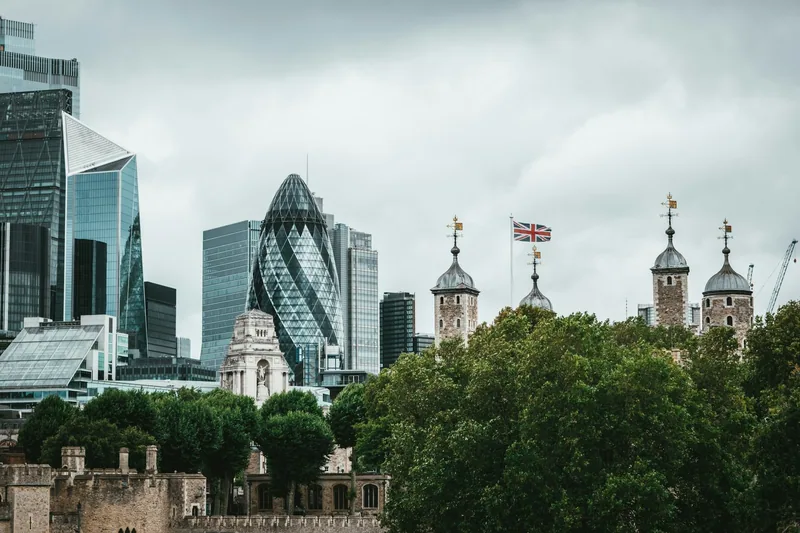
The City of London, usually just called "the City" or "the Square Mile", is London's oldest district and its financial centre: a small area of glass towers, Roman remains and Wren churches around St Paul's Cathedral. It is crowded with office workers on weekdays and almost empty at weekends, and both sides are worth seeing.
The City is not the same as the whole of London. It is a separate local authority of just over one square mile on the north bank of the Thames, roughly between Temple in the west and the Tower of London in the east. The Romans founded their town, Londinium, here almost 2,000 years ago, and for most of history this small area simply was London. It still has its own Lord Mayor, its own police force and many traditions that go back to the Middle Ages.
Very few people live in the City, but hundreds of thousands work here. That creates an unusual rhythm for visitors: busy lunchtimes and after-work crowds outside the pubs from Monday to Thursday, then quiet streets, closed sandwich bars and empty lanes on Saturday and Sunday. If you like history, architecture and free views from rooftops, the City rewards a full day.
The Square Mile at a glance
- Where
- North bank of the Thames, from Temple and Blackfriars to Aldgate and Tower Hill
- Top sights
- St Paul's Cathedral, Sky Garden, Leadenhall Market, the Monument, Roman remains, Wren churches
- Main stations
- Bank, St Paul's, Liverpool Street, Moorgate, Farringdon, Tower Hill, Blackfriars
- Fare zone
- Zone 1
- Best time
- Weekdays for atmosphere and open cafés; weekends for quiet streets and photography
- Not ideal for
- Evening dining at weekends and a hotel stay if you want neighbourhood life around you
Weekday crowds and empty weekends
From Monday to Friday the City runs on office hours. Between about 08:00 and 09:30 the pavements around Bank, Liverpool Street and Cannon Street are full of commuters walking fast. Lunchtime brings long queues at sandwich shops and food stalls, and from about 17:30, especially on Thursdays, the pubs spill out onto the pavements with people in suits drinking standing up.
At weekends the picture changes completely. Many cafés, sandwich chains and some pubs close on Saturday and Sunday, and some streets are almost silent. This is the best time to photograph the narrow lanes, the churches and the towers without crowds. The big attractions, such as St Paul's on Saturdays and the Sky Garden, stay open, but plan where you will eat. The pubs and restaurants around St Paul's, the Barbican, Smithfield and Liverpool Street are the most reliable options.
Bank holidays feel like Sundays. Our guide to Sundays, bank holidays and opening hours explains what closes across London on those days.
St Paul's Cathedral and the western City
Sir Christopher Wren's cathedral, finished in the early 18th century after the Great Fire of 1666 destroyed its medieval predecessor, dominates the western half of the City. Its dome is one of the largest in the world and still shapes the skyline, because protected views stop towers from blocking it from several points in London.
Sightseeing is from Monday to Saturday. An adult ticket costs £27, or £29.70 with the optional donation, and includes the cathedral floor, the crypt and the dome galleries, with multimedia guides (September 2026). Children aged 6-17 pay £10.50. Climbing to the Golden Gallery at the top of the dome is hard work but gives one of the best views in London. Our guide to St Paul's Cathedral has the details on tickets, services and the climb.
Behind the cathedral, the One New Change shopping centre has a free roof terrace with a close view of the dome. South of St Paul's, the Millennium Bridge crosses the river to Tate Modern and the South Bank riverside walk. To the north-west is Smithfield, where the new home of the London Museum, in the old Smithfield General Market buildings, opens on 28 November 2026 with free galleries. Until then, the only site open is the Docklands museum; see our London Museum guide.
Wren churches and small green spaces
After the Great Fire, Wren and his office rebuilt more than 50 City churches. Many survive, often squeezed between office blocks, and most are free to enter when open. They are quiet places to sit and are some of the best free architecture in London. Opening times vary a great deal, and many open only on weekdays, so check each church's website.
- St Stephen Walbrook, near Bank, has a domed interior that is often described as a trial run for St Paul's.
- St Mary-le-Bow on Cheapside is the church of the "Bow bells": by tradition a true Cockney is born within the sound of them.
- St Bride's, off Fleet Street, is the journalists' church, and its tiered spire is said to have inspired the shape of the traditional wedding cake.
- St Bartholomew-the-Great, near Smithfield, is much older than Wren: a Norman church from the 12th century that survived the fire. Check its website for visiting times and any charge for visitors.
Look out too for the City's tiny gardens. Postman's Park, near St Paul's, has a moving wall of ceramic plaques remembering ordinary people who died trying to save others. St Dunstan-in-the-East, near the Tower, is the ruin of a bombed church with trees and climbing plants growing through its walls, one of the most photographed corners of the City.
Roman London under your feet
Almost everything built by the Romans in Londinium now lies below street level, but several remains can be visited. The London Mithraeum, under the Bloomberg building near Bank, shows the reconstructed remains of a Roman temple to the god Mithras, together with objects found on the site. It is free, though booking guarantees entry; it is open Tuesday to Saturday 10:00-18:00 and Sunday 12:00-17:00, and closed on Mondays.
Beneath Guildhall Art Gallery, next to the medieval Guildhall, you can see the remains of London's Roman amphitheatre, rediscovered only in 1988. A dark outline in the courtyard paving above shows where the arena stood. Check the City of London website for the gallery's current opening days.
Sections of the Roman and medieval city wall still stand in the open air, most notably next to Tower Hill station and along the street called London Wall, near the Barbican. They are free to see at any time. For a guided introduction to Roman and medieval London, many of the walking tours we recommend start in the City.
Free rooftops and the tallest viewpoints
The City has the best collection of free viewpoints in London, most of them on top of new office towers. You need to book some of them in advance.
| Viewpoint | Height and setting | Booking |
|---|---|---|
| Sky Garden, 20 Fenchurch Street | Indoor garden and terrace at the top of the "Walkie-Talkie" tower | Free tickets released on Monday mornings, three weeks ahead; one-hour time slots |
| Horizon 22, 22 Bishopsgate | Level 58, described as London's highest free viewing platform | Free; book a time slot online |
| The Garden at 120, Fen Court | Open-air rooftop garden on the 15th floor | Free and open to everyone; check opening hours on its website |
| One New Change roof terrace | Low-level terrace facing the dome of St Paul's | Free, no booking |
Sky Garden is open free on weekdays 10:00-18:00 and at weekends 11:00-21:00, and walk-ins are sometimes possible when there is space, but not after 17:00 on weekdays. Horizon 22 is open on weekdays 10:00-18:00, Saturdays 10:00-17:00 and Sundays 10:00-16:00. Read our Sky Garden booking guide, and compare it with other options in our round-up of the best free viewpoints in London.
Horizon 22 is the fallback when Sky Garden is fully booked. Sky Garden slots for popular times go quickly after the Monday release. Horizon 22, a ten-minute walk away, is higher, also free, and often easier to book at short notice. Check both websites before you give up on a view.
Leadenhall Market, the Monument and the eastern City
Leadenhall Market is a covered Victorian market hall with a painted iron-and-glass roof, now used by restaurants, pubs and shops. It is famous as a Harry Potter filming location and is especially photogenic in the early morning or on a weekend, when it is empty. The public areas are open 24 hours a day, although many of its businesses close at weekends. Scaffolding is currently up for maintenance, but the market is fully open.
A few minutes south, the Monument is a stone column built to remember the Great Fire of 1666, which started in a bakery on nearby Pudding Lane. You can climb its 311 steps to a small caged balcony at the top. An adult ticket costs £7.00 and a child £3.50 (September 2026). It is open daily 09:30-13:00 and 14:00-18:00, with last entry at 12:30 and 17:30. The staircase is narrow, and there is no lift.
At the eastern edge of the City stands the Tower of London, just outside the City boundary, and Tower Bridge beside it. Both deserve a separate half day; see our guides to the Tower of London and Tower Bridge. North-east of Liverpool Street, the City gives way to the markets and street art of Spitalfields and Shoreditch; our guide to Spitalfields and the Brick Lane markets is a good next step.
Money, museums and the Barbican
The Bank of England Museum, inside the Bank of England on Threadneedle Street, explains the history of money and banking. It is free and open Monday to Friday, 10:00-17:00, with last entry at 16:30, so it is another sight to fit into a weekday.
In the north of the City, the Barbican is a huge concrete housing estate and arts centre built from the 1960s to the 1980s. Whether you love or hate its Brutalist style, it is fascinating to walk through, with raised walkways, lakes and a hidden conservatory full of tropical plants that opens on selected days. The Barbican Centre hosts concerts, theatre, cinema and exhibitions; check the programme on its website.
Where to eat and drink in the Square Mile
On weekdays the City is full of places to eat quickly: sandwich chains, food stalls and counters at every station. Sit-down restaurants tend to be aimed at business lunches and can be expensive. In the evenings, the busiest areas are around Liverpool Street, Leadenhall Market, Smithfield and the Barbican.
The City is also one of the best places in London for old pubs, including several that were rebuilt immediately after the Great Fire and some tucked into alleys that are easy to miss. Our guide to London's historic pubs lists the most interesting ones. For drinks with a view, several City towers have bars on their upper floors; see our list of rooftop bars in London.
Getting around the City of London
The City has more stations than almost any area of its size. Bank is served by the Central, Northern, Waterloo & City lines and the DLR, and is linked underground to Monument (District and Circle lines). The Elizabeth line stops at Liverpool Street and Farringdon, giving direct trains to Paddington, Heathrow and Canary Wharf. St Paul's is on the Central line, and Tower Hill on the District and Circle lines. All are in Zone 1, and the daily cap for Zones 1-2 is £8.90 with contactless or Oyster.
Distances are short: from St Paul's to the Tower of London is about 25 minutes on foot, through some of the most interesting streets. The River Bus stops at Tower pier, and our guide to the Uber Boat river service explains fares. Bank station is large and has long passages between lines, so allow extra time when changing there.
Check for line closures before a weekend in the Square Mile. Planned engineering works on the Tube often take place at weekends, and a closed line can make Bank or Liverpool Street awkward to reach. Look at the TfL status page before you set off. The stations are close together, so walking to the next one is usually easy.
Events: the Lord Mayor's Show and more
The City's biggest public event is the Lord Mayor's Show, a procession of floats, bands and soldiers that celebrates the new Lord Mayor. In 2026 it takes place on Saturday 14 November, setting off from Mansion House at 11:00. It is free to watch from the pavements. Our November events guide covers the rest of that month.
Frequently asked questions
Is the City of London the same as London?
No. The City of London is a small, separate district of about one square mile at the historic heart of the capital, with its own Lord Mayor and police. "London" as a whole is Greater London, which covers 32 boroughs plus the City.
Is the City of London worth visiting at the weekend?
Yes, if you like quiet streets and architecture. St Paul's is open for sightseeing on Saturdays and the Sky Garden opens at weekends, but many cafés, some pubs and the Bank of England Museum are closed, so plan meals in advance.
What is the best free view in the City of London?
The Sky Garden and Horizon 22 are both free with a booked ticket. Sky Garden has an indoor garden and a terrace, while Horizon 22 on level 58 is higher. The One New Change roof terrace needs no booking and faces St Paul's.
Can I see Roman remains in London for free?
Yes. The London Mithraeum near Bank is free, and sections of the Roman city wall at Tower Hill and London Wall can be seen outdoors at any time. The remains of the Roman amphitheatre lie under Guildhall Art Gallery.
Is the City of London a good place to stay?
It can be, especially for short trips with good transport links, and hotel prices sometimes drop at weekends when business travellers leave. The downside is that the area feels deserted in the evenings and at weekends, with fewer places to eat nearby.
Sources
- St Paul's Cathedral - Ticket types and prices (checked September 2026)
- Sky Garden - Booking (checked September 2026)
- Horizon 22 - Home page (checked September 2026)
- The Monument - Home page (checked September 2026)
- London Mithraeum Bloomberg SPACE - Home page (checked September 2026)
- Bank of England - Museum (checked September 2026)
- Leadenhall Market - Visit (checked September 2026)
- Lord Mayor's Show - Home page (checked September 2026)