
The best way to see London's Thames bridges is on foot: a riverside walk of roughly 4 km from Westminster Bridge to Tower Bridge passes all the best-known central bridges, and every one of them is free to walk over. Allow two to three hours with stops.
The Thames runs through the middle of London from west to east, and for centuries its bridges decided how the city grew. Today the central stretch has road bridges, railway bridges and footbridges packed close together, each from a different period. Some are famous landmarks, such as Tower Bridge. Others are ordinary road crossings that happen to have some of the best views in the city.
This guide introduces the main bridges from east to west, explains what makes each one worth a look, and then links them into a single walk along the South Bank. A common mix-up is worth clearing up straight away: the grand Victorian bridge with two towers is Tower Bridge. London Bridge is the plain concrete one a little further west.
The bridge walk at a glance
- Route
- Westminster Bridge to Tower Bridge along the South Bank
- Distance
- Roughly 4 km (about 2.5 miles), flat
- Time
- About an hour of walking; two to three hours with stops
- Cost
- Free (the Tower Bridge exhibition inside the towers is paid)
- Start
- Westminster station (Jubilee, District and Circle lines)
- Finish
- Tower Hill station (District and Circle lines) or London Bridge (Northern and Jubilee lines)
- Best time
- Late afternoon into dusk, when the bridges and buildings light up
Who looks after the central bridges
Five of the bridges in this guide belong to a charity called City Bridge Foundation: Tower Bridge, London Bridge, Southwark Bridge, the Millennium Bridge and Blackfriars Bridge. The charity has roots going back to the Middle Ages, when a fund was set up to look after the old London Bridge, and it still pays for their upkeep without public money. The surplus from its endowment funds grants to London charities.
The other bridges on the walk, including Westminster Bridge and Waterloo Bridge, are part of the ordinary road network. For you as a visitor the difference does not matter much, except that City Bridge Foundation publishes a page of planned works and closures on its five bridges, which is worth checking before a big day out.
| Bridge | Current bridge opened | Who can cross | Close to |
|---|---|---|---|
| Tower Bridge | 1894 | Pedestrians and traffic | Tower of London, Shad Thames |
| London Bridge | 1973 | Pedestrians and traffic | Borough Market, the Shard |
| Southwark Bridge | 1921 | Pedestrians and traffic | Bankside, the Globe |
| Millennium Bridge | 2000 | Pedestrians only | St Paul's, Tate Modern |
| Blackfriars Bridge | 1869 | Pedestrians and traffic | Blackfriars station |
| Waterloo Bridge | 1945 | Pedestrians and traffic | Southbank Centre, Somerset House |
| Golden Jubilee Bridges | 2002 | Pedestrians only | London Eye, Embankment |
| Westminster Bridge | 1862 | Pedestrians and traffic | Big Ben, London Eye |
Tower Bridge: the one on the postcards
Tower Bridge is the bridge most visitors picture when they think of London. It was designed by the City Architect Sir Horace Jones with the engineer Sir John Wolfe Barry and opened in June 1894 after eight years of construction. Its two Gothic towers are clad in stone and granite to match the Tower of London next door, but inside is a steel frame.
It is a working bascule bridge: the two halves of the road can be raised to let tall ships through. By law the bridge must lift for registered vessels with a mast or superstructure of 30 feet or more, free of charge, at any time of day or night, with 24 hours' notice. It lifts around 800 times a year, and the times and ship names are published in advance on the official Tower Bridge lift schedule. Watching a lift from the riverbank is free and takes only a few minutes.
Walking across the road deck costs nothing. The paid Tower Bridge exhibition takes you up to the high-level walkways, with their glass floors, and down to the Victorian engine rooms that once powered the lifts. It is open daily from 9:30am. Our full guide to visiting Tower Bridge covers tickets and timing.
The lift schedule turns a bridge photo into an event. Before you set out, look at the published lift times. If a ship is due while you are nearby, stand in Potters Fields Park on the south bank or on the riverside path by the Tower of London and watch both halves of the road rise.
London Bridge: the modest one with the long story
Many first-time visitors walk onto London Bridge expecting towers and are disappointed to find a plain three-span concrete road bridge. The current bridge was built between 1967 and 1972 and opened by Queen Elizabeth II in 1973. But there has been a London Bridge on or near this spot for far longer than any other crossing in the city.
The first stone bridge was begun in 1176 by a priest, Peter de Colechurch, and completed in 1209. It carried houses and shops, and it stood for more than six centuries before a new bridge replaced it between 1823 and 1831. That 19th-century granite bridge was sold in the late 1960s and rebuilt in the United States, in Lake Havasu City, Arizona.
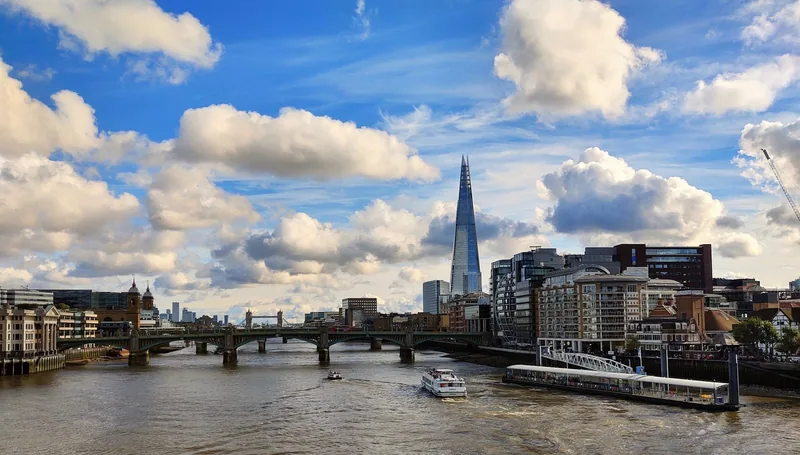
The bridge is still worth crossing for the view east towards Tower Bridge and HMS Belfast. At the southern end are Borough Market, Southwark Cathedral and the Shard.
Southwark Bridge and the Millennium Bridge
Southwark Bridge is the quietest of the central bridges, with five steel arches on granite piers. The first bridge here opened in 1819. The bridge charity bought it in 1868; according to City Bridge Foundation, the City had long wanted control of it to stop criminals escaping the City's jurisdiction by fleeing across it into Southwark. The present bridge was built between 1912 and 1921. It carries relatively little traffic, which makes it a calm place to stop and look both ways along the river.
The Millennium Bridge, a little further west, is a 325-metre steel footbridge linking the City at St Paul's Cathedral with Tate Modern on Bankside. It was the first new pedestrian bridge across the Thames for over a century, and it is sometimes called the "Blade of Light". It opened on 10 June 2000 but closed within days because it swayed noticeably as crowds walked across. After engineers fitted dampers, it reopened in 2002, and Londoners still call it the "wobbly bridge".
Walk it from south to north for the best view: the path lines up almost perfectly with the dome of St Paul's. Harry Potter fans may recognise it from a film, and our guide to Harry Potter locations in London has more.
Blackfriars Bridge and the station over the river
The first Blackfriars Bridge opened in the 1760s and was originally named Pitt Bridge, after the prime minister William Pitt the Elder. The present bridge, designed by Joseph Cubitt with five wrought-iron arches, was opened by Queen Victoria in 1869. Look at the stone columns above the piers: the carved birds on the side facing upstream are land birds, and those facing downstream towards the sea are seabirds.
Next to it is a railway bridge that carries Blackfriars station right across the Thames, with platforms above the water and entrances on both banks. Even if you are not taking a train, it is an unusual way to cross, though you need to touch in and out with a ticket, contactless card or Oyster to pass the gates.
Waterloo Bridge: the best view on the river
Waterloo Bridge crosses the Thames on a bend, which gives it views in both directions that no other bridge can match. Look east and you see St Paul's and the towers of the City. Look west and you see the London Eye, the Houses of Parliament and the trees of the Embankment. Many Londoners consider this the finest free viewpoint in the city, especially at dusk. We rank it alongside the hills and rooftops in our guide to the best free viewpoints in London.
The current concrete bridge was built during the Second World War and fully opened in 1945. It is sometimes called the "Ladies' Bridge", because much of the construction work was done by women while men were away fighting. At the south end are the Southbank Centre, the BFI and the National Theatre.
The Golden Jubilee Bridges and Westminster Bridge
The Golden Jubilee Bridges are two slim footbridges on either side of the Hungerford railway bridge, which carries trains into Charing Cross. They opened in 2002 and link Embankment and Charing Cross on the north bank with the Southbank Centre and the London Eye on the south. They are free to use and good for photos of the London Eye up close.
Westminster Bridge, opened in 1862, is painted green to match the leather seats in the House of Commons, the chamber closest to it. It leads straight to the Elizabeth Tower, home of the bell known as Big Ben, and the Houses of Parliament. A short walk further upriver, Lambeth Bridge is painted red, the colour of the House of Lords.
Keep walking past the cup-and-ball games on Westminster Bridge. The bridge is one of the most crowded spots in London, and crowds attract pickpockets and street gambling games in which the player rarely wins. Walk past, keep your phone and wallet in a front pocket, and read our advice on scams and pickpockets in London.
The walk: Westminster to Tower Bridge along the South Bank
The simplest route follows the Queen's Walk, the riverside path on the south bank, from Westminster to Tower Bridge. It is flat and traffic-free for most of the way. Walking at an easy pace takes about an hour, but with photo stops and a coffee, two to three hours is more realistic. It works in either direction; we prefer finishing at Tower Bridge, especially as the lights come on.
- Westminster Bridge. Start at Westminster station, look at Big Ben and Parliament, then cross the bridge to the south bank. If you have time, our page on tours of the Houses of Parliament explains how to see inside.
- London Eye and the Golden Jubilee Bridges. Turn left and walk past the London Eye. The footbridges are just beyond it.
- Southbank Centre and Waterloo Bridge. Continue past the concert halls and the second-hand book market under the bridge. Climb the steps to the top of Waterloo Bridge for the view, then come back down.
- Blackfriars and Bankside. Pass the OXO Tower and walk under Blackfriars Bridge to reach Tate Modern.
- Millennium Bridge. Stop at the south end for the view of St Paul's, or cross and come back.
- Shakespeare's Globe and Southwark Bridge. Walk past the Globe and under Southwark Bridge on the narrow riverside lanes.
- London Bridge and Borough. Pass under London Bridge, with a detour to Borough Market if you are hungry.
- Tower Bridge. Walk past HMS Belfast and Potters Fields Park, then cross Tower Bridge to the Tower of London.
Most of the South Bank path is step-free, but there are steps up to some bridges and a few narrow sections around Bankside. For the neighbourhood itself, see our guide to the South Bank. And if you like exploring on foot, our advice on when walking beats the Tube shows how close many central sights really are.
Seeing the bridges from the water
Going under the bridges is a different experience from walking over them. The cheapest way is the Uber Boat by Thames Clippers river bus. Its main RB1 route calls at Westminster, the London Eye and Tower piers, among others, so you can walk one way and take the boat back. You can pay with contactless or Oyster, but river bus fares do not count towards the daily cap. Fares change after 31 October 2026, so check the current prices in our guide to the Thames river bus or on the operator's website.
If you would prefer commentary and a seat with a view, sightseeing boats run the same stretch. Our comparison of Thames river cruises sets out the options.
Frequently asked questions
What is the difference between Tower Bridge and London Bridge?
Tower Bridge is the Victorian bridge with two stone towers and a road that lifts to let ships through, next to the Tower of London. London Bridge is the plain concrete road bridge a short way upriver, opened in 1973 on the site of the city's oldest crossing.
Can you walk across Tower Bridge for free?
Yes. The pavements on both sides of the road deck are free to use at any time. Only the Tower Bridge exhibition, which includes the high-level walkways with glass floors and the Victorian engine rooms, needs a paid ticket.
How long does it take to walk from Westminster Bridge to Tower Bridge?
The riverside walk along the South Bank is roughly 4 km and takes about an hour at a steady pace. With stops for photos, a coffee and a look at Borough Market or Tate Modern, most people take two to three hours.
Why is the Millennium Bridge called the wobbly bridge?
When it opened on 10 June 2000, the footbridge swayed from side to side as crowds crossed it and had to close within days. Engineers added dampers to stop the movement, and it reopened in 2002. The nickname has stayed, although the bridge no longer wobbles.
How can I find out when Tower Bridge will open?
The official Tower Bridge website publishes upcoming lift times, with the name of each vessel and its direction of travel. The bridge lifts around 800 times a year, and extra lifts can be added at short notice, so check on the day.
Sources
- City Bridge Foundation - Our bridges (checked September 2026)
- City Bridge Foundation - Bridge works and closures (checked September 2026)
- Tower Bridge - Bridge lift times (checked September 2026)
- Tower Bridge - Plan your visit (checked September 2026)
- Transport for London - About the River Bus (checked September 2026)
- Uber Boat by Thames Clippers - Route map (checked September 2026)