
Guildhall is the City of London's medieval town hall, and the remains of a Roman amphitheatre lie under the square in front of it. The amphitheatre and the art gallery built above it are free and open every day from 10am to 5pm. The medieval Great Hall itself is a different matter: you can normally only get inside on a £15 guided tour that runs once a month.
That distinction catches people out, and it is the first thing to understand. Guildhall is a working seat of local government, not an open monument. The free part, and the part worth planning a morning around, is the Guildhall Art Gallery and the amphitheatre underneath it, both entered from Guildhall Yard.
The whole site has been important for a very long time. Roman Londinium's arena stood here, a hall is mentioned in a document from 1128, and the present Great Hall dates from 1411. Our guide to the City of London sets the surroundings in context.
What is open, and what it costs
- Guildhall Art Gallery and Roman Amphitheatre
- Free, daily 10am–5pm, last admission 4.45pm
- Booking
- Recommended but not required; you can walk in
- Free guided tours of the gallery
- Tuesday to Sunday at 12.15pm and 1.15pm, 30–45 minutes, no booking
- Guildhall Great Hall
- Guided tour only, £15 per person, monthly, booked in advance
- Address
- Guildhall Yard, London EC2V 5AE
- Lockers
- Refundable £1 deposit, maximum 32 x 53 x 42 cm, unattended
- Collection
- About 4,500 works, including more than 1,300 oil paintings, from 1670 onwards
The amphitheatre: what is actually down there
The arena was lost for centuries and turned up in the late 1980s, when archaeologists worked on the site before the new art gallery was built. Note a small inconsistency you may meet in print: the City's own pages give the discovery date as both 1987 and 1988, so do not be surprised to see either.
What survives is a section of the original circular walls, several metres below the present street. This was where crowds gathered for wild animal fights, public executions and gladiatorial combat. The City presents the remains as an interactive display rather than a reconstruction, and it takes about twenty minutes to go round.
Entry is free and included in the Guildhall Art Gallery admission ticket, and you go in through the gallery, not from the yard. Up at ground level, look down: the outline of the arena is marked in dark stone across the paving of Guildhall Yard, which gives you the size of the thing far better than the basement does.
Two free guided tours run every day except Monday. City Guides lead introductory tours of the art gallery at 12.15pm and 1.15pm, Tuesday to Sunday, lasting 30 to 45 minutes. No booking is needed and they cost nothing. They are for individual visitors rather than groups, and they do not run on a handful of days when family activities take over the gallery.
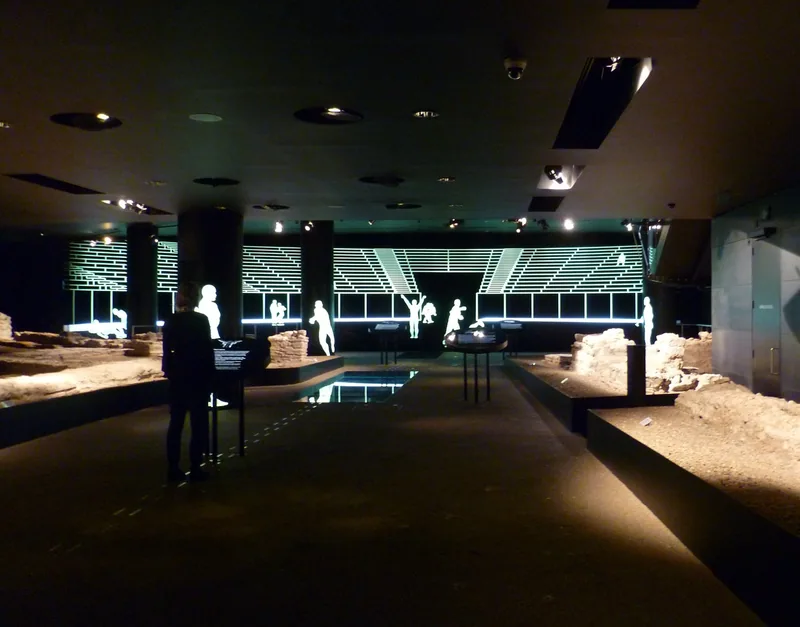
Photo: Philafrenzy · CC BY-SA 4.0 · Wikimedia Commons · resized
The art gallery upstairs
The collection belongs to the City of London Corporation and runs to about 4,500 works, of which more than 1,300 are oil paintings, dating from 1670 to the present. Its strength is Victorian painting, including Pre-Raphaelite works, alongside ceremonial and topographical pictures of the City itself.
Those City views are the reason to come if you already know London. They show streets you have walked that morning, before the Blitz and the office towers. The Smartify app, downloaded before you arrive, tells you about individual paintings on your own phone.
The gallery also runs temporary exhibitions, and the neighbouring City of London Heritage Gallery shows documents from the City's archives; an exhibition on links between America and the City ran from May to October 2026. Both are free. For the bigger collections, see our guide to free museums in London and the National Gallery.
Getting into the Great Hall
The Great Hall is the City's only surviving secular medieval building, begun in 1411 and standing on the largest medieval crypts in London. It survived both the Great Fire and the Blitz, which makes it the only secular stone structure in the City that predates 1666. The ceiling is about 27 metres up, there are monuments to Nelson, Wellington and Churchill, and Lady Jane Grey was tried here in 1553.
You cannot simply walk in. City of London Guides run monthly tours on the days the Court of Common Council meets, and these are the normal way for the public to see the hall:
- Price: £15 per person, booked in advance through City of London Guides.
- Time: tours start promptly at 11am and last about an hour.
- When: monthly, on Common Council days, with no tours in August or November. Dates listed for late 2026 were Thursday 8 October and Thursday 3 December.
- On the day: bring your booking confirmation and identification. Children must be accompanied throughout.
- Caveat: Guildhall is a working venue, and access to parts of it, including the crypts, may be restricted when tours run.
The best part of the arrangement is what comes afterwards. Because the tours run on Common Council days, you can go straight from the tour to watch the City's elected assembly in session. That is an unusual thing to be able to do on a Thursday morning, and it is free.
Closures happen at short notice for civic and state functions. The City publishes a recorded message on 020 7332 1313, updated daily, for exactly this reason. Call it on the morning of your visit if the Great Hall is the point of your trip, because a banquet or a ceremony will close it without warning.
The closures to know about in November
Mid-November is the Lord Mayor's season and the gallery's hours change around it. On Friday 13 November the gallery and amphitheatre open from 10am to 3.30pm, and the Main Gallery on the upper level only from 10am to midday. On Saturday 14 November they open 11am to 5pm, and on Monday 16 November they are closed all day.
Saturday 14 November 2026 is the Lord Mayor's Show, which sets off from Mansion House at 11am and is free to watch. If you are in the City that weekend, plan around the procession rather than against it.
Practical details
Admission is free but the gallery asks you to book a general admission ticket, which saves time at the door; walking in is also fine. Lockers are available during opening hours for a refundable £1 deposit, taking bags up to 32 x 53 x 42 cm, but the cloakroom is unattended and nothing is looked after, so do not leave anything valuable.
Floor plans and an access guide for both the gallery and the amphitheatre can be downloaded from the City of London website, and there is a visual map for visitors who want to know the layout in advance. Both spaces are indoors and level once you are inside, which makes this a reliable wet-weather stop; see our other ideas for a rainy day in London.
An hour and a half, planned
Here is the order we would do it in. Arrive at about 11.30am and start underground with the amphitheatre, which takes twenty minutes and is the thing you came for. Come up into the gallery and spend half an hour with the City views and the Victorian rooms.
Join the free introductory tour at 12.15pm or 1.15pm, which lasts 30 to 45 minutes and is the part most visitors skip, then go back to anything the guide has made you curious about. Finish outside in Guildhall Yard, standing on the marked outline of the arena with the medieval hall in front of you, which is the moment the whole site finally makes sense.
That is an hour and a half and costs nothing. Book a free admission ticket on the City of London's website beforehand if you want to save a minute at the door, and book the Great Hall tour separately with City of London Guides if you want to see inside the hall itself.
Getting there
Guildhall Yard opens off Gresham Street, in the middle of the City. Bank and St Paul's are each about five minutes away on foot, Moorgate and Mansion House a little further, and Liverpool Street and Cannon Street are both within about fifteen minutes. Plan the journey on the TfL website, and see our guide to the Underground if you are new to the network.
The City empties at weekends, which is worth knowing in both directions: the gallery is open seven days a week and is at its quietest on a Sunday, but the surrounding streets have very little open for lunch.
What to put either side of it
This is the best free hour in the City, and it combines easily. Leadenhall Market is ten minutes east, and the Roman forum and basilica that lie beneath it were the civic centre of the same Roman city. St Paul's Cathedral is five minutes west, the Monument ten minutes south, and Sky Garden is free with a booked ticket.
North, about ten minutes away, is the Barbican Centre, whose foyers are free and open late. For Roman and medieval London in one collection, the London Museum's new home at West Smithfield opens on 28 November 2026 with free galleries; see our guide to the London Museum.
For a day in the City spent almost entirely on free things, add the churches and the surviving fragments of the Roman wall, and finish in one of the places covered in historic pubs in London. More no-cost ideas are gathered in London without spending money, and buildings that are normally shut let the public in during the Open House Festival each September.
Frequently asked questions
Is the Roman amphitheatre in London free?
Yes. Admission to London's Roman Amphitheatre is free and included in the Guildhall Art Gallery ticket, which is also free. Both open daily from 10am to 5pm, with last admission at 4.45pm. You enter through the art gallery in Guildhall Yard.
Can you go inside Guildhall Great Hall?
Not usually on your own. The normal public route is a guided tour run by City of London Guides, which costs £15, starts at 11am, lasts about an hour and runs once a month on the days the Court of Common Council meets. Tours must be booked in advance, and there are none in August or November.
How long do you need at the Guildhall Art Gallery and amphitheatre?
About an hour and a half for both, of which the amphitheatre takes roughly twenty minutes. Add the free introductory tour of the gallery, which runs at 12.15pm and 1.15pm from Tuesday to Sunday and lasts 30 to 45 minutes, and you have a comfortable morning.
Do you need to book the Guildhall Art Gallery?
No, but it is recommended. Booking a free general admission ticket in advance saves time on arrival; you can also walk in on the day. Lockers are available for a refundable £1 deposit, though the cloakroom is unattended.
When was the London amphitheatre discovered?
In the late 1980s, during archaeological work before the present Guildhall Art Gallery was built. The City of London's own pages give the date as 1987 on one page and 1988 on another, so both appear in print.
Sources
- City of London - Visit Guildhall Art Gallery (checked September 2026)
- City of London - London's Roman Amphitheatre (checked September 2026)
- City of London - Guildhall Great Hall (checked September 2026)
- City of London Guides - Guildhall monthly tours (checked September 2026)
- The City of London - Guildhall Art Gallery opening times (checked September 2026)