
The Old Bailey is the Central Criminal Court, where the most serious criminal trials in England and Wales are heard. Anyone aged 14 or over can sit in the public galleries for nothing, between 9.30am and 3.30pm on weekdays. But you cannot take a phone in, there is nowhere to leave one, and since June 2026 you also need photographic identification. People are turned away every day for not knowing this.
There is no cloakroom, no locker and no bag drop at the Old Bailey. The court says in plain terms that it does not provide facilities for the safekeeping of items. If you arrive with a phone, a camera, a laptop, a water bottle or a rucksack, your choice is to go away and come back without them. Plan your whole morning around that single fact.
Once you are past that, it is one of the most extraordinary free hours in London. You sit in a wooden gallery above a working courtroom and watch a murder trial, a fraud case or a sentencing, with barristers in wigs below you and a judge on the bench. Nothing is staged. If you want a gentler introduction, the civil courts on the Strand let you keep your phone: see our guide to sitting in on a case at the Royal Courts of Justice.
Visiting the public galleries
- Address
- Central Criminal Court, Old Bailey, London EC4M 7EH
- Public access
- 9.30am to 3.30pm, weekdays (the building itself is open 8am to 7pm)
- Cost
- Free, no booking
- Minimum age
- 14; security officers may ask for proof of age
- Identification
- Official photographic ID required since 1 June 2026, checked on each entry
- Phones and cameras
- Not permitted, and cannot be left at the door
- Bags
- Handbags acceptable; large bags and rucksacks refused
- Groups
- Maximum 20, and the security team must be emailed 72 hours ahead
- Enquiries
- 020 7192 2739
The identification rule that caught everyone out
From 1 June 2026, the Central Criminal Court requires anyone entering a public gallery to produce official photographic identification. It is checked every time you go into a gallery, not once on arrival, and entry is refused without it. The court says the rule exists to protect the safety of court users and the integrity of proceedings, and that in the event of serious misbehaviour a visitor's details may be passed to the police.
A passport, a national identity card or a photographic driving licence will do. A photograph of a document on a phone will not, for the obvious reason that you cannot bring the phone. Carry the physical document.
The court also warns that gallery arrangements can change at short notice, and advises carrying the documentation in case requirements change again. Take that literally: bring ID even if you have read somewhere that it is not needed.
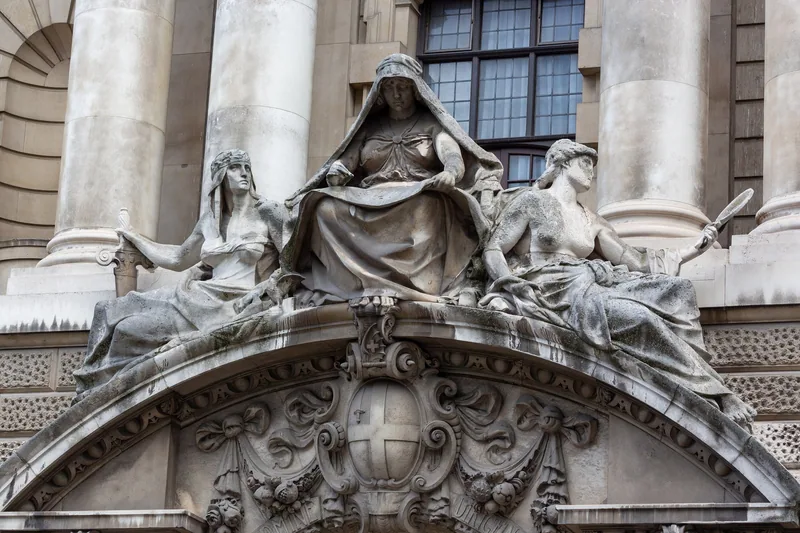
Photo: The wub · CC BY-SA 4.0 · Wikimedia Commons · resized
What you cannot bring, in full
The published list is long and the court says it is not exhaustive: the security team has the final say, and anything an officer thinks could be used as a weapon is refused, however harmless it seems to you. The items named are:
| Category | Refused at the door |
|---|---|
| Anything electronic | Mobile phones, cameras, any recording device, laptops, Kindles, smart tech, batteries |
| Blades and tools | Knives and bladed items, multi-tools, combs with sharp points |
| Optics and lights | Binoculars, monoculars, torches, laser pens |
| Liquids and sprays | Liquids, perfume and other sprays, e-cigarettes, drugs |
| Food | Food and drink of any kind, including sweets and chewing gum |
| Other | Large bags, helmets, stab vests, personal alarms, lift keys, animals other than guide dogs |
Handbags are accepted. Rucksacks and anything larger are not. There is no left-luggage office near the court, so if you are carrying a case, use one of the options in our guide to left luggage in London and travel on to the court with nothing but your ID, a notebook and a pen.
Security is thorough: X-ray screening, pat-down searches, 24-hour patrols and CCTV, with the City of London Police alongside. Counter-terrorism officers work the surrounding streets under Project Servator, which is why you may see uniformed groups standing about outside doing nothing in particular.
The coffee-shop trick that actually works. Go into a cafe near St Paul's first, leave your bag and phone with the person you are travelling with, and take turns. One of you watches a trial for an hour while the other has a coffee, then you swap. It is the only reliable way for a solo traveller with luggage to see the inside of the building.
Dress, conduct and who may go in
The court asks visitors to the public galleries to dress appropriately and says that entry to the building may be refused if you do not. This is not a suit-and-tie rule, but shorts, beachwear and slogan clothing will cause a problem. Treat it as you would a formal public building.
No one under 14 is admitted, and officers may ask for proof of age for anyone who looks close to it. Groups are capped at 20 people and must email the court's security team 72 hours before arriving. If you need any adjustment for a disability, the court asks for 48 hours' notice so the team can arrange it, and visitors of the Sikh faith who wear the five articles of faith are asked to contact security before coming for guidance on access.
Inside the gallery, the rules are those of any English court and they are not negotiable. Silence. No photography or recording of any kind, by any means. No talking to anyone in the well of the court. Move in or out while the court is between items, not while counsel is on their feet. Anything you would call a phone is already at home, so the usual courtroom risk does not arise here.
Finding something worth watching
There is no visitor timetable, because the court does not run to one. Eighteen courtrooms sit at the Old Bailey and what is in each of them changes daily. Trials that have been running for weeks may be deep in expert evidence that is impossible to follow from cold; a sentencing hearing, by contrast, is short, self-contained and often the most gripping thing in the building.
Ask at the entrance. The staff know which courts have gallery space and which are in the middle of something. Our advice: get there around 10am, when the day's business starts properly after the judges have dealt with preliminaries, and be prepared to sit in whichever court has room rather than the one you read about in the newspaper.
Not everything is open. A judge may direct that a particular hearing goes ahead behind closed doors, and reporting restrictions apply in many cases. If a court usher asks you to leave, leave.
The building, and the prison underneath it
The site has held a court since the 16th century, and before that, prisoners were kept in Newgate, the prison that stood here from at least the end of the 12th century. Newgate itself replaced the Roman west gate of the city, and every courthouse on the site has stood on the line of the Roman wall. A section of that wall is still preserved in the basement of the present building.
Public executions took place outside. The last public hanging here was in 1868 and the last execution behind closed doors in 1902; the last beheading anywhere in the country took place outside the prison in 1820.
The courthouse you see now is Edwardian. Six architects were invited to submit designs in 1898, with the brief asking for impressiveness and dignity without excessive ornamentation. Edward Mountford won, and chose a dome that would answer St Paul's Cathedral up the hill. The first stone was laid in 1902, and the building opened in 1907 with four courts and 90 cells, at a cost to the City of London Corporation of nearly £400,000. Stones from the demolished prison were used in the facade.
A 1941 air raid did heavy damage, and an IRA car bomb hit the building again in the 1970s. Rebuilding after each attack added the courts that take the total to eighteen.
The gold figure on the dome
Lady Justice stands 60 metres above the street and is 3.7 metres tall, cast in bronze and covered in gold leaf, with an arm span of 2.4 metres. She holds the sword in her right hand and the scales in her left. Unlike almost every other statue of Justice, she is not blindfolded.
Inside, a plaque commemorates the trial of the Quakers William Penn and William Mead, whose jury refused to convict them and was punished for it. The case established the principle that a jury may return a verdict according to its conscience, which is a large part of why the galleries above the courts are open to the public at all. The central chair in each of the eighteen courts is reserved for the Lord Mayor, who is the Chief Justice of the City of London, a survival explained in our guide to how the City governs itself.
Saturday tours, and why they are the easier option
If the gallery rules sound like too much, the Corporation runs out-of-hours guided tours on Saturdays, led by City of London Guides, and they must be booked in advance. You see historic rooms rather than a live trial, including areas closed on a working day, and the guide covers Newgate, the famous trials and the artworks in the building.
Crucially, mobile phones are allowed on the tour. Photography is still banned in the courtrooms, the cells and the Judges' Dining Room, but you may carry your phone through the door. Some Saturdays there is also a version that finishes with afternoon tea in the Grand Hall. Dates and prices are listed on the court's own page, which links to the official booking page: see the Corporation's Central Criminal Court page for the current programme.
A Saturday tour is the only way to photograph anything at the Old Bailey. Even then the cameras stay away in the courtrooms. If you simply want a picture of the building, the classic shot is from the corner of Old Bailey and Newgate Street, with the dome and the gold figure against the sky.
Getting there, and what to do with the rest of the day
St Paul's station on the Central line is a four-minute walk, and City Thameslink is about the same. Our Underground guide explains the lines. Note that you want the street called Old Bailey, which runs between Newgate Street and Ludgate Hill, and that the public gallery entrance is not the grand main door used by court users. It is signed; if you cannot find it, ask one of the officers outside.
An hour in the galleries sits neatly inside a day in the Square Mile. The cathedral is three minutes away, the London Museum opens its new Smithfield home on 28 November 2026 a short walk to the north, and the free churches described in our guide to All Hallows and the City churches are scattered all round you.
For the social history behind the criminal trials, our page on the real history behind the Ripper tours is a better starting point than the tours themselves, and the old pubs listed in our guide to historic London pubs include several that lawyers and journalists have used for a century. If you want more free days out of this kind, see free things to do in London.
Frequently asked questions
Can the public go into the Old Bailey?
Yes. The public galleries above the courtrooms are open free of charge from 9.30am to 3.30pm on weekdays, with no booking. You must be at least 14, carry official photographic identification, and arrive without a phone, camera or large bag, because the court provides no storage.
Why can't you take a phone into the Old Bailey?
Electronic devices of every kind, including phones, cameras, laptops and recording equipment, are banned from the public galleries for security reasons and to protect court proceedings. The critical point is that the entrance has no storage of any kind, so anyone carrying one has to go away and come back.
Do you need ID to get into the Old Bailey?
Yes, since 1 June 2026. Official photographic identification is required for access to the public galleries and is checked each time you enter a gallery. Entry is refused without it, so bring a passport, national ID card or photocard driving licence rather than a copy on your phone.
Can children visit the Old Bailey?
No one under 14 is admitted to the public galleries, and security officers may ask for proof of age. The subject matter is often distressing and the galleries are not designed for young visitors, so families with younger children should choose the Royal Courts of Justice or one of London's museums instead.
How do I book a tour of the Old Bailey?
Guided tours run on Saturdays outside court hours and must be booked in advance through the official listing linked from the City of London Corporation's Central Criminal Court page. Some dates include afternoon tea in the Grand Hall. Phones are allowed on the tour, but photography is not permitted in the courtrooms, the cells or the Judges' Dining Room.
Sources
- City of London Corporation - Central Criminal Court (checked September 2026)
- City of London Corporation - Central Criminal Court prohibited items (PDF) (checked September 2026)
- HM Courts & Tribunals Service - Central Criminal Court (checked September 2026)
- GOV.UK - What to expect coming to a court or tribunal (checked September 2026)
- City of London - The Old Bailey visitor listing (checked September 2026)