
All Hallows by the Tower is the oldest church in the City of London and it is free to walk into, seven days a week. Underneath it, in a crypt museum that is also free, you can stand on the tessellated floor of a Roman house laid in the late 2nd century. Dozens more churches are scattered through the Square Mile, almost all of them free, and most visitors walk past every one.
These buildings are the best-value hour in the City. They are warm, quiet, usually empty, and they contain Roman floors, Saxon arches, Wren woodwork and war memorials that no museum could assemble. The catch is opening times: most are weekday buildings that shut when the office workers go home, and several close all weekend.
Our guide to the City of London as a neighbourhood introduces them in a paragraph. This page is the practical version: which ones to go into, what is inside each, when the doors are actually open, and how to string them into a walk.
All Hallows by the Tower
- Address
- Byward Street, London EC3R 5BJ
- Entry
- Free, including the crypt museum
- Open
- Monday to Friday 8am to 5pm; Saturday and Sunday 10am to 5pm
- Volunteer guides
- Most weekdays, 10.30am to 1.30pm and 2pm to 4pm; short tours leave on demand
- Best arrival time
- Before 3.30pm, to allow time to look round
- Groups
- Self-guided groups of more than five must book in advance
- Nearest station
- Tower Hill (District and Circle), two minutes
- Refreshments
- The Byward Kitchen & Bar, in the church building
What is actually inside All Hallows
The church stands immediately north-west of the Tower of London, which is how it got its unglamorous name. It was founded long before the Tower existed, and the fabric spans about thirteen centuries. Five things are worth finding.
- The Roman pavement. Down in the crypt, part of the tessellated floor of a late 2nd-century domestic house survives in place. You are standing on the floor level of Londinium, several feet below the modern street.
- The Saxon arch. At the west end of the church, an arch survives from the building's earliest phase, long before the Norman Conquest, built with re-used Roman material.
- The registers. The crypt museum holds parish registers going back to the 16th century, and their entries are a roll call of Atlantic history: the baptism of William Penn, founder of Pennsylvania; the marriage of John Quincy Adams, later President of the United States; and the burial of Archbishop William Laud after his execution on Tower Hill.
- Shackleton's crow's nest. The large barrel with metal uprights and a spliced rope is the crow's nest from the Quest, the ship Ernest Shackleton took on his last Antarctic voyage in 1921. It used to sit in a corner of the museum and is now displayed in the south aisle of the church. The Quest sailed past this church and through a raised Tower Bridge on 17 September 1921 with the river banks lined with well-wishers.
- Toc H. A model of Talbot House recalls the work of the Reverend Philip "Tubby" Clayton, vicar here and founder of the Toc H movement that began in a soldiers' rest house behind the lines in the First World War. His effigy is in the church.
The building you see was heavily rebuilt after severe bomb damage in the Second World War. Enough of the older fabric survived, above and below ground, to make the church a layered record of the site rather than a reconstruction.
The volunteer guides are the best free tour in the City. They are on duty most weekdays from 10.30am to 1.30pm and from 2pm to 4pm, and they will take you round on the spot, at no charge, from the Saxon arch to the present day. Just ask. Arrive before 3.30pm so there is time to finish.
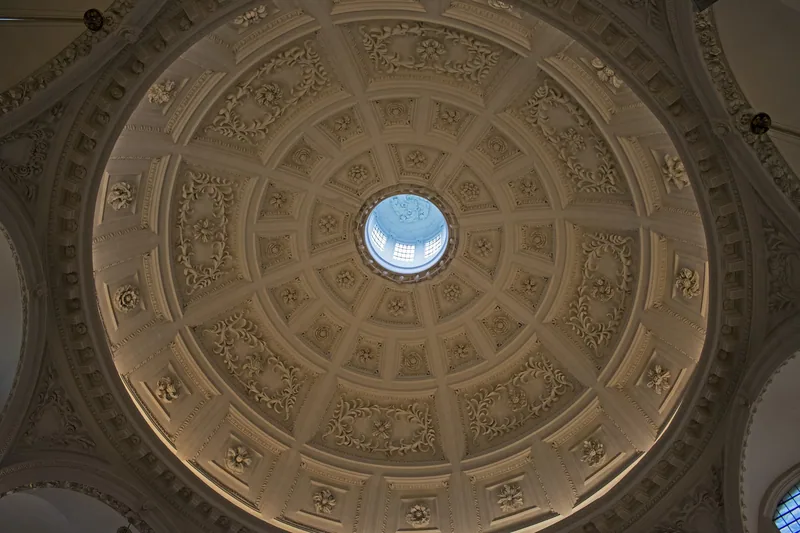
Photo: Ymblanter · CC BY-SA 4.0 · Wikimedia Commons · resized
The walk: six more churches, all free
These are the ones we would go into, listed west to east, with the hours they publish. All are free.
| Church | Opening hours | Why bother |
|---|---|---|
| St Bride's, Fleet Street | Mon to Fri 8am to 5pm; Sat 10am to 3.30pm; Sun 10am to 6.30pm | The journalists' church. A Roman tessellated pavement of about AD 180 sits behind the altar in the crypt chapel, and the stepped spire is the one that supposedly gave confectioners the idea for a tiered wedding cake |
| St Bartholomew the Great, Smithfield | Mon to Sat 10am to 5pm; Sun between services | Norman, 12th century, and older than anything Wren touched. Free to enter, though the parish asks for a donation |
| St Lawrence Jewry, next to Guildhall | Mon to Fri 9am to 5pm | Free lunchtime recitals every Tuesday at 1pm in term time; a Royal Marines' chapel open for quiet prayer on weekdays |
| St Mary-le-Bow, Cheapside | Mon to Fri 7.30am to 6pm; weekends informally | The Bow Bells. It opens earlier than almost anything else in the City, which makes it a good first stop |
| St Stephen Walbrook, behind Mansion House | Mon to Fri 10.30am to 3.30pm | Wren's domed interior, often called a rehearsal for St Paul's, with a massive round stone altar under the dome |
| St Dunstan in the East | Daylight hours, outdoors | A bombed church left as a ruin and planted as a garden, with its own guide on this site |
St Bartholomew the Great is closed to visitors from Monday 21 to Saturday 26 September 2026. During that week the neighbouring St Bartholomew the Less, open every day from 8am to 10pm, stays open for visitors and private prayer. Church closures for weddings, funerals and concerts are common and are usually announced only a few days ahead, so check the individual website the night before.
The weekday problem
City churches are financed and staffed by a working population that goes home at six and disappears on Friday night. That produces a pattern you need to plan around.
- Tuesday to Thursday, 11am to 3pm is the reliable window. Nearly everything is open, the guides are on duty, and the recitals happen.
- Monday is slightly thinner, and some churches open late after the weekend.
- Friday afternoon starts to close down from about three.
- Saturday and Sunday are for All Hallows, St Bride's and St Bartholomew the Great, and for the outdoor ruins. Almost everything else is locked.
The exception is a Sunday morning service, which is free, open to anyone and often the only way into a building. You are not expected to be Anglican or to join in; sit at the back and leave when you like.
Free music at lunchtime
The City churches put on more free music than any other part of London, and it is almost all in the middle of the day, aimed at office workers with an hour to spare.
The most dependable is St Lawrence Jewry, beside Guildhall, which runs recitals every Tuesday at 1pm during term time, plus a series played by young organists from schools accredited by the Royal College of Organists. All Hallows runs its own organ recital series. Several other churches put on piano or chamber recitals on fixed weekdays, usually at 1pm or 1.05pm, and they are advertised on a board outside rather than anywhere findable in advance.
Take cash or a card for the retiring collection, which is the usual arrangement. Our guide to free live music in London has the rest of the city's options.
Ceremonies you can watch
All Hallows keeps two customs that are worth timing a visit around. Beating the Bounds is the ancient parish ritual of walking the boundary and striking the markers with willow wands, and which this parish still carries out every year. The Knollys Rose Ceremony involves a single red rose being carried on a cushion to the Lord Mayor at Mansion House, in payment of a rent imposed on Sir Robert Knollys in the 14th century and never cancelled.
Both are free to watch, both happen once a year, and dates are published on the church's events pages. They are the kind of thing the City does without irony, and they make more sense once you understand how the Square Mile governs itself: see our guide to the City of London explained. In September, the Open House Festival opens church towers and roofs that are shut for the rest of the year.
How to behave in a working church
None of these buildings is a museum, and all of them are used for prayer during opening hours. The conventions are simple: keep your voice down, do not walk in front of anyone who is praying, ask before photographing people, and if a service starts while you are there, either sit down quietly or leave by the nearest door.
Photography of the building is generally fine, and flash generally is not. Some churches ask for no photography at all, and there will be a sign. Groups of more than five people should book ahead at All Hallows, and larger groups should assume the same elsewhere.
A two-hour City church walk
Start at Tower Hill station. All Hallows is two minutes away; allow forty-five minutes including the crypt. Walk north-west to St Dunstan in the East, five minutes, then on to the Monument and up the hill to St Stephen Walbrook.
From there it is three minutes to Bank junction and the Royal Exchange, five more to St Lawrence Jewry and Guildhall, then down Cheapside past St Mary-le-Bow to St Paul's. If you still have energy, Postman's Park and its wall of memorial plaques is five minutes north, and St Bartholomew the Great five minutes beyond that, near where the London Museum opens its Smithfield building on 28 November 2026.
Two hours at a steady pace, six or seven churches, and the only money you will spend is on lunch. For the legal quarter's equivalent, see our guide to Temple Church and the Inns of Court, and for other days out that cost nothing, free things to do in London.
For lunch, the old City pubs in our guide to historic pubs in London are mostly on this route, and Leadenhall Market is a short detour east with places to sit down.
Frequently asked questions
Is All Hallows by the Tower free?
Yes. Entry to the church and to the crypt museum, with its Roman pavement and parish registers, is free. It opens Monday to Friday from 8am to 5pm and at weekends from 10am to 5pm. Volunteer guides give short tours on most weekdays without charge.
What is the oldest church in the City of London?
All Hallows by the Tower, founded in the Saxon period, with a Saxon arch still standing at the west end and a Roman floor beneath it. St Bartholomew the Great in Smithfield, founded in the 1120s, describes itself as London's oldest parish church, and the two claims rest on different definitions.
Are the City churches open at weekends?
Mostly not. The Square Mile empties out at the weekend and so do its churches. All Hallows by the Tower, St Bride's and St Bartholomew the Great open on Saturdays and Sundays; the majority do not. Tuesday to Thursday between 11am and 3pm is the reliable window.
Can you see Roman remains in a City church?
Yes, in two. The crypt museum at All Hallows by the Tower has part of a tessellated floor from a late 2nd-century house, and the crypt at St Bride's on Fleet Street has a Roman pavement dated to around AD 180 behind the altar of the main crypt chapel. Both are free.
Where can I hear free lunchtime music in the City?
St Lawrence Jewry beside Guildhall runs recitals every Tuesday at 1pm during term time, including a series by young organists from Royal College of Organists schools. All Hallows by the Tower has its own organ recital series. Several other City churches hold weekday recitals around 1pm, usually advertised on a board outside.
Sources
- All Hallows by the Tower - Visit (checked September 2026)
- All Hallows by the Tower - The Crypt Museum (checked September 2026)
- St Bride's Fleet Street - Visit (checked September 2026)
- Great St Bartholomew - Visit Us (checked September 2026)
- St Lawrence Jewry - services and recitals (checked September 2026)
- St Mary-le-Bow - opening times (checked September 2026)
- St Stephen Walbrook - opening times (checked September 2026)