
Lesnes Abbey Woods in south-east London has two free things side by side: the ruins of an abbey founded in 1178, and, a short walk up into the woods, a fossil pit where the public may dig and take home small finds, most often sea shells and sharks' teeth about 55 million years old. The park is open from dawn to dusk every day of the year, and it is about ten minutes' walk from Abbey Wood station on the Elizabeth line.
Bexley Council manages the site. It covers 88 hectares of woodland, heath, meadow and formal gardens on a hillside above Thamesmead, with the ruins on the lower slope and the woods rising behind. There is no ticket, no booking for families and no opening day to catch, which makes it unusual among London's prehistoric attractions.
Our guide to Bexleyheath and Erith places the abbey among the borough's other sights, including Hall Place, whose stone is said locally to have come from the abbey. This page is about the visit itself: where the pit is, the rules for digging, what you are likely to find, and how to make a half-day of it with children.
Lesnes Abbey Woods at a glance
- Price
- Free, including the fossil pit for individuals and families
- Open
- Dawn to dusk, 365 days a year (Bexley Council)
- Address
- Lesnes Abbey Lodge, New Road, London SE2 0AX
- Station
- Abbey Wood (Elizabeth line, Southeastern, Thameslink), about 10 minutes' walk
- From central London
- 26-27 minutes on the Elizabeth line from Tottenham Court Road; TfL's planner quoted £3.60 for a weekday morning journey in November 2026
- Digging rules
- No more than 2 kg of material taken away; dig no deeper than two feet (about 60 cm); refill large or deep holes
- Groups and schools
- Must book with the council at least a month ahead; a charge applies
- Facilities
- Kiosk and toilets at the Lodge, by the ruins; play area and outdoor gym
The fossil pit, and what is in it
Part of the woods is a Site of Special Scientific Interest, and the council describes it as containing fossils from the Eocene epoch, the period after the dinosaurs when mammals spread across the world. The council's pages give the age as 54.5 million years on one page, 55 million on another and 55.5 million in its family activity booklet; "about 55 million years" is the fair summary.
Scientists have recorded more than 40 species of mammal from the site, as well as reptiles, fish and early birds. A visitor with a sieve is not going to find a mammal skeleton. The council says the most common finds are various shells and sharks' teeth, and its family booklet lists sharks' teeth and shells among the things to tick off.
Only one small area of the woods is open for digging: the fossil pit itself. Nowhere else in the park, and certainly not around the ruins, is for digging, which is a protected monument.
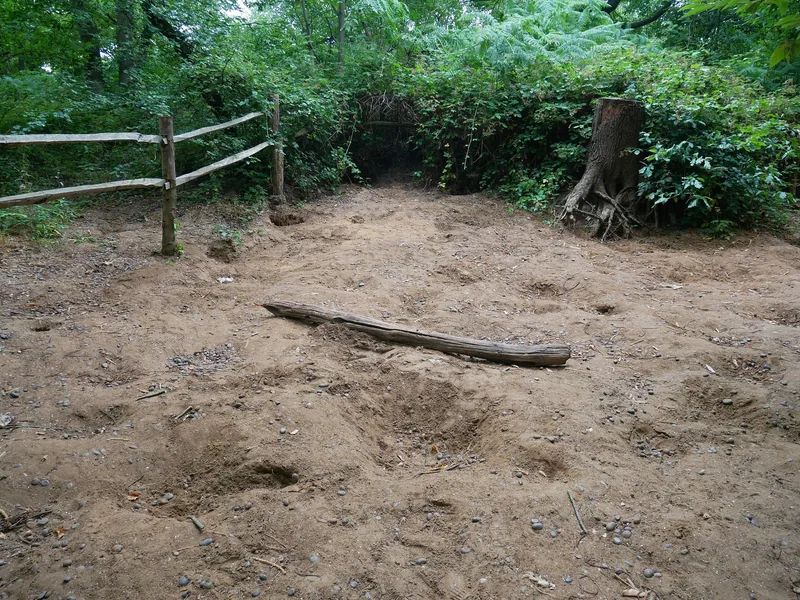
Photo: Ethan Doyle White · CC BY-SA 4.0 · Wikimedia Commons · resized
Finding the pit: it is not by the ruins
It is easy to assume the fossils are next to the abbey. They are not. On the council's park map the fossil pit is marked in the woods south of the ruins, beside a timber sculpture of a Coryphodon, a large early mammal. On the map's scale that is roughly 250 metres from the ruins in a straight line, uphill and under the trees.
From the Lodge and the abbey, take the path up the slope into the woodland behind the Monk's Garden. The dark green "Lesnes Explore" themed walk on the map passes the pit. The council's group sessions walk participants "up into the woods" to reach it, which is a fair description: allow ten minutes from the ruins at a child's pace, more in mud.
Save the council's park map on your phone before you go. Paths in the woods cross and fork, and the pit is out of sight of the ruins. On the map it is number 15, "Fossil Pit & Coryphodon sculpture"; with that on your screen, the sculpture is the landmark to look for.
The digging rules, and what you can take home
The council allows anyone to dig in the pit, and it sets three rules for visitors. You may remove no more than 2 kilograms of material from the site. You must not dig more than two feet deep. And you should fill in any large or deep holes when you finish. Groups, schools and professional digs must contact the council to book, and pay a charge.
Within those limits, small finds are yours to keep, which is what makes this place different from a museum. The 2 kg limit is generous for teeth and shells; it exists to stop people carrying away the fossil-bearing sand itself.
The council's guided group sessions use sieves and trowels, with identification guides and bags for finds. A family arriving on its own needs to bring the same kit: a garden trowel, a kitchen sieve or a cheap garden riddle, a small bag or pot for finds, and a bottle of water to rinse the sand off what you sift. A magnifying glass helps with the smaller teeth.
Sieve the sand rather than digging deep. Most finds come from sifting loose material near the surface, not from tunnelling, and the two-foot limit is there because deep holes damage the site and are a hazard for the next family. Sift, look, refill, and move a step along.
What to wear, and when to go
The pit is in open woodland on a slope, so wear shoes you do not mind getting muddy and clothes that can kneel in sand. After heavy rain the paths are slippery and the sand clogs a sieve, so a dry spell is the best time. There is no shelter at the pit.
The park is open from dawn to dusk, so in winter the day is short: plan to be down from the woods before the light goes. Spring is the most attractive season. The council says the wild daffodils in March are believed to be the largest display in south-east England, and the woods fill with bluebells in April and May. Our guides to London in March and London in April cover what else is on.
The abbey ruins: who founded it, and why
Lesnes Abbey was founded in 1178 by Richard de Luci, Chief Justiciar of England, for canons of the Augustinian order. The council says he founded it as penance for his role in the murder of Thomas Becket, Archbishop of Canterbury, in 1170. It was dedicated to St Mary and St Thomas the Martyr.
It was never a rich house. Its land included the marshes where Thamesmead now stands, and the cost of draining them and keeping the river embankments up drained the abbey too. Cardinal Wolsey closed it in the 1520s, more than a decade before Henry VIII's Dissolution of the Monasteries; the council's page gives 1525, and the Historic England list entry 1524.
What survives is low walls of Kentish ragstone, flint and chalk, in places up to about eight feet high, marking out the abbey church and the monastic buildings to its north, with one pointed stone doorway and several lancet windows. The ruins are a scheduled monument and Grade II listed. A mansion built into the remains was demolished in 1844, and the site was excavated in stages from 1909.
The layout is easy to read from the slope above, and the Monk's Garden lies beside them. In the woods near the garden is the Conduit Pond, a spring-fed pool the council believes supplied the monks with drinking water, since the Thames here was too salty to drink.
The rest of the park
The Lodge by the ruins has the kiosk, the toilets and a programme of workshops and events. Further along Abbey Road there is a large play area, a junior BMX track, a parkour area, ball courts and an outdoor gym. The council's map also marks a London skyline viewpoint beside the ruins, a heathland area with a tumulus (an ancient burial mound), an old chalk pit and a memorial to William Morris, whose Red House is a couple of miles south.
The park and gardens are accessible to wheelchair users, and the council recommends the entrance at the bottom of the hill on New Road, near Monks Close, where there are Blue Badge bays. The woods and the fossil pit are on rougher, sloping paths and the council does not describe them as accessible. Dogs must be on a lead in the park area and are not allowed in the play area or the Monk's Garden.
Getting there, and making a half-day of it
Abbey Wood station is the end of the south-eastern branch of the Elizabeth line, and Southeastern and Thameslink trains stop there too. The council puts the walk at ten minutes; it is uphill at the end. Buses 229, 469, 301, 244, B11, 180 and the Superloop SL3 and SL11 all serve the park, and route 99 reaches the woods by the Woolwich Road entrance. If you drive, the council points to the Gayton Road and Felixstowe Road car parks near the station, about ten minutes away, and limited street parking on Abbey Road and New Road.
With children, the abbey, a dig in the pit and a run in the play area fill about three hours. Combine it with the Thames Barrier or Woolwich on the way back, both on the same side of the river. For a fossil theme across the day, the dinosaurs at the Natural History Museum are the indoor complement, and mudlarking on the Thames foreshore is the other place in London where looking at the ground pays off, though there you need a permit to dig.
Is it worth the journey? For families with children who like collecting things, yes: it is free, the train ride is under half an hour from the West End, and they will probably go home with a shark's tooth. For adults without children, the ruins alone are a pleasant hour but not a reason to cross London; our list of free things to do in London has closer options.
Frequently asked questions
Can you keep fossils from Lesnes Abbey?
Yes, within limits. Bexley Council allows visitors to take away no more than 2 kilograms of material from the site, and asks you not to dig deeper than two feet and to refill large holes. Small finds such as shells and sharks' teeth are what most people go home with.
Do you need to book to dig in the Lesnes Abbey fossil pit?
Not as an individual or family: the pit is in a public park open from dawn to dusk. Groups, schools and professional digs must contact Bexley Council at least a month ahead to book, and the council charges for this.
Where is the fossil pit in Lesnes Abbey Woods?
In the woods south of the abbey ruins, uphill from the Lodge, beside a timber sculpture of a Coryphodon. It is marked as number 15 on the council's park map, and the "Lesnes Explore" themed walk passes it.
How do you get to Lesnes Abbey from central London?
Take the Elizabeth line to Abbey Wood, about 26 minutes from Tottenham Court Road, and walk about ten minutes uphill to the park. Southeastern and Thameslink trains also stop at Abbey Wood, and several bus routes, including the Superloop SL3 and SL11, serve the park.
How old are the fossils at Lesnes Abbey?
About 55 million years old, from the Eocene epoch. Bexley Council's own pages give figures between 54.5 and 55.5 million years. The site is a Site of Special Scientific Interest for these fossils.
Sources
- Lesnes Abbey Woods (Bexley Council) - Unique geology and fossil pit rules (checked November 2026)
- Lesnes Abbey Woods (Bexley Council) - Fossil hunting for groups (checked November 2026)
- Lesnes Abbey Woods (Bexley Council) - History of the Abbey (checked November 2026)
- Lesnes Abbey Woods (Bexley Council) - Facilities and accessibility (checked November 2026)
- Lesnes Abbey Woods (Bexley Council) - Directions and contact (checked November 2026)
- Lesnes Abbey Woods (Bexley Council) - Park map (checked November 2026)
- Historic England - Ruins of Lesnes Abbey, list entry 1359415 (checked November 2026)
- Transport for London - Journey planner (checked November 2026)