
An escape room is a locked set you have sixty minutes to solve your way out of, usually with three to six people. In London the going rate is about £32 a head off-peak and £37 at peak times, the games are private so you are never put with strangers, and popular weekend slots go a week or two ahead. The one thing that catches visitors out is per-person pricing with a minimum charge, which makes a game for two much dearer per head than a game for four.
This page covers how they work, what a family of four really pays, which ones suit which ages, and what goes wrong. If it is the real underground war headquarters you are after rather than a puzzle version of one, see our guide to the Churchill War Rooms instead.
Escape rooms in London
- Length
- Usually 60 minutes of game time, plus about 20 minutes of briefing and photographs
- Price
- Around £32 per person off-peak, £37 peak; longer games more (September 2026)
- Team size
- Designed for 3–6; two is possible but harder
- Privacy
- Reputable venues never mix bookings. You play with your own group
- Booking
- One to two weeks ahead for weekend evenings; a few days midweek
- Minimum age
- Varies. Under-9s often struggle; some rooms are 14+ or 18+
How the hour actually goes
You arrive, leave your coats and bags, and get a short briefing: the story, the rules, how to ask for a clue. Then the door closes and the clock starts.
Inside, you search the room for objects and information, work out what connects them, and use the answers to open locks, drawers and doors. Progress is usually linear at first and then branches, which is why several people working in parallel beats one person working carefully. A games master watches on camera and sends hints, either on a screen or over a speaker.
Nobody is locked in against their will: every venue has a way out in an emergency, and you can leave at any point. The door being "locked" is part of the fiction, not a safety arrangement.
At the end you get a photograph with a sign saying whether you escaped, and about half of teams do not. That is normal and by design.
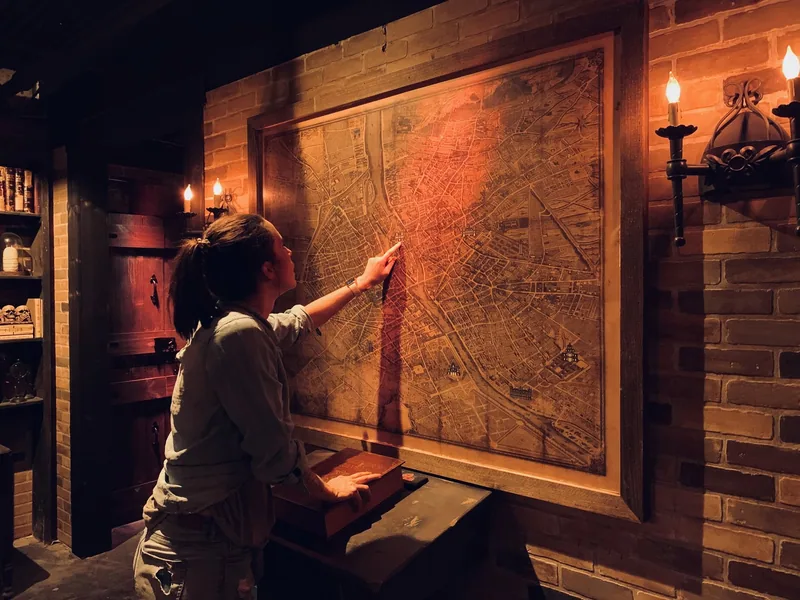
Photo: Hudson Bloom · CC BY-SA 4.0 · Wikimedia Commons · resized
What it costs, and the trap in the pricing
London escape rooms charge per person, not per room, with a minimum number of people billed. We checked one long-established venue near King's Cross as a reference point; it is one of many operators and we are not recommending it over the others, but the price structure is typical.
| Booking | Off-peak | Peak |
|---|---|---|
| Standard 60-minute mission | £31.99 per person | £36.99 per person |
| Longer mission (4–8 players) | £39.99 per person | £39.99 per person |
| Minimum charged | Three players, even if two turn up | |
Prices checked September 2026; confirm on the venue's own booking page. Now the arithmetic that matters.
- Two adults, off-peak: billed as three, so £95.97, or almost £48 each. Escape rooms are poor value for couples.
- Two adults and two children, off-peak: £127.96 for the four of you.
- The same family at peak: £147.96. Moving to a weekday afternoon saves £20.
- Six people: £191.94 off-peak, and the same room, so the per-head cost is unchanged but the game is easier.
Two people should find a third, or go off-peak. Because the minimum charge is three players, a couple pays for a person who is not there. Bringing along a friend costs nothing extra, and it genuinely improves your chances: sixty minutes is not long with two pairs of hands.
Group discounts are not the norm. If you have more than six, most venues run several identical rooms at the same time so two teams can race each other, which is the best version of an escape room for a large group. Our page on how much a trip to London costs puts these figures against the rest of a day out.
Team size: why three to five is the sweet spot
Rooms are designed for a range, typically three to six. Two can complete most of them but will run out of time on the searching stage. Seven people in a room built for six means somebody spends the hour looking over shoulders, and venues say so openly.
Four is the number we would aim for with mixed ability, five if the group includes someone who has never done one. If you are eight, book two rooms rather than squeezing into one.
Age limits and what suits children
There is no single rule, and the limits are set room by room. As a guide:
| Age | What to expect |
|---|---|
| Under 9 | Venues warn that younger children may find the puzzles hard and struggle to stay focused for an hour. Allowed in most rooms with adults, but they will not be solving much |
| 9–13 | Works well in a family team where adults carry the harder logic. Choose a light-hearted theme |
| 14+ | The natural audience. Seasonal horror versions of otherwise ordinary rooms are often rated 14 and over |
| 18 only | Some dedicated horror rooms are strictly over-18. Photographic ID may be required |
The seasonal point matters for an autumn visit: around Halloween, several operators run their standard rooms with different lighting and sound and raise the age rating accordingly. If you have booked a family game in late October, check whether the version running that week is the one you think you booked.
Our guides to London with kids, London with teenagers and rainy-day activities for children cover the alternatives if the ages in your group do not line up.
How far ahead to book
Escape rooms have very small capacity. A venue might have four rooms running one game an hour, which is at most 24 teams a day. That is why weekend evenings disappear.
- Friday and Saturday, 5pm to 9pm: book one to two weeks ahead.
- Sunday afternoon: a few days is usually enough.
- Weekday afternoons: often available the same day, and cheaper.
- Between Christmas and New Year: book well before you travel. It is one of the busiest weeks of the year for indoor activities.
Booking systems hold slots briefly while you pay, so if your session times out you may find the time blocked for twenty minutes before it returns. Wait rather than rebooking. Refunds are rarely given when a team member drops out, though most venues will try to help you move a booking if the whole group cannot come.
Practical details nobody mentions
- Arrive 15 minutes early. The clock starts at your slot time, not when you get there.
- Luggage is usually manageable. Venues near stations are used to travellers and will normally store a suitcase, though space can be limited. If in doubt, read our guide to left luggage in London first.
- Wear something you can crouch in. Low drawers, floor-level clues and dim lighting.
- Tell them about claustrophobia or mobility needs when booking. Many rooms are in basements and railway arches with steps and no lift; our guide to accessible London covers the general problem, but you must ask the venue directly about a specific room.
- Alcohol before a game is a bad idea, and venues operate age-verification policies. Save the pub for afterwards.
- Ask for hints. Teams that refuse clues out of pride do not escape, and the games master would rather you enjoyed the last twenty minutes than stared at a padlock.
Where they are
Escape rooms are scattered through zones 1 and 2, usually in basements, upper floors and railway arches rather than on high streets, which is why you rarely notice them. The practical consequence for a visitor is that the location matters less than the timing: almost anywhere in central London is thirty minutes from almost anywhere else on the Underground, and our guide to the Tube covers the network.
King's Cross is the easiest area to build an evening around, because the venue we checked is there and the area is full of places to eat afterwards. Book a room for six, eat at eight, and the evening organises itself; see late-night food in London for the later end.
What goes wrong
Four things, in order of frequency. Arriving late, which eats your game time. Booking for two, paying for three and then not finishing. Choosing by theme rather than difficulty: most venues rate their rooms, and a first-timer in the hardest room will have a frustrating hour. Too many people, which turns half the group into spectators.
None of these is the venue's fault and all of them are avoidable in ninety seconds of reading before you book.
If an escape room is not quite right
The nearest cousins are immersive theatre, where you walk through a performance rather than solve it, covered in our guide to West End theatre; and outdoor puzzle trails, which are cheaper and work in daylight. For a group evening with no puzzles at all, comedy clubs take walk-ins more readily.
For a rainy afternoon with children, ice skating costs less per head and burns more energy, and our list of things to do when it rains in London has more. For an evening walk with a story attached instead of a puzzle, see ghost tours in London. The full list is under family days and experiences.
Frequently asked questions
How much does an escape room cost in London?
Around £32 per person off-peak and £37 at peak times for a standard 60-minute game, with longer games nearer £40 (September 2026). Pricing is per person with a minimum of about three people charged, so a game for two costs almost £48 a head.
Will we be put in a room with strangers?
No. Reputable London venues run every game as a private booking and do not combine groups to fill a room. If a venue does mix bookings, it will say so, and most people would avoid it.
How many people should be in an escape room team?
Three to five is the sweet spot for a 60-minute game. Two can do it but will usually run out of time. Six is the normal maximum, and above that most venues suggest booking two identical rooms so the group can split and race.
Are escape rooms suitable for young children?
Children under about nine often find the puzzles hard and struggle to concentrate for a full hour, and venues say as much. From nine upwards a family team works well if the adults handle the harder logic. Some rooms are rated 14 and over, and dedicated horror rooms may be strictly 18.
How far in advance should I book?
One to two weeks for Friday and Saturday evenings, a few days for Sunday, and often the same day for a weekday afternoon, which is also the cheapest slot. Book well before you travel for the week between Christmas and New Year.
Sources
- clueQuest - prices, team sizes and booking FAQs (checked September 2026)
- clueQuest - escape room missions, London (checked September 2026)
- GOV.UK - Alcohol and young people: the law (checked September 2026)