
Woolwich is eight minutes from Canary Wharf, fifteen from Liverpool Street and twenty-one from Tottenham Court Road on the Elizabeth line, and it is in fare Zone 4, so a day out here sits inside the same daily cap as a day in the centre. What you get for the journey is a military arsenal turned into a creative quarter, a free ferry with lorries on it, a Victorian foot tunnel under the river, a seven-day market and the Thames Barrier a mile upstream.
What you do not get is the museum most people come looking for. Firepower, the Royal Artillery Museum that occupied part of the Arsenal, closed at the end of 2016 and its collection and archive moved to Larkhill in Wiltshire, along with the Royal Artillery itself. Plenty of listings still name it.
Woolwich is not pretty and it does not try to be. It is a working town centre with a large West African and Nepali population, a garrison, a river frontage of new flats and a shopping street that has seen better decades. It is also one of the best-value half-days in London, because almost everything worth doing here is free.
Woolwich at a glance
- Where
- Royal Borough of Greenwich, SE18, fare Zone 4
- Two stations, one minute apart
- Woolwich for the Elizabeth line; Woolwich Arsenal for the DLR and Southeastern trains
- Journey times
- Canary Wharf 8 minutes, Liverpool Street 15, Tottenham Court Road 21, Abbey Wood 6
- Fare
- Woolwich to Canary Wharf £3.20 peak, £2.40 off-peak
- Free things
- The ferry, the foot tunnel, the Arsenal riverfront, Beresford Square market, the Barrier from the bank
- Step-free
- Woolwich and the DLR platforms at Woolwich Arsenal are; the Southeastern platforms are not
The two stations, and which one you want
Woolwich has two stations with almost the same name, a minute's walk apart, and choosing wrongly costs you twenty minutes.
Woolwich is the Elizabeth line station, opened with the central section in 2022, and it is the one to use from anywhere in central London. It is step-free from street to train, and TfL's station data records step-free route information for both platforms.
Woolwich Arsenal is the older station: the Docklands Light Railway underground and Southeastern trains from London Bridge and Cannon Street on the surface. The DLR platform is step-free, reached by lift; the two National Rail platforms are not, according to TfL's own station data. That matters if you are coming from London Bridge with a suitcase or a pushchair. Our guides to the Elizabeth line, the DLR and step-free travel in London cover the network side.
Both stations are in Zone 4. Because zones affect the cap rather than every journey, a day that comes out here and goes back into the centre costs little more than a day spent entirely in Zone 1; our page on London's travel zones explains how that works. The Superloop's SL11 route also runs along the river between North Greenwich and Abbey Wood through Woolwich, for a flat bus fare; see the Superloop and outer London buses.
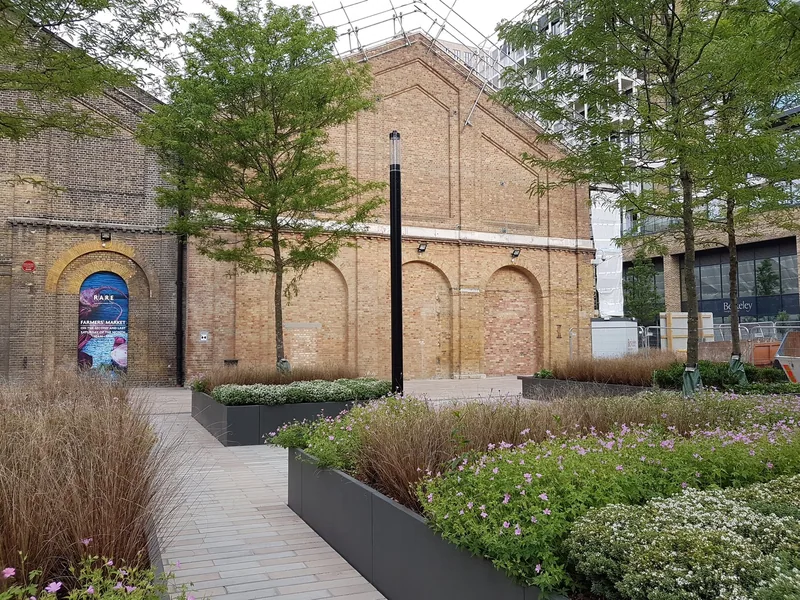
Photo: Kleon3 · CC BY-SA 4.0 · Wikimedia Commons · resized
The Royal Arsenal, and what is in it now
The Royal Arsenal is the reason Woolwich exists. Guns, gunpowder and ammunition were made and stored here for three centuries, and the site employed tens of thousands of people in both world wars. It closed as a manufacturing site and has been redeveloped as housing since the late 1990s, but the best of the eighteenth and nineteenth-century buildings survive along a grid of streets behind the river wall.
Walk in from Beresford Square through the Arsenal gatehouse and you are on No 1 Street: long brick ranges, a parade ground, cannon still lying about, and a riverfront path with the Thames on one side.
At 11 No 1 Street, in the buildings of the old Fireworks Factory, is Woolwich Works, which opened in September 2021. The Royal Borough of Greenwich restored the buildings to create a creative district of about 15,000 square metres, with concert and performance venues, dance studios and offices. There is no ticket needed to walk through the site, and its own bar and cafe were rated 4 for hygiene at an inspection in July 2024.
Two pubs occupy Arsenal buildings on the same street: one in the Dial Arch itself, rated 5 in March 2025, and one in the old guardhouse, rated 5 in December 2024. The Dial Arch is the obvious lunch stop on this walk and the only place on the Arsenal site with a garden.
The Arsenal riverfront is the free half-hour that makes the journey worth it. From Beresford Square, through the gatehouse, along No 1 Street to the river, then west along the Thames Path towards the Barrier. Flat, paved, step-free and open at all hours, with the working river in front of you: container traffic, aggregate wharves and cranes rather than tour boats. Nobody charges for any of it.
Crossing the river for nothing, twice
Woolwich has two free river crossings and they are both worth doing once.
The Woolwich Ferry is run by Transport for London, carries pedestrians, cyclists and vehicles including lorries, and charges nothing at all: no ticket, no reader to touch. It runs from 06:00 to 22:00 seven days a week, every fifteen minutes until 21:00 and then at 21:20, 21:40 and 22:00, with the same timetable on Sundays and public holidays. It is step-free from the road on both banks, which makes it the accessible option here.
The Woolwich Foot Tunnel runs 504 metres under the river from Woolwich High Street to North Woolwich, was built in 1912 for dockworkers, and is open 24 hours with a lift and a spiral staircase at each end. It is emptier and plainer than the better-known Greenwich tunnel, and its lifts have a poor record. Our guide to the ferry and the foot tunnels has the live status page to check and explains the rule about pushing bicycles.
Ride the ferry out and back rather than treating it as transport. It takes about half an hour including the wait, and it is the best free view of the estuary in London.
The Thames Barrier
A mile upstream, between Woolwich and Charlton, the ten steel gates of the Thames Barrier cross the river. You cannot walk onto it, but you can see it closely from the south bank path, and the walk from the Arsenal along the Thames Path takes about twenty-five minutes.
The Information Centre on the south bank opens on Saturdays only, from 4 April to 31 October 2026, with tickets sold at the door between 10:30 and 15:30 at £6.00 for an adult and £4.80 for a child. The long annual test, when the gates are raised in daylight, falls on Sunday 11 October 2026. Our Thames Barrier guide has the test dates, the north-bank alternative at Thames Barrier Park and the awkward business of there being no station at the Barrier itself.
Further downstream on the same bank is the Victorian sewage-pumping cathedral at Crossness, which opens only on listed dates and is worth checking before you plan around it.
Beresford Square, Powis Street and the market
Beresford Square, immediately outside the Arsenal gatehouse, holds an open-air market run by the council, trading Monday to Sunday from 08:00 to 16:00, with times varying on bank holidays. It sells clothing, fresh food, household goods and hot food, it is aimed at people who live here, and it is a genuine working market rather than a visitor attraction. Fresh produce is cheapest on the weekdays.
Powis Street, running west from the square, is the pedestrianised shopping street: national chains, phone shops, African supermarkets and empty units, with the domed former Royal Arsenal Co-operative Society building at its western end. Woolwich Town Hall of 1906, on Wellington Street, is the best building in the town centre; it is a working council building, so access depends on what is on.
General Gordon Square, between the two stations, is the town's public space and where the big outdoor performances happen. It has a large screen and a fountain, and on a warm day it fills with people eating from the market.
Eating here, which is the other reason to come
Woolwich has one of the largest West African populations in London and a significant Nepali one, and the food is the best value in the borough. It is spread along Powis Street, Woolwich New Road and Plumstead Road rather than concentrated in one block: African supermarkets with frozen fish cabinets and sacks of garri, two or three point-and-choose hot counters where you build a plate from trays, and restaurants that come alive at the weekend. Our guide to Nigerian and Ghanaian food in London explains how to order at a counter like that and what the dishes are.
For Nepalese food, a small kitchen at 24 Calderwood Street, a minute from the Elizabeth line station, was rated 5 in February 2026, and there is a Himalayan dumpling counter at 125 Powis Street. Our page on Nepalese and Himalayan food in London explains why this part of London has them, which is a story about Gurkha settlement rather than about restaurants.
Prices here are low by London standards: a filled container of rice, one meat and a stew is one of the cheapest full meals in the city, and our guide to eating cheaply in London sets it in context. Sunday from about one o'clock is when the restaurants are fullest, because the congregations come out.
Woolwich is the quietest place in London to shop for West African ingredients. Peckham's Rye Lane has the livelier street scene and the crowds to go with it; Woolwich has the same shops and nobody queueing. If you want to look at a frozen tilapia cabinet without being in anybody's way, come here on a weekday morning.
The festival, and the two nights it owns
The Greenwich and Docklands International Festival has made Woolwich its centre of gravity. The opening and closing large-scale outdoor pieces are staged in General Gordon Square, with street theatre in Beresford Square, and both evenings draw the biggest crowds of the whole festival. It is free and mostly unticketed, and the Elizabeth line is what made it reachable from the West End.
Our guide to the festival has the venues and the access arrangements, which are unusually good. The practical warning is about getting home: evening shows finish late enough that you should look up your last train before the performance rather than after it.
Woolwich Common, the barracks and the hill behind
South of the town centre the ground rises to Woolwich Common, an open expanse of rough grass with the Royal Artillery Barracks along its northern edge. The barracks front is very long, very plain and best seen from the common, since it is a working military site and not open. Keep climbing and you reach the wooded ridge above the town: our page on Severndroog Castle and Oxleas Wood covers the eighteenth-century folly up there, which opens on limited days.
Is it worth the journey?
Yes, for half a day, if you want a part of London that is not performing for visitors. The Arsenal riverfront, the ferry, the market and the Barrier together make an easy four hours, all of it free apart from the Barrier's information centre and lunch.
No, if you are looking for a pretty riverside village with tea rooms. That is Greenwich, fifteen minutes west, or the village of Blackheath on the hill above it, and none of the three is an alternative to the others so much as an opposite. And if you want towers, restaurants and shopping, Canary Wharf is eight minutes away on the Elizabeth line, which is the single fact that has changed Woolwich most in the last five years.
Frequently asked questions
How long does it take to get to Woolwich from central London?
Twenty-one minutes from Tottenham Court Road and fifteen from Liverpool Street on the Elizabeth line, and eight minutes from Canary Wharf. Southeastern trains from London Bridge and Cannon Street serve Woolwich Arsenal, a minute's walk from the Elizabeth line station.
Is the Royal Artillery Museum in Woolwich still open?
No. Firepower, the Royal Artillery Museum, closed at the end of 2016, and the collection and archive moved to Larkhill in Wiltshire with the Royal Artillery itself. A number of listings and guidebooks still name it, so do not plan a visit around it.
Is the Woolwich Ferry free?
Yes, completely. Transport for London runs it for pedestrians, cyclists and vehicles with no ticket and no card to touch. It sails from 06:00 to 22:00 every day of the week, every fifteen minutes until 21:00, and it is step-free from the road on both banks.
Is Woolwich station step-free?
The Elizabeth line station is step-free from street to train. At Woolwich Arsenal, the DLR platform is step-free by lift but the two Southeastern platforms are not, according to TfL's own station data. Use the Elizabeth line if steps are a problem.
What is there to do in Woolwich for free?
Walk the Royal Arsenal riverfront and No 1 Street, ride the Woolwich Ferry there and back, walk the 1912 foot tunnel under the river, see the Thames Barrier from the south bank path, and browse Beresford Square market, which trades seven days a week from 08:00 to 16:00.
Sources
- Royal Borough of Greenwich - Woolwich Works, the Fireworks Factory buildings and the creative district (checked September 2026)
- Royal Borough of Greenwich - Beresford Square Market, trading days and hours (checked September 2026)
- Transport for London - Woolwich Ferry, timetable and free travel (checked September 2026)
- Royal Borough of Greenwich - Woolwich and Greenwich foot tunnels and lift status (checked September 2026)
- The National Archives - Royal Artillery Museum archive record, noting the closure of Firepower and the move to Larkhill (checked September 2026)
- Transport for London - detailed station data (platforms, lifts and step-free routes at Woolwich and Woolwich Arsenal) (checked September 2026)
- Transport for London - Single Fare Finder and Journey Planner, for the fares and journey times given (checked September 2026)
- Food Standards Agency - Food hygiene rating search (checked September 2026, for every business referred to and its inspection date)