
One building justifies the journey out here: the Red House in Bexleyheath, built in 1859 by Philip Webb for William Morris as Webb's first commission, listed grade I, and open in 2026 on Thursdays and Fridays only, by pre-booked guided tour, in a season that ends on 30 October. Four miles east at Erith, Bexley Council's own description of the pier is "London's longest", it runs out across the mudflats into the shipping channel, and there is very little else.
This is the London Borough of Bexley, the far south-east, Kent until 1965 and still addressed as Kent by half its shops. Bexleyheath is a 1930s and 1960s suburban town centre with a Broadway and a Victorian parish church. Erith is an old riverside town that lost its industry and has been being rebuilt, in fits and starts, ever since.
The journey is the thing to know before you commit. Bexleyheath to Charing Cross is thirty-eight or thirty-nine minutes. Erith to Charing Cross is forty-one to forty-five, and the fastest realistic route is not the direct train at all — it is six minutes to Abbey Wood and then the Elizabeth line. Erith is Zone 6, so a journey to Zone 1 costs £5.20 off-peak and £8.50 in the peak, the highest fares in this round of neighbourhood guides.
Bexleyheath and Erith at a glance
- Where
- DA6, DA7 and DA8, London Borough of Bexley, south-east London
- Stations
- Bexleyheath (Zone 5) and Barnehurst on the Bexleyheath line; Erith (Zone 6), Slade Green and Belvedere on the North Kent line. No Underground, no DLR, no tram
- Measured journey times
- Bexleyheath to Charing Cross 38-39 minutes; Erith to Cannon Street 40-42 direct; Erith to Abbey Wood 6 minutes, then the Elizabeth line
- Fares
- Bexleyheath to Zone 1 £4.40 off-peak / £6.60 peak; Erith £5.20 / £8.50
- The Red House
- Pre-booked guided tours only. In September and October 2026 the National Trust's calendar showed Thursdays and Fridays, 11:00-16:00, with the last open day on Friday 30 October. Adult £14.00; no parking
- Free
- Erith Pier and Riverside Gardens; Lesnes Abbey ruins; Danson Park; the churchyards
The Red House, and the four things the list entry tells you
Red House Lane, Bexleyheath DA6 8JF, four minutes' walk from Bexleyheath station — which makes it, by some distance, the easiest grade I building in outer London to reach. Historic England listed it on 25 May 1950 and the entry is short enough to quote the substance of: "1859. By Philip Webb (his first commission) for William Morris, who lived here until 1864."
Then the sentence that earns the grade: "Interior almost unaltered. Important fixed cupboards, settle and other furnishings with some painted decoration by Burne-Jones and others." This is the house where the Arts and Crafts movement was worked out in practice, by the people who invented it, and the fittings they made are still in the rooms they made them for. Our page on the Red House goes room by room.
You cannot walk in, and you cannot come at the weekend. Entry is by pre-booked guided tour only, and in September and October 2026 the National Trust's own day-by-day calendar showed the house open on Thursdays and Fridays only, 11:00 to 16:00, with the last open day of the year on Friday 30 October. Tickets are released in weekly batches every Thursday, covering dates up to about two weeks ahead. When we read the National Trust's ticketing site on 28 September 2026, a non-member adult was £14.00, a child aged 5 to 17 £7.00, a family of two adults and up to three children £35.00, and one adult with up to three children £21.00; under-fives need no ticket, members go free, and a carer's ticket is complimentary. There is no car park.
Two days a week, two weeks' notice, and no parking. Every part of the Red House booking system works against a casual visit: tours only, Thursdays and Fridays, tickets released in weekly batches so you cannot book months ahead, and nowhere to leave a car. Build the day around the tour slot you manage to get, and have Hall Place or Danson Park as the rest of it.
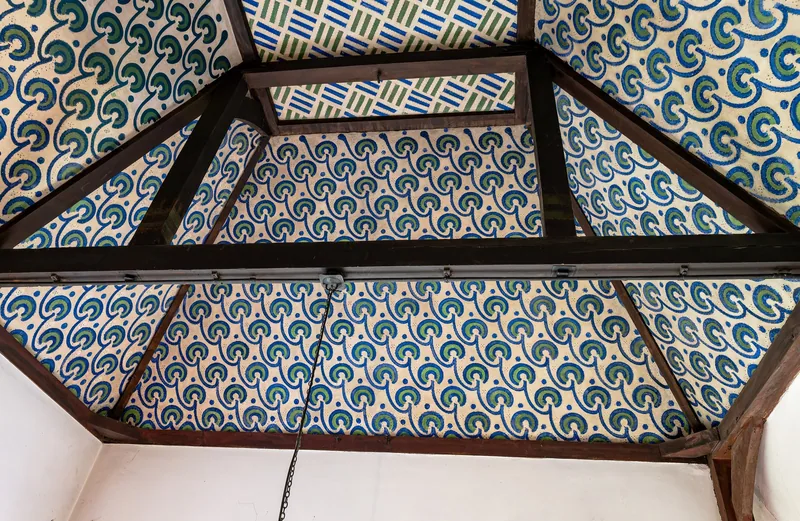
Photo: Tilman2007 · CC BY-SA 4.0 · Wikimedia Commons · resized
Hall Place and Danson House, the borough's other two houses
Bexley has two more good houses and both are easier to get into than the Red House. Hall Place at Bexley is listed grade I — the garden walls, gate piers and gates are separately grade I as well — and its gardens are a registered park at grade II. It is the Tudor-and-Jacobean house with the famous chequerboard flint and rubble front, and the topiary Queen's Beasts in the garden.
Danson House, in Danson Park at Welling, is the Palladian villa designed by Sir Robert Taylor in 1765 that Historic England uses as the comparison for Beckenham Place Mansion. Danson Park round it is a registered park at grade II covering eighty hectares, free and open, with a lake; the Danson Stables held a hygiene rating of 5 at an inspection in May 2025 and the park kiosk a 5 in September 2026.
Our combined guide to Hall Place and Danson House carries the opening days and prices for both, which change seasonally and are not the same as each other. The practical point for this page: all three houses are in the same borough, none of them is within walking distance of another, and the bus is how you join them up.
Erith: the pier, the Thames and an honest assessment
Erith is nine minutes' walk from its station down to the water, and the walk down is not encouraging — a retail park, a dual carriageway and the back of a shopping precinct. Then the river opens out. This is below the Thames Barrier, the tide runs hard, seagoing ships pass, and the Essex bank opposite looks like a different county, which it is.
Erith Pier is described by Bexley Council as London's longest pier, and the council's own account of it is the useful one: it stretches "across the mudflats and into the Thames navigational channel", which is why it works as a walk. It is a concrete working pier, not a Victorian pleasure pier — no amusements, no kiosks, no turnstile. People fish from it. It is free and open, and the sky over it is the reason to come.
Behind it, Riverside Gardens has been rebuilt, and the council's Greater Erith programme has also delivered a new square at the pier entrance and a community space on Pier Road called 68. There is a further plan to replant and rebuild the pier structure itself, for which the council bid £300,000 to the Greater London Authority's Green Roots Fund; we could not confirm the outcome, so treat the pier as it is now rather than as it is drawn. The answer to "is anything happening in Erith" is yes, at the scale of a park rather than a district.
The one listed building worth crossing the road for is Christ Church on Victoria Road, grade II*. Historic England dates it to 1874 and names the architect, J. P. St Aubyn: yellow stock brick with polychrome red brick, an almost detached north-west tower of 1914 with a broached stone spire, five lancet windows in the chancel by Hardman of 1875, a reredos triptych of the Adoration of the Magi in fifteenth-century Italian style by A. O. Hemming of 1904, and eight painted panels of 1906-9 by Ward and Hughes running from the martyrdom of St Alban to the martyrdom of St Edmund. Erith Library, further along, is listed grade II.
We could not find a recently inspected place to eat in Erith and we are not going to invent one. Several of the obvious candidates — the Playhouse bar, the riverside social club, the yacht club — were last inspected by the Food Standards Agency in the first half of 2024, which is outside the two-year window we use before naming somewhere. Look up whatever you find on the FSA register yourself, or eat at Bexleyheath instead.
Bexleyheath town centre, and what it is
The Broadway is a pedestrianised shopping street with the usual chains, a market on some days, and a clock tower. The parish church, Christ Church Bexleyheath, is listed grade II along with its vicarage, both listed in December 1980. That is the whole architectural account of the town centre, and it is why we open this page with the Red House rather than with Bexleyheath.
What Bexleyheath does have is an easy train, a Zone 5 fare, and a long run of ordinary suburban shops that are a good deal cheaper than anything in central London. If you are staying out here for a football match or to see relatives, that is what you have.
Lesnes Abbey, and the two other free things nearby
Three miles west, on the Abbey Wood side of the borough, are the ruins of Lesnes Abbey, a scheduled monument covering 1.4 hectares and protected since November 1930. The footings of an Augustinian abbey founded in 1178 sit in a park on a hillside, with woods behind and a view north over the marshes. It is free, open and a fifteen-minute walk uphill from Abbey Wood station on the Elizabeth line, which makes it the most accessible historic site in the borough by a wide margin.
Further west again, Crossness Pumping Station at Belvedere is a cathedral of Victorian ironwork that opens only on a handful of published dates a year, with the beam engine running on fewer still — check the dates before travelling. The Thames Barrier is downriver of nothing and upriver of Erith, and its information centre is on the Woolwich side.
East of Erith, beyond the borough boundary, Rainham Marshes sits on the opposite bank; there is no crossing here, so it is a separate trip.
Getting here, and whether to bother
There is no Underground, no DLR and no tram in this borough. Everything runs on Southeastern from Charing Cross, Cannon Street, London Bridge or Victoria, and the Superloop express buses are how you move sideways to Bromley, Bexleyheath and Woolwich. Contactless works throughout. Our overview of London's main railway stations explains which terminus serves which part of the south-east.
Our verdict: come for the Red House, on a booked Thursday or Friday in the season, and build the rest of the day round it — Hall Place in the morning, the Red House tour in the afternoon, back before dark. Come for Erith only if wide rivers and working waterfronts interest you for their own sake, in which case combine the pier with Lesnes Abbey and treat it as a half-day. Do not come out here at a weekend or in winter expecting to get into anything, and do not come at all on a first visit to London. Woolwich and Greenwich, both nearer, give a visitor much more per hour.
Frequently asked questions
Can you see the Red House and Hall Place on the same day?
Yes, on a Thursday or Friday, which are the only days the Red House opens. Hall Place at Bexley keeps longer hours and is a short bus or train ride away, so the workable order is Hall Place in the morning and the Red House tour slot in the afternoon. Both are in the same borough but not within walking distance of each other.
How long does it take to get to Bexleyheath from central London?
Thirty-eight or thirty-nine minutes from Charing Cross on a Southeastern train, when we measured it in September 2026. Bexleyheath is in fare Zone 5, so a journey to Zone 1 costs £4.40 off-peak and £6.60 peak. The Red House is four minutes' walk from the station.
Is Erith Pier really the longest pier in London?
Bexley Council calls it London's longest pier in its own published material, and describes it as stretching across the mudflats and into the Thames navigational channel. It is a working concrete pier rather than a Victorian pleasure pier, so there is nothing on it: the point is the walk out into a wide, tidal, working river, with the rebuilt Riverside Gardens behind it. Both are free.
Is Erith worth visiting?
Only for the river. The pier, the rebuilt Riverside Gardens and the grade II* Christ Church of 1874 are worth about ninety minutes between them, and the walk down from the station is unpleasant. Erith is in Zone 6, which makes it the most expensive journey in this part of London, and the quickest way back to the centre is six minutes to Abbey Wood and then the Elizabeth line.
What can you see in this part of London on a Sunday?
Very little indoors. The Red House opens on Thursdays and Fridays only, Crossness opens on a handful of dates a year, and Hall Place and Danson House keep seasonal hours you must check. What is open every day, free, is Erith Pier and Riverside Gardens, Danson Park, Lesnes Abbey and the churchyards. Plan a Sunday here as a walk, not a visit.
Sources
- Historic England - National Heritage List for England open data and list entries (Red House 1064203; Hall Place 1188277 and its walls 1064250; Christ Church Erith 1188549; Erith Library 1255449; Christ Church Bexleyheath 1359404; Lesnes Abbey scheduled monument 1002025; Danson Park registered park 1000211; Hall Place registered park 1000247) (checked September 2026)
- National Trust ticketing - Red House admission prices, tour length and address (checked September 2026)
- National Trust - Red House visitor page (checked September 2026)
- Transport for London Journey Planner - measured Bexleyheath and Erith journey times (checked September 2026)
- Transport for London - Single Fare Finder, for the Bexleyheath and Erith fares and zones (checked September 2026)
- London Borough of Bexley - the Erith Garden Pier project, "London's longest pier" and the Greater Erith programme (this page blocks automated requests; read on an Internet Archive copy of 1 September 2025) (checked September 2026)
- London Borough of Bexley - parks, leisure and libraries, for Riverside Gardens and Danson Park (checked September 2026)
- Food Standards Agency - food hygiene rating search (Danson Stables, Danson Road DA6 8HL, rated 5 in May 2025; Danson Park Kiosk, rated 5 in September 2026) (checked September 2026)