
The Red House is the only house William Morris commissioned, helped decorate and lived in, and you can only see it on a pre-booked guided tour. It opens for a short season, roughly May to October, and in September and October 2026 the National Trust's own calendar showed it open on Thursdays and Fridays only, 11am to 4pm, with the last open day of the year on Friday 30 October. An adult ticket is £14.
Philip Webb designed it in 1859, as his first commission, for Morris and his wife Jane. They moved in in 1860 and were gone within five years; the list entry says Morris lived here until 1864. In those few years the house became the workshop of what turned into the Arts and Crafts movement: Morris, Webb, Edward Burne-Jones, Jane Morris and Elizabeth Burden painted, embroidered and built furniture into the fabric of the rooms, and out of that came the firm that became Morris & Co.
It is small. It is in a suburban street in Bexleyheath, thirty-five minutes from central London by train. It has no cafe and no car park. And it is one of the most important houses of its century anywhere in Britain, which is why the tour system exists: the rooms cannot take a crowd.
The Red House: booking, hours and prices
- Address
- Red House Lane, Bexleyheath, London DA6 8JF
- Access
- Pre-booked guided tours only, on the hour from 11am to 3pm
- Days open
- Thursdays and Fridays in September and October 2026, 11am to 4pm. The National Trust describes the season as May to October
- Last day of the 2026 season
- Friday 30 October
- Tickets
- £14 adult; £7 child aged 5 to 17; under-5s free; £35 for two adults and up to three children; £21 for one adult and two children. National Trust members free
- Booking
- New tickets released every Thursday, up to two weeks ahead
- Listing
- Grade I, list entry 1064203, first listed 25 May 1950. Webb's timber well head in the garden is separately Grade I, entry 1359397
- Nearest station
- Bexleyheath, about 10 minutes on foot
- Facilities
- Toilets and a secondhand bookshop in the Stables. No cafe, no car park, assistance dogs only
- Telephone
- 020 8303 6359
The booking system, and why it catches people out
This is the part to get right, because everything else is straightforward. There is no walk-up admission. Tours run on the hour from 11am to 3pm, and tickets go on sale in a weekly batch: the National Trust releases new tickets every Thursday, covering dates up to two weeks in advance. That means you cannot book three months ahead, and you cannot turn up and hope.
It also means the release day matters. If you want a specific Thursday or Friday, look on the Thursday two weeks before it.
The number of open days is smaller than most people assume. In September and October 2026 the Trust's own day-by-day calendar showed the house, garden and toilets open on Thursdays and Fridays only, 11am to 4pm, and closed every Saturday, Sunday, Monday, Tuesday and Wednesday. Earlier in that same season Saturdays had been open, so the pattern within a year is not fixed. Check the calendar for your week rather than trusting a summary, including ours.
Between November and April the Red House is shut, and that is most of the year. The 2026 season's last open day was Friday 30 October. The 2027 dates had not been meaningfully published as of late September 2026, so if you are planning a winter trip to London, take this off the list and go to the William Morris Gallery in Walthamstow instead.
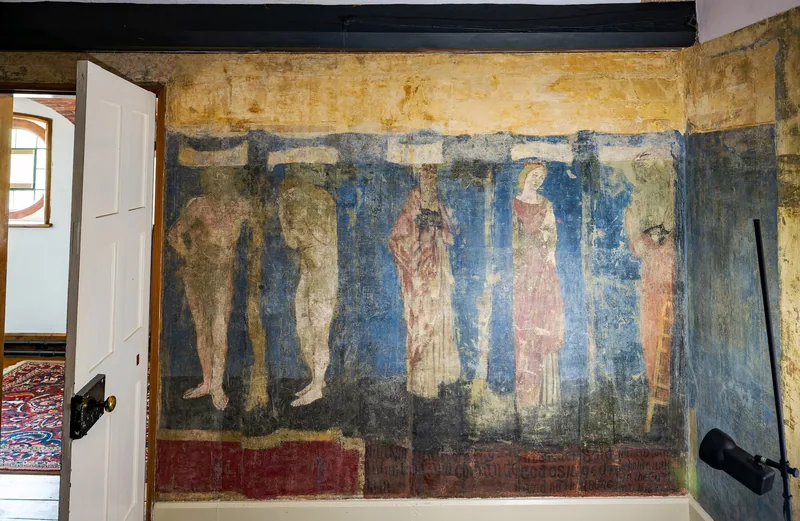
Photo: Tilman2007 · CC BY-SA 4.0 · Wikimedia Commons · resized
What the list entry says the house is
Red House was listed at Grade I in May 1950, which was very early for a Victorian house, and the statutory description is unusually direct about why.
It records a moderately sized L-shaped building of two storeys, dated 1859, by Philip Webb, described as his first commission, for William Morris, who lived here until 1864. Red brick with a hipped tiled roof. A gabled, two-storeyed porch on the north front. An oriel on the west lighting the main room on the first floor. A staircase tower in the angle with a pointed roof and finials. Sliding sash windows, singly and in pairs, with cambered heads under relieving arches, and casements with circular leaded lights on the upper floor. The style is called the simplified Gothic of Street and Butterfield's domestic work, which is the historical box the house belongs in.
Then the sentence that explains the ticket: the interior is almost unaltered, with important fixed cupboards, a settle and other furnishings, some carrying painted decoration by Burne-Jones and others. Those are fixtures, not loans. They are part of the building.
Two more listed things sit in the garden. The well head south-east of the house is Grade I in its own right: circular, heavy timber construction carrying a conical tiled roof, also by Webb and also 1859. The outhouse to the north-east and the street wall and gateway to the north are each Grade II.
What you actually see on the tour
Expect a guided visit of the house, rather than free roaming. The Trust's own facilities list is honest about the shape of it: visits to the house are by pre-booked guided tour, folding stools are available for visitors to carry round with them, and an iPad with images and information is provided on the upper floor.
The house's own summary of what survives is worth quoting for what it includes: original features and furniture by Morris and Webb, stained glass and paintings by Burne-Jones, and embroidery by Jane Morris and Elizabeth Burden. Burne-Jones called the place the most beautiful place on earth, and the Trust still puts his phrase on the page.
The garden is small and part of the point. Morris held that the house and garden should work together and that the garden should clothe the house. What is there now is Arts and Crafts style planting, an apple orchard and a rose arch, in a plot hemmed in by later suburban building.
Allow about ninety minutes in total: an hour for the tour, half an hour for the garden and the well head, and a few minutes for the secondhand bookshop in the Stables, which is run by the Friends of Red House.
Getting there, and the parking problem
| Route | Detail |
|---|---|
| Train | Bexleyheath station, direct from London Victoria, Charing Cross and Cannon Street. TfL's walking route gives about 10 minutes and 750 metres from the station |
| Bus | The 89, 96, 422, 486, B11, B12, B14, B15 and B16 all stop at Upton Road, which is the nearest stop to the house |
| Car | There is no car park at Red House. The Trust directs drivers to Danson Park, a mile away at DA6 8HL, which charges at weekends and bank holidays |
| Accessible parking | Two pre-bookable disabled parking spaces on site. Telephone the property directly to book one |
Bexleyheath is inside the London fare zones, so contactless and Oyster work for the whole journey and the daily cap applies. The buses are ordinary London buses on a single fare.
Access: the ground floor only
Be clear about this before booking. The Trust states that there is ramp access to the ground floor of the house but no step-free access to the first floor, which is where the oriel-lit main room is. Ramps are provided to get over the two shallow steps at the entrance.
The approach is the harder part: a gravel driveway, grass lawns and uneven brick paths that can be slippery when wet. The grounds are mostly level but the main drive has thick gravel and there are occasional steps. There are accessible toilets on site, and an access statement published by the Trust for the property. Assistance dogs only, and no other dogs anywhere.
Where to eat, because there is nowhere here
The Red House has no cafe, no coffee shop and no restaurant. That is not an oversight; there is nowhere to put one. Bexleyheath town centre is the nearest option, about ten minutes from the station in the other direction.
The better plan on a fine day is Danson Park, a mile west, which has three separate places to eat that all hold the top hygiene rating: the Boathouse, rated 5 in December 2025; Danson Stables, rated 5 in May 2025; and the park kiosk, rated 5 in September 2026. Those ratings can be looked up on the Food Standards Agency register. We do not link to venues' own websites.
What to put it with, and the one alternative that is free
Red House is too small to be a day out on its own, and its Thursday and Friday opening makes it awkward to combine with anything that shuts on weekdays. Two combinations work.
The first is local. Hall Place and Danson House are the two Grade I houses of the same borough, half a mile and a mile and a half away, and the Hall Place gardens are free and open every day; Bexleyheath and Erith covers the area around them. Further out in the same direction, Crossness Pumping Station is the great Victorian interior of this corner of London, and Eltham Palace is the big-name house nearest to it.
The second is thematic. Morris's London is a route rather than a place. The William Morris Gallery in Walthamstow is free and holds the collection, and it is the right answer for anybody who cannot get a Red House ticket. It has been closed for refurbishment since 22 June 2026 and reopens on 3 October 2026 with a new exhibition, so check the date before travelling in the last days of September. The V&A has the Morris & Co. room in its refreshment rooms, and Chiswick House is the eighteenth-century villa that Webb's generation was arguing against. For the other listed house in London designed by an architect for his own use rather than a client's, see Pitzhanger Manor.
If you are building a wider trip out of free attractions, our list of free things to do in London is the place to start, and the Open House Festival in September is when a great many normally closed London interiors open without a ticket.
Frequently asked questions
Do you need to book the Red House?
Yes. Entry is by pre-booked guided tour only, on the hour from 11am to 3pm, and there is no walk-up admission. Tickets are released in weekly batches every Thursday, covering dates up to two weeks in advance, so you cannot book months ahead.
How much does the Red House cost?
£14 for an adult, £7 for a child aged 5 to 17, free for under-5s, £35 for a family of two adults and up to three children, and £21 for one adult and two children. National Trust members go free. Those were the prices published on the property's page in September 2026.
What days is the Red House open?
The National Trust describes the season as May to October. In September and October 2026 the day-by-day calendar showed Thursdays and Fridays only, 11am to 4pm, with the final open day on Friday 30 October. Saturdays had been open earlier in the same season, so check the calendar for your own week.
Is the Red House wheelchair accessible?
Partly. There is ramp access to the ground floor but no step-free access to the first floor. The drive is thick gravel, the brick garden paths are uneven and slippery when wet, and there are occasional steps. Accessible toilets are provided, and two disabled parking spaces can be booked by telephoning the property.
Is there parking or a cafe at the Red House?
Neither. There is no car park; the Trust points drivers to Danson Park a mile away, which charges at weekends and bank holidays. There is no cafe either. The only facilities on site are toilets and a secondhand bookshop in the Stables run by the Friends of Red House.
Sources
- Historic England - Red House, list entry 1064203 (Grade I) (checked September 2026)
- Historic England - Well head to south east of Red House, list entry 1359397 (Grade I) (checked September 2026)
- National Trust - Red House: opening calendar, prices, facilities and directions (checked September 2026, via a dated Internet Archive copy of 8 September 2026 because the live site blocks our request)
- Food Standards Agency register - the Boathouse, Danson Stables and Danson Park Kiosk, Danson Park DA6 8HL (checked September 2026)
- Transport for London - Journey Planner, walking route from Bexleyheath station (checked September 2026)