
A London food tour is a guided walk of two to four hours with six or seven tastings built into it, usually enough to replace a meal. The good ones get you behind a counter and introduce you to the person who made the thing you are eating. The weak ones march you between shops that would have sold you the same sample for free.
Our guide to walking tours in London covers the wider field. This page is about whether a food tour earns its price, which markets suit which format, and how to build the same afternoon yourself if you would rather spend the money on more food.
The three main areas
- Borough Market
- Produce, cheese, charcuterie, oysters and coffee, in a covered market beside London Bridge. The most tour-covered square in the city
- Brick Lane and Spitalfields
- Bengali curry houses, salt beef and bagels, street food halls. The strongest tours for migration history
- Soho and Chinatown
- Old Italian delicatessens, patisseries, Cantonese bakeries. Best in the evening
- Length
- Usually 2 to 4 hours, with 5 to 8 tastings
- Group size
- Anything from 6 to 20. Above a dozen, small shops cannot hold you
What you are buying, and what you are not
You are not buying access. Every market and almost every shop on any London food tour is open to the public, and nothing on the route requires a ticket. What a tour buys, when it works, is four things:
- Introductions. A guide who has bought from the same trader for five years gets you a word with them at a busy counter. You would not get that on your own at noon on a Saturday.
- Curation. Borough Market alone has enough stalls to defeat anyone in an hour. Somebody choosing six things for you has real value.
- Order and quantity. A good tour paces the tastings so you are not full after the second one. That sounds trivial until you have tried it yourself.
- Context. Why the salt beef bar is where it is, why the market has a wholesale section and a retail one, who used to work here.
What you are not buying is a restaurant meal. Tastings are portions, not plates, and you rarely sit down. If what you want is lunch, book lunch.
Borough Market runs its own official tours, and they are the benchmark. The market lists two: a tasting tour on selected Friday mornings from 10am to 1pm, and a private behind-the-scenes tour lasting two and a half hours that takes in tea, cheese, charcuterie and oysters and finishes in a wine warehouse with a glass of English sparkling wine. Both are booked through the guides' own sites via the market's tours page. If you want to know what a serious food tour looks like, read those two listings and compare anything else against them.
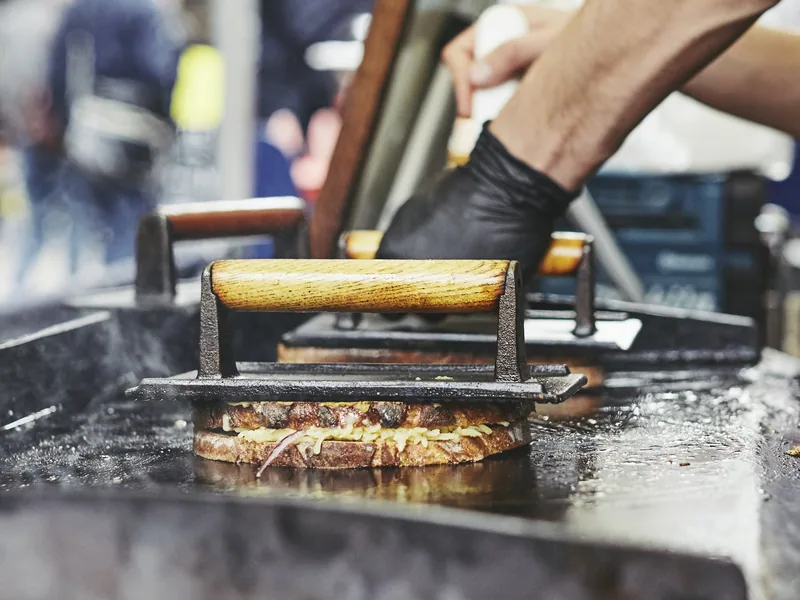
Photo: William Harold Amos · CC BY-SA 4.0 · Wikimedia Commons · resized
Six questions that separate a good tour from a bad one
Almost every complaint about food tours comes down to one of these being unanswered before booking.
- How many tastings, and is it a meal? "Six tastings" can mean six mouthfuls or six small plates. Listings that specify what you will eat are telling you they are confident about it.
- How big is the group? A dozen people fit inside a small delicatessen. Twenty do not, and you will be eating on the pavement.
- Are drinks included? Many tours include a beer or a glass of wine, which accounts for a chunk of the price. Some include nothing.
- Do you sit down at all? Three hours standing in a market is tiring, particularly for older visitors.
- Who is the guide? Named guides with a food background, or a stated Blue Badge qualification, are a good sign. So is a guide who also runs private tours, because reputation matters to them.
- Can dietary requirements be met? Ask before booking, not on the day. Some tours are built around charcuterie and cheese and genuinely cannot be adapted.
Borough Market: what a tour adds, and what it does not
Borough is the most photographed food market in Britain and, on a Saturday, the most crowded. That crowding is the strongest argument both for and against a tour.
For: a guide will take you at a time the market is workable, steer you past the queues sold entirely on social media, and get you to the traders who have been there for decades. Against: at peak times a group of fifteen cannot move through the aisles, and you will spend the tour looking at the back of someone's head.
Our guide to Borough Market has the opening days and the stalls; note that it does not trade on Mondays and that the full market runs later in the week. Weekday mornings are when a tour here works best. Borough and Bermondsey covers what else is within walking distance, including Maltby Street Market under the railway arches, which is smaller, cheaper and much less toured.
Brick Lane and Spitalfields: the tours with the best story
The East End food tours carry more history than the Borough ones, because the food is the history. The same streets have fed Huguenot, Jewish and Bengali London in turn, and a good guide can show you a building that has been a church, a synagogue and a mosque.
This is where a guide earns the fee most clearly. On your own, Brick Lane is a row of curry houses with touts outside; with someone who can explain what changed in 1970 and what changed in 2005, it is one of the most interesting streets in Europe. See Brick Lane and London's curry scene and salt beef, bagels and Jewish London, and pair the walk with the murals in our guide to Shoreditch street art tours.
Soho and Chinatown: the evening option
Soho food tours tend to run later and cover a narrower area: Italian delicatessens that have been on the same corner since the 1940s, French patisseries, a couple of long-standing restaurants, and the Cantonese bakeries of Chinatown a few streets south. Because the distances are short, these are the easiest tours for anyone who does not want to walk far.
They are also the ones most easily replicated. Our guides to Soho and Chinatown name the same shops, and the total walking distance is under a kilometre.
Doing it yourself: a Borough afternoon for the price of a tour
Here is the honest comparison. A food tour costs what it costs, and the food inside it would cost less bought directly. What you lose by going alone is the introductions and the curation. If you are confident, the self-guided version goes like this.
- Arrive on a weekday before noon. The stalls are open, the traders have time to talk, and you can move.
- Do one lap without buying anything. This is the step most people skip and the one that matters.
- Buy small, from five different stalls. One cheese, one charcuterie, one bread, one hot thing, one sweet thing. Ask each trader what they would eat.
- Take it outside to the churchyard or the river. Standing in the aisle eating is what makes the market unpleasant for everybody.
- Walk ten minutes to Maltby Street for coffee and something you did not find at Borough.
Total time: about two and a half hours, which is the same as a tour. Our guides to London's food markets and cheap eats in London cover the rest, and how much a trip to London costs puts food spending in context.
Ask the trader, not the guide, what to buy. The single best question in any London market is "what would you take home today?" It works at a cheese counter, a fishmonger and a bakery, it costs nothing, and it is exactly what you are paying a guide to do on your behalf.
Dietary requirements, and where tours struggle
Food tours are built around a fixed sequence of tastings, so adapting one is harder than adapting a restaurant meal.
| Requirement | How it usually goes |
|---|---|
| Vegetarian | Usually manageable with notice, though a charcuterie-led tour will leave you short |
| Vegan | Harder. Ask for a written confirmation of what you will be given |
| Coeliac | Difficult on bread-and-pastry routes. See our guide to gluten-free eating in London and ask about cross-contamination directly |
| Halal | Straightforward on East End routes, less so elsewhere. Our page on halal food in London has the background |
| Nut and other allergies | Tell the operator at the time of booking and again on the day. A market environment cannot guarantee separation |
If you are vegan or vegetarian, a dedicated tour is a better bet than an adapted mainstream one; see vegan and vegetarian London for where the concentration is.
Tipping, and whether the guide is being paid by the shops
Guides on fixed-price tours are usually paid a fee by the operator, and a tip at the end is customary but not obligatory in Britain; our guide to tipping in London explains the general expectation.
The question worth asking is different: does the tour pay the businesses on the route, or do the businesses pay the tour? Reputable operators buy the food they hand you, which is why the ticket price is what it is. A tour that is being paid to bring you through a door has a different set of incentives, and it will show in which doors you go through.
When a food tour is the wrong choice
Skip it if you have one day in London and have never seen the city; skip it if you dislike eating standing up; skip it if you have a specific cuisine in mind, because a general tour will give you one bite of it at most. Our guides to traditional British food and afternoon tea cover two things people often book a tour hoping to find and do not.
Take one if you are staying several days, if you like knowing where things come from, if you are travelling alone and would enjoy the company, or if you are about to spend a week eating in London and want somebody to calibrate you on the first morning. That last case is the best argument for a food tour there is.
Frequently asked questions
Are London food tours worth the money?
They are if you value introductions and curation over quantity. The food alone costs less bought directly, so the fee pays for the guide's relationships with traders, the order the tastings come in, and the history. On a short trip with one free afternoon, that can be good value; on a tight budget it is not.
Does Borough Market run its own tours?
Yes. The market lists two official tours: a tasting tour on selected Friday mornings from 10am to 1pm with private weekday departures, and a private behind-the-scenes tour of about two and a half hours that includes tastings from traders and ends with a glass of English sparkling wine. Both are booked through the guides' own websites.
Will a food tour replace a meal?
Usually yes, if it has five or more tastings. Eat lightly beforehand rather than not at all, because the first tasting is often an hour into the walk. Tours that describe themselves as "tastings" rather than "a walking lunch" may leave you hungry.
How far do you walk on a London food tour?
Between one and three kilometres, spread over two to four hours, with frequent stops. Soho and Chinatown routes are the shortest; East End routes cover the most ground. Most tours are standing-heavy rather than walking-heavy.
Can you do a London food tour for free?
Not as a guided tour, but the markets and shops on every route are open to the public and free to enter. Walking Borough Market on a weekday morning, doing one lap before buying and asking each trader what they would take home gets you most of the way there for the price of the food.
Sources
- Borough Market - Official tours (checked September 2026)
- Borough Market - opening times (checked September 2026)
- GOV.UK - Tips at work and service charges (checked September 2026)