
When it rains and the children have already seen two museums, London still has plenty of indoor options: swimming pools, soft play, climbing walls, ice rinks, bowling alleys, children's theatres and cinemas. The main thing to work out is which of them take walk-ins, because on a wet Saturday most of the good ones do not.
Our general guide to what to do in London on a rainy day covers the museums, the covered markets and the arcades. This page deliberately leaves those out. It is for the second or third wet day, when another gallery will not work, and it is organised around the practical question of what you can still get into at 11am on a Saturday in February.
One warning before anything else. London's indoor children's venues fill up in bad weather faster than any other kind of attraction, because every local family has the same idea at the same moment. Booking a slot the night before, or even at breakfast, changes the day completely.
Rain doubles the demand and halves the availability. Soft play centres, trampoline parks and swimming lessons are dominated by local families, not tourists, and they book in advance. If you turn up unannounced at a play centre at midday on a rainy Sunday you will usually be told the next free session is at 3pm.
Book or walk in: the question that decides your afternoon
It helps to split London's wet-weather options into three groups before you leave the hotel.
- Always walk in: the free national museums, public libraries, big shopping centres, station concourses, bookshops with children's floors. No ticket, no slot, no risk.
- Usually walk in, sometimes queue: public swimming pools outside lesson hours, ice rinks on a weekday, bowling alleys before 4pm, cinema matinees.
- Book or forget it: soft play and trampoline parks, climbing centres, children's theatre, anything described as an "experience", and every hands-on gallery that charges for entry.
If the forecast is bad, spend five minutes the night before booking one thing in the middle group and one in the third. That gives the day a spine, and the free walk-in places fill the gaps around it. Our guide to London's weather month by month shows which months make this worth doing in advance.
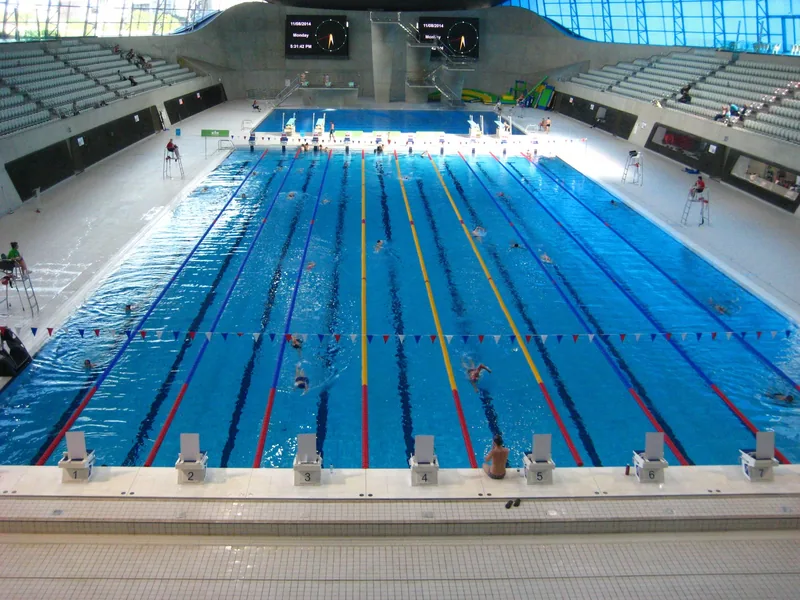
Photo: OlafJanssen · CC BY-SA 4.0 · Wikimedia Commons · resized
Swimming: the best indoor hour for the money
An hour in a heated pool is the most reliable way to exhaust a child in London, and it is far cheaper than any ticketed attraction. Almost every London borough has at least one public pool, most are run by charitable operators on the council's behalf, and a family swim usually costs a fraction of a museum's paid exhibition.
Two stand out for visitors. The London Aquatics Centre in the Olympic Park has the 50-metre pool built for the 2012 Games, a separate training pool and a diving pool, and it runs family inflatable sessions at weekends and in school holidays. Bookings are made online or in the operator's app, and the family sessions are the ones that sell out. London Fields Lido in Hackney is outdoors but heated to around 24 degrees, floodlit, and open daily from 6.30am to 9pm all year, which means swimming in the rain is genuinely pleasant rather than an endurance test.
Check whether the pool you pick has lesson blocks, because public swimming often stops for two or three hours after school and on weekend mornings. Bring your own towels; most London pools sell them at a mark-up or not at all. Armbands and floats are usually not provided.
Soft play, climbing and trampolines by age
London's indoor play industry sorts itself fairly neatly by age, and picking the wrong band is the most common mistake.
- Under 5: soft play centres with ball pits, padded frames and a coffee bar for adults. Sessions are typically 90 minutes and priced per child, with accompanying adults free or nearly free. Socks are almost always compulsory for both child and adult.
- 5 to 10: bigger indoor adventure centres with slides, climbing frames and obstacle courses. This is the sweet spot, and the age range where booking matters most.
- 8 and up: trampoline parks and indoor climbing centres. Trampoline parks require a signed waiver, usually valid for a year, which you can complete online before you arrive and which saves 10 minutes of queueing at the desk.
- 11 and up: bouldering walls, which need no ropes or partner and take walk-ins more readily than roped climbing. Most London walls hire shoes.
Prices for these change often and vary by day and time, so check the individual centre's own booking page rather than relying on a figure from a guide. Look specifically for the "socks" rule, the waiver, and whether the price includes an accompanying adult. For older children who have outgrown all of this, see our separate guide to London with teenagers.
Ice rinks and bowling, often in the same building
London's seasonal outdoor rinks all close in the spring, but a handful of indoor rinks run all year. Queens in Bayswater is the city's oldest and only year-round indoor rink, and it sits in the same building as 17 bowling lanes, six interactive dartboards, on-ice curling lanes and a retro arcade, which makes it a rare venue where a mixed-age group can all do something different under one roof. The rink at Alexandra Palace also runs through the year and caters for skaters from about age 3 upwards.
Bowling works well for a wet afternoon because it is slow, indoors, and priced per lane rather than per person, so a family of four is no more expensive than a couple. Book a lane at weekends. Our guide to ice skating in London covers the winter rinks and the year-round ones in more detail.
Children's theatres, and their free play spaces
London has two theatres built specifically for children, and both are a better use of a wet afternoon than most people realise.
Polka Theatre in Wimbledon programmes work for children from babies to early teens, and it also keeps free play spaces that anyone can use without a ticket. It opens Tuesday to Friday from 9am to 5pm and at weekends from 9.30am to 5pm. The Unicorn Theatre at 147 Tooley Street, a few minutes from London Bridge station, is the other, with productions aimed at specific age bands rather than at "families" in general, so read the age guidance before booking.
Both sell out for school-holiday runs. If you are visiting outside a holiday, midweek matinees are often half empty and easy to book on the day.
Discover Children's Story Centre, Stratford
Discover, on Stratford High Street, is the closest thing London has to an indoor playground built around storytelling rather than climbing frames. It is aimed at children aged 0 to 11, and the indoor Story Worlds let children crawl into a tree house, steer a spaceship, perform in a puppet castle and run a story factory. There is a sensory space for babies and toddlers up to 2, and storytelling sessions for the under-5s included in the entry ticket.
You book an entry ticket online for a date, then add free sessions and exhibitions to it. The centre is at 383-387 High Street, E15 4QZ, about five minutes' walk from Stratford station, so it combines easily with the rest of Stratford and with the covered shopping centre next to the station if the rain gets worse.
Stratford is the best rainy-day base in London for under-10s. Within ten minutes on foot you have Discover, a very large covered shopping centre with a cinema, the free V&A East Museum, and the Aquatics Centre pool. If the forecast is grim for a whole day, go there rather than into Zone 1.
Cinemas, and when children's films actually show
British cinemas run discounted children's screenings on weekend mornings, usually starting between 10am and 11.15am, showing films that have been out for a few weeks at a low flat price. Most large chains run a version of this, and the tickets are cheap enough that walking out after 40 minutes is not a disaster.
Two cinema experiences are worth a detour rather than a convenience. The BFI IMAX at Waterloo has Britain's largest cinema screen and is a short covered walk from the station. Independent cinemas in Bloomsbury, Brixton and east London run parent-and-baby screenings on weekday mornings, where the lights stay half up and nobody minds noise. Check each cinema's own listings: children's programmes change weekly and are not always visible on the main booking page.
Free places to shelter for an hour
Sometimes you do not need an activity, only a dry room with something to look at and a toilet nearby.
- Public libraries. Every London borough library has a children's section, and none of them will ask whether you live locally. The Barbican, Idea Store Whitechapel and the children's floor of the Royal Festival Hall are all comfortable places to sit for an hour.
- Bookshops with children's floors. Several of the larger ones run free story times at weekends.
- Station concourses. St Pancras, King's Cross and Paddington are all covered, warm, full of trains to watch and have proper toilets.
- Crossrail Place Roof Garden in Canary Wharf is under a glass roof, free, and quiet on a wet day. Our page on roof gardens and free terraces lists the others.
- The free museums' non-museum bits. The London Transport Museum is a museum, but its buses and Tube cabs function as indoor play equipment for a four-year-old, and the Horniman in Forest Hill has a small aquarium and a hands-on base.
Knowing where the toilets are matters more with children than anything else on this list; our page on public toilets in London explains which are free and which are behind the ticket gates.
What a wet day costs a family of four
A rough budget for two adults and two children aged 6 and 9, excluding transport and food:
| Wet-day option | Rough cost for a family of four | How long it fills |
|---|---|---|
| Public swimming pool | Low - usually under £25 | 1-2 hours |
| Bowling, one lane | Moderate, priced per lane | 1-1.5 hours |
| Soft play or trampoline park | Moderate to high, priced per child | 90-minute session |
| Children's cinema screening | Low at a weekend morning showing | About 2 hours |
| Children's theatre matinee | Higher, but the main event of the day | 1-2 hours |
| Wonderlab at the Science Museum | From £13.50 per person, under-3s free | 1-2 hours |
| Library, station, roof garden | Free | As long as you need |
Wonderlab, the paid hands-on gallery at the Science Museum, is the one museum entry we would break our own rule for on a wet day: it is a room full of things to pull and drop rather than a display, prices start from £13.50 per person with the same price for all ages, and booking ahead is cheaper than paying at the door. For where to base yourself, see where to stay in London with kids, and for the outdoor version of all this when the sun returns, our guide to city farms and playgrounds.
Frequently asked questions
What can you do in London with children when it rains and you have already done the museums?
Swim, bowl, skate indoors, go to a children's theatre matinee, book a soft play or trampoline session, or take a cheap weekend morning cinema screening. Stratford, with Discover, a covered shopping centre, a cinema and the Aquatics Centre within a few minutes of each other, is the easiest single place to spend a whole wet day.
Do London soft play centres take walk-ins?
Some do on weekdays in term time, but almost none can be relied on at weekends or in school holidays, and rain makes it worse because local families book the same sessions. Book online the night before if you can, and complete any waiver form in advance to save time at the desk.
How much does swimming cost in London?
Public pool prices are set by each borough and its leisure operator, and a family swim is usually the cheapest indoor activity available, well below the cost of a paid attraction. Prices and session times are on each centre's own booking page, so check before you travel because lesson blocks close pools to the public for hours at a time.
Is there an indoor ice rink in London open all year?
Yes. Queens in Bayswater describes itself as London's only year-round indoor rink and also has bowling, darts and an arcade in the same building. The rink at Alexandra Palace also runs throughout the year. The well-known outdoor rinks at Somerset House and the Tower of London are winter-only.
What should we pack for a wet day out in London with children?
Waterproof coats rather than umbrellas, because umbrellas are unmanageable in crowds, plus a spare pair of socks for soft play and a small towel. Our guide to what to pack for London goes through the rest by season.
Sources
- Discover Children's Story Centre - Plan your visit (checked September 2026)
- Polka Theatre, Wimbledon - Opening hours and what's on (checked September 2026)
- Unicorn Theatre - Visit (checked September 2026)
- QUEENS Skate Dine Bowl, Bayswater (checked September 2026)
- Alexandra Palace - The Ice Rink (checked September 2026)
- London Aquatics Centre - Swimming (checked September 2026)
- London Fields Lido - Opening times and facilities (checked September 2026)
- Science Museum - Wonderlab prices and opening times (checked September 2026)