
King's Cross is the area around two of London's great railway stations, King's Cross and St Pancras International, and the old goods yards behind them, which have been rebuilt as a new quarter of squares, shops and restaurants beside the Regent's Canal. It is worth a visit even if you are not catching a train.
For most of the 20th century King's Cross had a poor reputation. The land north of the stations was full of empty warehouses, gasworks and railway sidings, and the streets around the stations were known for drugs and street crime. Since the late 2000s the former goods yard has been redeveloped into a large new district with offices, flats, a university art school, public squares and a shopping street in converted Victorian coal stores.
The result is one of the most talked-about regeneration projects in Europe. It is clean, carefully designed and well managed, and it gives visitors a pleasant canal-side area to eat, walk and sit outside. The older streets around the stations have improved too, but they still feel like a busy transport hub, with traffic, noise and some rough edges late at night.
King's Cross in brief
- Where
- North of Bloomsbury, on the border of the boroughs of Camden and Islington
- Key places
- St Pancras International, King's Cross station, Granary Square, Coal Drops Yard, Regent's Canal, British Library
- Tube lines
- Northern, Piccadilly, Victoria, Circle, Hammersmith & City and Metropolitan lines at King's Cross St Pancras
- Trains
- Eurostar to Paris and Brussels, high-speed trains to Kent, Thameslink to Gatwick and Luton, trains to the north and Scotland
- Fare zone
- Zone 1
- Best for
- Travellers arriving or leaving by train, canal walks, modern architecture, relaxed outdoor dining
Two stations with very different stories
King's Cross and St Pancras stand side by side on Euston Road, and together they form one of the busiest transport hubs in Britain. King's Cross, the plainer building with two great arched train sheds, opened in 1852 and serves the East Coast Main Line to York, Newcastle and Edinburgh, plus trains to Cambridge. Its modern western concourse, with a white steel roof spreading out like a tree, is a striking space in its own right.
St Pancras International, next door, is the red-brick Victorian building with a clock tower and a Gothic hotel on its front. Its enormous iron-and-glass train shed was restored and reopened in 2007 as the London terminus for Eurostar. Inside, look for the large bronze statue of a couple embracing under the station clock, known as The Meeting Place, and the statue of the poet John Betjeman, who campaigned to save the building from demolition. The station's upper and lower levels have shops, cafés and champagne bars, and it is a comfortable place to wait for a train.
Both stations are explained in more detail in our guide to London's main railway stations, including which destinations leave from which terminus.
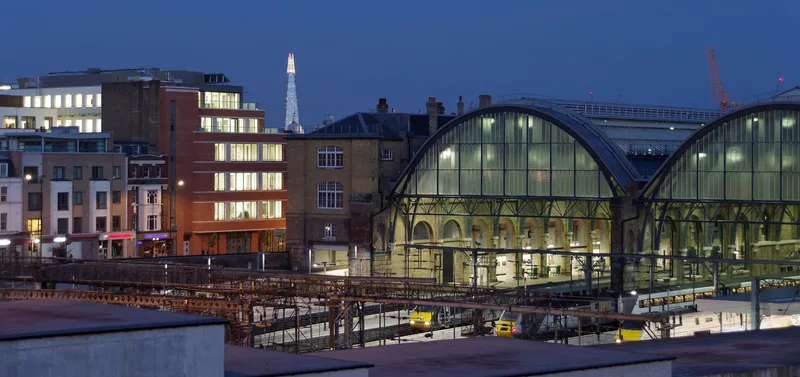
Photo: mattbuck (category) · CC BY-SA 4.0 · Wikimedia Commons · resized
Platform 9¾ and the Harry Potter connection
In the Harry Potter books, the Hogwarts Express leaves from Platform 9¾ at King's Cross. The station has turned this into a permanent photo spot: a luggage trolley that seems to disappear into a brick wall, just outside the Harry Potter Shop King's Cross in the western concourse. The shop is open Monday to Saturday 08:00-22:00 and Sunday 09:00-20:00. Staff take photos that you can buy, and the shop says you are also welcome to take your own.
There is often a queue for the trolley, sometimes a long one in school holidays and at weekends. Early morning and late evening are usually calmer. If you are a fan, combine this with our list of Harry Potter filming locations around London, and remember that the big studio experience is outside the city: trains to Watford Junction for the Warner Bros. Studio Tour leave from Euston, a 10-minute walk west along Euston Road.
Granary Square, Coal Drops Yard and the canal
Walk north from King's Cross station along King's Boulevard, and within five minutes you reach the Regent's Canal and Granary Square. The square is built around the Granary Building, a Victorian grain store now used by Central Saint Martins, one of the world's best-known art and design colleges. In front of it, rows of fountains shoot up from the paving. On warm days children run through the jets and families picnic on the wide steps that lead down to the water.
Just west of the square is Coal Drops Yard, two long Victorian brick sheds once used to unload coal from railway wagons. They have been converted into a shopping street with independent fashion and design shops, restaurants and bars, and the two roofs curve up to meet each other in the middle. It opened in 2018 and is a good place to browse, though prices lean towards the upper end.
Across the canal, Gasholder Park is a small circular lawn inside the restored iron frame of a Victorian gasholder, and more gasholder frames have been turned into round blocks of flats. Camley Street Natural Park, run by the London Wildlife Trust, is a small nature reserve on the canal bank with ponds and woodland, surprisingly quiet for a spot so close to two stations.
Granary Square is best on a dry weekday evening. Office workers leave around 18:00, the fountains are usually still running and the canal steps catch the evening light. At weekends the square is busier with families, and in wet weather there is little shelter apart from the restaurants.
Walking the Regent's Canal towpath
The Regent's Canal runs east to west through King's Cross, and its towpath is one of the most enjoyable walks in north London. Head west and you pass narrowboats, lock gates and the backs of old warehouses on the way to Camden Lock, which takes about 30 to 40 minutes at an easy pace. From there you can explore the stalls of Camden Market or continue along the canal to the edge of Regent's Park and London Zoo.
Heading east instead, the towpath stops at the Islington Tunnel, where you follow signed streets over the top near Angel before rejoining the canal towards Broadway Market. The London Canal Museum, on New Wharf Road near the canal, tells the story of the waterways and the ice trade; it is open Tuesday to Sunday and on bank holiday Mondays.
The towpath is narrow in places and shared with cyclists and runners. Walk on the side away from the water edge, listen for bells, and keep children close. After dark, parts of it are poorly lit and very quiet, so use the streets instead.
The British Library and other things to see
The British Library, on Euston Road next to St Pancras, is the national library of the United Kingdom. Visitors can enter free and see the Treasures Gallery, which displays some of the library's most important books, maps and manuscripts. The building is open Monday to Thursday 09:30-20:00, Friday 09:30-18:00, Saturday 09:30-17:00 and Sunday 11:00-17:00. It will be closed on Saturday 26 and Sunday 27 September 2026 for maintenance. The library says it is still recovering from a cyber-attack and that not all services are back yet, so check its website before a visit with a specific aim.
The courtyard in front of the library, with a large bronze statue of Isaac Newton, is a good place to sit away from the traffic. Many of the other free museums nearby, including the Wellcome Collection and the British Museum, are covered in our guide to neighbouring Bloomsbury, a 15-minute walk south.
Eating, drinking and evenings out
The new King's Cross has a good choice of restaurants, most of them in Coal Drops Yard, around Granary Square and along the canal. There are also food stalls and casual counters, and the stations themselves have plenty of fast options. Expect prices typical of central London, and book ahead for popular places on Friday and Saturday evenings.
The area is lively on summer evenings, with people drinking outside along the canal, but it quietens down after about 22:00. For a traditional pub or cheaper food, walk a few streets east into Islington or south towards the Grays Inn Road. For a full night out, Camden and Islington are close by; see our guides to Camden Town and Islington.
Staying near the stations: pros and cons
King's Cross has many hotels, from budget chains and hostels on the side streets to the grand Victorian hotel in the front of St Pancras and new design hotels near the canal. It is an excellent base if you are arriving by Eurostar, travelling on to the north or Cambridge by train, or taking early flights from Luton or Gatwick.
Why it works
- Six Tube lines from one station complex, plus Eurostar and direct trains to three airports
- Walking distance to Bloomsbury and the British Museum
- Pleasant canal-side area for evenings
What to watch for
- Euston Road and Pentonville Road are very busy and noisy
- Some cheap hotels on the side streets are basic and dated
- The streets directly around the stations can feel uncomfortable late at night
Our dedicated guide to staying near King's Cross, St Pancras and Paddington compares the station areas in detail.
Trains, Eurostar and day trips from King's Cross
St Pancras International is the only London station for Eurostar. The company recommends that Standard and Plus passengers arrive 75 minutes before departure, and gates close 30 minutes before the train leaves. Passport and security checks for both the UK and France or Belgium take place before you board, so queues can build on busy days. Read our Eurostar guide before you travel, or see how to see Paris in a single day if you are short on time.
St Pancras also has Southeastern high-speed trains to Kent, including Canterbury West in about 54 minutes, which makes a day trip to Canterbury easy. From King's Cross, direct trains run to Cambridge. Thameslink trains from the lower level of St Pancras go to Gatwick and Luton airports, and the Luton Airport Express leaves from the upper level, reaching Luton Airport Parkway in about 22 minutes. Details are in our Luton Airport guide.
The Gatwick train from St Pancras costs almost double at peak times. With contactless or Oyster, St Pancras to Gatwick on Thameslink costs £19.20 at peak times and £10.70 off-peak (fares checked September 2026). If your flight allows it, travel outside the weekday rush hours of 06:30-09:30 and 16:00-19:00.
King's Cross has a left luggage service in the station, run by the Excess Baggage Company. Network Rail lists its hours as Monday to Friday, 07:00-23:00; weekend hours are not published there, so check with the operator. Our left luggage guide lists other options.
Getting around from King's Cross
King's Cross St Pancras Underground station is one of the best connected in London, with the Northern, Piccadilly, Victoria, Circle, Hammersmith & City and Metropolitan lines. The Piccadilly line runs direct to Heathrow, for £5.90 with contactless or Oyster. The Victoria line reaches Oxford Circus and Victoria in a few minutes. The station is in Zone 1, and the daily cap for Zones 1-2 is £8.90.
The station is large and the passages between lines are long. Allow extra time for changes, especially with luggage, and follow the signs carefully: exits for King's Cross, St Pancras and the British Library are in different places.
Frequently asked questions
Is King's Cross worth visiting if I am not catching a train?
Yes. Granary Square, Coal Drops Yard and the Regent's Canal make a pleasant half day, especially in good weather, and the British Library's free Treasures Gallery is next door. Combine it with a canal walk to Camden or a visit to the British Museum in Bloomsbury.
Is Platform 9¾ free to visit?
The trolley photo spot is outside the Harry Potter Shop in the station concourse, and you can queue and take your own photo. The shop sells professional photos taken by its staff, but you do not have to buy one. Expect queues at busy times.
Is King's Cross a safe area to stay in?
The new development north of the stations is well lit and well managed. The streets directly around the stations are busy and generally fine by day, but they can feel rough late at night. Use normal care, keep valuables secure and choose a hotel on a well-lit main street.
How early should I arrive at St Pancras for Eurostar?
Eurostar recommends arriving 75 minutes before departure for Standard and Plus tickets and 45 minutes for Premier. Gates close 30 minutes before departure (15 minutes for Premier), and passport checks happen before boarding.
How long does it take to walk from King's Cross to Camden?
Along the Regent's Canal towpath the walk to Camden Lock takes around 30 to 40 minutes at an easy pace. It is a pleasant route by day, but choose the streets after dark.
Sources
- Harry Potter Shop King's Cross - Visit us (checked September 2026)
- British Library - Visit the British Library (checked September 2026)
- London Canal Museum - Home page (checked September 2026)
- Eurostar - Check-in (checked September 2026)
- Network Rail - London King's Cross station (checked September 2026)
- Transport for London - Tube and rail fares (checked September 2026)