
The Parkland Walk is a dismantled railway turned into London's longest linear nature reserve, and it does not run in one piece. The southern section is just over 3km from Finsbury Park to Holmesdale Road in Highgate; the northern section is only about 750 metres, from Cranley Gardens into Alexandra Park. Between them is a gap of 1.3 to 1.8km that you have to walk on streets or through the woods, which makes the whole thing about 5km.
Almost nobody mentions that gap, and it is the one fact that changes how you plan the walk. The walk is free, open at all hours, flat by London standards and surfaced well enough for a pushchair in most places. At the northern end it delivers you into Alexandra Park, 196 acres of hillside that has been open to the public since 1863 and is open day and night all year round.
Our guide to Alexandra Palace covers the building, the ice rink, the roof walk and the boating lake. This page is about the walk to get there and the park you arrive in.
The Parkland Walk and Alexandra Park at a glance
- Cost
- Both free, at any hour
- Southern section
- Just over 3km, Finsbury Park (Oxford Road or Florence Road) to Holmesdale Road, Highgate
- Northern section
- About 750 metres, Cranley Gardens to Muswell Hill, continuing into Alexandra Park
- The gap between them
- 1.3 to 1.8km on foot, depending on the route
- Walking time
- Haringey's own guided walk down to Finsbury Park is billed as 45 minutes. Allow two hours for the lot, with the link
- Managed by
- Haringey and Islington councils, with the Friends of the Parkland Walk
- Alexandra Park
- 196 acres, open throughout the day and night, all year. Playground and skatepark close at dusk
- Stations
- Finsbury Park at the south end; Alexandra Palace and Wood Green at the north
Where the line went, and why there is a hole in the middle
The railway opened in 1873 to carry Londoners from Finsbury Park up to Alexandra Palace, and it lost its passenger service in the 1950s. The trackbed became a footpath, and it is now the longest linear nature reserve in London.
The reason it is in two pieces is the tunnels. The line ran under Highgate through tunnels that are now, in the Friends' words, one of London's major bat-roosting sites, with the bats feeding along the length of the walk itself. So the path stops at Holmesdale Road on one side of the hill and starts again at Cranley Gardens on the other, and you cross in between on your feet.
The Friends of the Parkland Walk publish three ways of doing it, and they are genuinely different walks:
- The pavement route. Up from Holmesdale Road, right at the Boogaloo, along Archway Road to the Woodman, then right into Muswell Hill Road as far as Cranley Gardens. Shortest, noisiest.
- Through Highgate Wood. The same as far as the Woodman, then straight into the wood and round its edge to Cranley Gate, where an underpass under Muswell Hill Road puts you at the start of the northern section. This is the route closest to where the railway actually ran.
- Through Queen's Wood and Highgate Wood. Follow the Capital Ring signs up Shepherds Hill, down to Priory Gardens, into Queen's Wood past the cafe, then across into Highgate Wood. Least traffic, most climbing, and the nicest of the three.
Our guide to Highgate Wood and Queen's Wood covers what you walk through on routes two and three, including the fact that cycling is banned in Highgate Wood, so anyone on a bike has to take the roads.
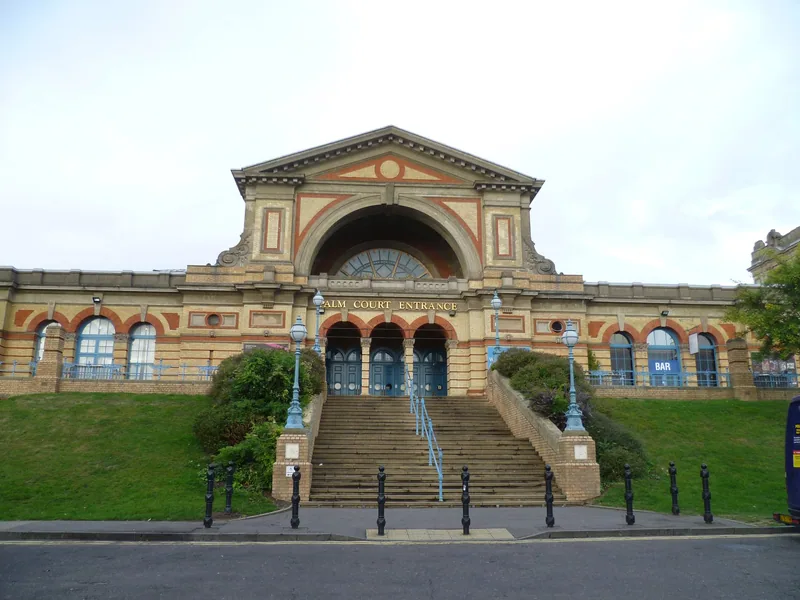
Photo: Philafrenzy · CC BY-SA 4.0 · Wikimedia Commons · resized
What is actually growing on it
More than 200 species of wildflower have been recorded along the line, which is the consequence of a railway cutting being left alone: the ballast and the embankment soils are poor and dry, and poor dry ground is where interesting plants win. Haringey describes it as perhaps the only place in the borough where orchids grow alongside dandelions and ivy climbs fig trees.
Foxes, hedgehogs, butterflies and a long list of birds are everyday sightings. Muntjac deer, which are small and shy, turn up occasionally, which is remarkable this close to inner London. The Friends and the Conservation Volunteers build dead hedges along the path edges and remove invasive plants, which is why the sides look untidy on purpose.
Two things on the southern section are worth stopping for. The Spriggan, a sculpted Cornish faerie made in 1993 by the artist Marilyn Collins, climbs out of the upper brickwork of an abutment just along from the old Crouch End Hill platforms: look up rather than ahead or you will walk straight past it. In Islington, between the Mountview Road bridge and the Blythwood Road gate, is a patch of acid grassland, the only one on the walk and the only one in the borough.
Check for diversions before you set out, because this path closes in sections. When we looked in September 2026 the Friends' site still carried notices about a significant closure and a major diversion in the Islington stretch between Crouch Hill and Blythwood Road, with dates that had passed. Haringey also has plans to replace the Stanhope Road bridge and to cut back vegetation along the path. None of that stops the walk, but it can add a street detour, so look at the Friends' access page on the morning you go.
The walk in a wheelchair or with a pushchair
This is better documented than most London walks and still not straightforward. The usable stretch is the southern section between the Oxford Road entrance to Finsbury Park and Blythwood Road: the access at both ends is almost level and the surface between them is reasonably firm. Beyond that it gets harder.
- Slopes up to some of the bridges may be too steep for an unpowered wheelchair.
- The Holmesdale Road entrance in Highgate is a steep slope.
- The Islington stretch has a surfaced ramp from Crouch Hill, but it is steep and the path runs across the face of an embankment with no barrier on the open side.
- There is a ramp from Hillside Rise behind Ashmount School.
- The northern section has reasonable ramps at both ends and runs straight on into Alexandra Park.
- Every other entrance is steps, up an embankment or down into a cutting.
The surface is coarse and there are rough stones and small tree stumps sticking up in places. The wettest part, and the one that holds pools of water after a run of rain, is the last stretch into Finsbury Park between Stapleton Hall Road and Oxford Road.
Alexandra Park: a hill that never shuts
The northern end of the walk becomes Alexandra Park, which is the part people underrate. Alexandra Palace says plainly that the park is open throughout the day and night, all year round, which is unusual for a London park of this size and makes an evening climb possible. The playground and skatepark close at dusk; nothing else does.
It has held a Green Flag for nineteen years, and the ecology is better than a hilltop event site has any right to be: the trust records 694 species of plants, animals and fungi in the park, including 212 insects and 26 arachnids, with 38 species classed as rare or legally protected. There is a wetlands boardwalk, a pitch and putt course, a high-ropes course in the trees and a boating lake, all covered on our palace page.
The view from the terrace in front of the palace runs south across the whole city. Our round-up of free viewpoints in London ranks it against the others; our own view is that it is the widest free view in north London and much the least crowded of the big three, which is a fair trade for the climb. Primrose Hill is prettier and busier.
Walk up, take the train down. The gradient is all in your favour if you start at Finsbury Park and finish at Alexandra Palace station, which sits at the Wood Green corner of the park with direct Great Northern trains back to Moorgate and King's Cross. Doing it the other way round means climbing out of the cutting at the Highgate end, which is the steepest part of the day.
Getting to each end
Finsbury Park is the southern end and is the easiest station on the walk: Piccadilly and Victoria lines, plus National Rail, with the Oxford Road and Florence Road entrances a few minutes away through the park. Our guide to Angel and Finsbury Park covers the area, which has more to eat than the northern end.
At the top, Alexandra Palace station is the closest and has direct trains from Moorgate and King's Cross; our explainer on London's railway stations sets out how those services work. Wood Green on the Piccadilly line is the nearest Underground station, and the W3 bus runs right up to the palace entrances, which is the answer if the hill is a problem.
For the gap in the middle, the nearest station is Highgate on the Northern line, close to both Holmesdale Road and Cranley Gardens. You can use it to walk one section only and skip the link, which is what we would do with children.
How to spend a day on it
Half a day does the southern section and the park: train to Finsbury Park, walk up in about 45 minutes to an hour, cross the hill through the woods, and arrive at the palace in time for a drink on the terrace before the light goes. A full day adds Highgate village, Crouch End for lunch, or the ice rink at the palace, which our guide to ice skating in London prices up.
In winter the walk is a better proposition than it sounds: the cutting is sheltered, the path drains reasonably outside the Finsbury Park end, and the bare trees open up views you cannot see in July. It also costs nothing at all, which puts it near the top of our list of free things to do in London. If you want more of this kind of walking, our guide to London's long walking routes covers the Capital Ring, which uses part of this one.
Frequently asked questions
How long is the Parkland Walk?
The southern section is just over 3km and the northern section about 750 metres, with a gap of 1.3 to 1.8km between them that has to be walked on streets or through Highgate Wood and Queen's Wood. Including the link, the whole thing is about 5km. The Friends' site also gives an overall figure of 4km for the path itself.
Can you cycle the Parkland Walk?
Yes on the walk itself, where cyclists and runners share the path but pedestrians have priority. No through Highgate Wood, where cycling is banned by byelaw, so a cyclist crossing the gap between the two sections has to use Archway Road and Muswell Hill Road.
Is Alexandra Park open at night?
Yes. Alexandra Palace states that the park is open throughout the day and night, all year round. The playground and skatepark close at dusk, and the car parks have their own hours, but the parkland and the terrace do not shut.
Is the Parkland Walk suitable for a wheelchair?
Partly. The stretch of the southern section between the Oxford Road entrance at Finsbury Park and Blythwood Road has nearly level access at both ends and a reasonably firm surface. The Holmesdale Road entrance is steep, some bridge approaches are too steep for an unpowered chair, and most other entrances are steps.
Which end should I start from?
Finsbury Park, so that the climb is spread over three kilometres rather than concentrated at the start, and so that you finish at Alexandra Palace with trains back into central London. Starting at the top means the steepest work comes at the Highgate end when you are already tired.
Sources
- Friends of the Parkland Walk - Access: section lengths, the gap, the three link routes and mobility detail (checked September 2026)
- Friends of the Parkland Walk - Sites of interest: the Spriggan, the Highgate tunnel bat roost and the acid grassland (checked September 2026)
- Friends of the Parkland Walk - Overview, management and current diversions (checked September 2026)
- Haringey Council - Parkland Walk local nature reserve: wildlife, opening, level access points (checked September 2026)
- Alexandra Park and Palace Charitable Trust - The Park: size, species counts and history (checked September 2026)
- Alexandra Palace - Opening times, including the park and the playground (checked September 2026)