
Alexandra Palace is a vast Victorian entertainment building on a hill in north London, set in 196 acres of park. Walking up to it and looking south over the whole city costs nothing. Inside there is an ice rink from £11.75, a theatre, a concert hall, cafes, and the studios where the world's first regular television service went on air in 1936.
Londoners call it Ally Pally and treat it as a park with a building in it. Visitors who come for the view, described in our guide to London's best free viewpoints, often do not realise how much else is there. This page is about the rest of it: what the building is, what you can actually do inside, what it costs, and how to get up the hill.
It was never a royal palace. It was built as a People's Palace, a commercial pleasure ground for north London, and it has been opening, burning down, reopening and reinventing itself ever since.
Alexandra Palace at a glance
- Address
- Alexandra Palace Way, London N22 7AY
- Park
- 196 acres, free, open to all
- Ice rink
- From £11.75 adult off-peak, £10.50 under-12 (September 2026)
- Pedalos
- £8.50 adult, £5.50 child, when the boating lake is open
- Summit roof walk
- Guided climb, 130 metres above sea level; book through the Palace
- Television
- The world's first regular high-definition service went out from here on 2 November 1936
- Nearest station
- Alexandra Palace, at the Wood Green corner of the park
- Big dates
- Fireworks and Drone Festival, 7 and 8 November 2026; the World Darts Championship over Christmas
A palace that keeps burning down
The first Alexandra Palace opened on 24 May 1873, Queen Victoria's fifty-fourth birthday, with concerts, recitals and fireworks. Sixteen days later it burned to the ground. A second building opened in 1875, with a Henry Willis organ that was among the largest in Europe at the time.
What followed was a hundred years of spectacle: a Venetian fete with the lake lit up and the choir singing from gondolas, a Victorian roller coaster, a stilted village built out over the water, and travelling entertainers of every sort. The first aerial photograph taken in Britain was made over this park in 1882, by a photographer who then forgot to point the camera at the Palace itself.
Another serious fire in 1980 gutted much of the building, and restoration has continued in stages ever since, most recently reopening the Victorian theatre that had stood derelict for decades. Alexandra Park and Palace Charitable Trust runs the whole site, and the park has held a Green Flag award for nineteen consecutive years.
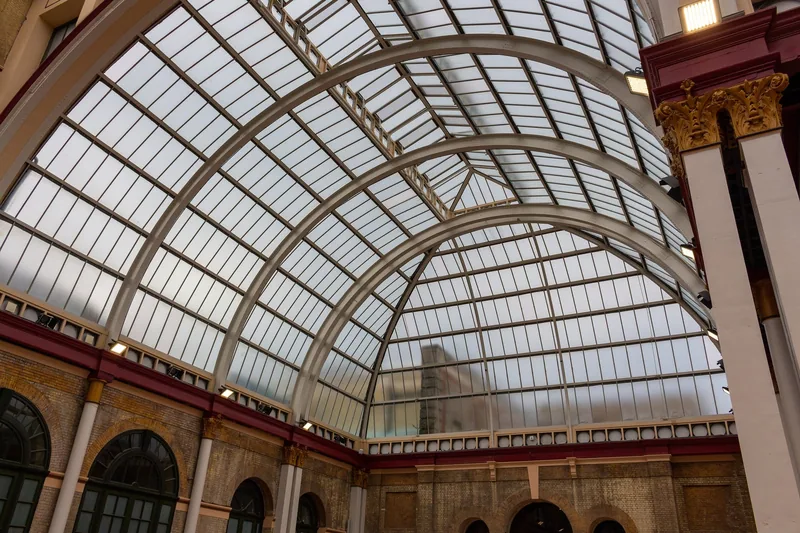
Photo: The wub · CC BY-SA 4.0 · Wikimedia Commons · resized
Where television started
The BBC arrived in 1935 and leased the entire east wing. Two former dining rooms became Studio A and Studio B, one fitted out by Marconi-EMI and the other by the Baird company, and the two systems competed head to head. Marconi-EMI's 405-line system won. On 2 November 1936 the world's first regular high-definition television service went on air from these rooms.
What followed from here is the shape of television as everyone now knows it: the first television gardening programme, the first cookery shows, and the election-night format devised by Grace Wyndham Goldie. The first programme made specifically for children went out in 1946, starring Muffin the Mule. Outside broadcast vans parked in the East Court and the theatre became a carpentry shop for building sets.
The news operation left in 1969, and the BBC stayed on with the Open University until 1981. The transmitter mast on the roof was chosen as one of the hundred objects telling the story of the corporation's first century.
2026 is the ninetieth anniversary, and most of the events are cheap or free. From September to November 2026 the Palace is running a season of talks, screenings, performances and exhibitions about the birth of television, including sessions on the pioneering women who worked in the studios and on the wartime role of the transmitter. Check the Palace's own What's On for dates.
The ice rink, and what it costs a family
The ice rink is the most-used thing in the building and it runs all year, not just at Christmas. Sessions are timed, and you should pre-book because they fill up.
| Ticket | Off-peak | Peak |
|---|---|---|
| Standard | £11.75 | £12.75 |
| Under 12 | £10.50 | £11.50 |
| Under 5 | £7.75 | £8.75 |
| Over 65 | £10.50 | £11.50 |
| Spectator | £2.50 | £3.00 |
Two adults and two children under 12 come to £44.50 off-peak and £48.50 at peak times (September 2026). Add a skate aid at £7.50 if you have a beginner: there is a seal for under-fives who are pushed along by an adult, a penguin for three to seven year olds up to 1.2 metres, and a snowman for taller children. Since 30 March 2026 the skate aids cannot be booked online and are sold at the rink on a first come, first served basis.
Session lengths vary. Term-time weekday sessions last two hours, except the last one of the day, which is an hour and a half; weekend and holiday sessions are an hour and a half. Arrive fifteen minutes before your slot. Anyone going onto the ice needs a skating ticket, including someone accompanying a private lesson, and anyone who wants to stand inside the rink without skating needs a spectator ticket.
| Day | Rink hours |
|---|---|
| Monday | 11.00 to 16.30 |
| Tuesday | 13.15 to 17.00 |
| Wednesday and Thursday | 11.00 to 17.00 |
| Friday | 13.15 to 17.00 |
| Saturday and Sunday | 11.00 to 16.30 |
Our guide to ice skating in London compares this rink with the seasonal ones in the middle of town, where prices are considerably higher and the season is six weeks long.
The roof walk, the boating lake and the trees
Summit is the newest thing here: a guided walk across the Palace roof to the Angel of Plenty statue, run with Wire & Sky, which the Palace calls the highest roof walk in the United Kingdom at 130 metres above sea level. You can book a daytime climb, a sunset climb or a London Lights climb after dark, and the views run about 25 miles on a clear day. Prices are on the booking page rather than published as a headline figure.
The boating lake is closed until further notice. Extreme weather and low water levels have taken the pedalos out of service, and the Palace says it will reopen when conditions allow. When it is running, a pedalo costs £8.50 for an adult and £5.50 for a child, with a maximum of four people per boat, at least one adult over 18, and no children under two. Check before you build an afternoon round it, and see our guide to boat hire and pedalos in London for alternatives.
Go Ape runs a high-ropes course in the woods behind the Palace, booked separately. There is also pitch and putt, a wetlands boardwalk, and a park with 694 recorded species of plants, animals and fungi in it, 38 of them rare or legally protected. It is a working ecosystem rather than an ornamental garden, which is part of its charm.
Concerts, darts and the theatre
The Great Hall is one of London's larger music venues, and the restored Victorian theatre beside it is one of its most atmospheric. Between them they take everything from touring bands to comedy and television recordings. Our guide to live music venues in London puts the Great Hall in context, and our guide to the big arenas explains where it sits in size terms.
Two fixed points in the calendar are worth planning around. The Fireworks and Drone Festival falls on Saturday 7 and Sunday 8 November 2026, with gates at 16.00 and tickets from £11.50; the Sunday is a family day with an earlier display. And over Christmas and New Year the Great Hall hosts the World Darts Championship, which is a genuinely strange and very British spectacle: see our guide to darts and snooker in London. Both sell out, and neither is something you can decide on the day.
Our guide to Bonfire Night in London explains why the big displays no longer fall on 5 November.
Getting up the hill
The Palace has a station named after it. Great Northern trains run there direct from Moorgate, calling at Highbury & Islington on the way, and there are direct services from King's Cross as well; the station sits at the Wood Green corner of the park. Our guide to London's railway stations explains how those services work.
On the Underground, the nearest station is Wood Green on the Piccadilly line, around twenty minutes from Piccadilly Circus. The W3 bus runs from Finsbury Park and Tottenham right up to the Ice Rink and Palm Court entrances, which saves the climb.
Whichever you choose, be aware that the walk from either station is uphill, and not gently. If you have a pushchair or limited mobility, the bus is the answer. Car parks operate a charging system and support the charity: East Court is open 05.30 to 00.30 with last entry at 20.00, and the Grove car park 06.00 to 19.00, both excluding event days. There are blue badge bays in both, and a drop-off point outside the Palm Court entrance.
Making a day of it
The park is the point. Come up in the late afternoon, walk the terrace while the light goes, and stay for a drink at one of the cafes. Highgate and Crouch End are both walkable from the park's western gates, and the Parkland Walk, a disused railway line turned into a footpath, runs down from here to Hampstead Heath.
For a family day, the rink and the playground fill a morning and the park fills an afternoon; see London with children. Crystal Palace Park in south London is the closest comparison: another Victorian pleasure ground built round an exhibition palace that burned down, and worth pairing if you like that sort of thing.
If you are collecting London houses that are not royal palaces despite the name, our guides to Fulham Palace and Lambeth Palace and to Strawberry Hill House cover two more, both a long way from the tourist centre and both worth the journey.
Frequently asked questions
Is Alexandra Palace free to visit?
The park and the terrace with the view over London are free and open to everyone, and you can walk into the public areas of the building without paying. The ice rink, the Summit roof walk, Go Ape, concerts and events are all ticketed separately.
How much is ice skating at Alexandra Palace?
From £11.75 for an adult off-peak and £12.75 at peak times, with under-12s at £10.50 or £11.50 and spectators at £2.50 or £3.00 (September 2026). Two adults and two children under 12 come to £44.50 off-peak. Skate aids cost £7.50 and must be bought at the rink rather than online.
Why is Alexandra Palace famous for television?
The BBC leased the east wing in 1935 and converted two dining rooms into television studios. On 2 November 1936 the world's first regular high-definition television service went on air from there. Many familiar formats, including television gardening, cookery and election-night coverage, were invented in the same building.
How do you get to Alexandra Palace from central London?
Take a Great Northern train from Moorgate or King's Cross to Alexandra Palace station, at the Wood Green corner of the park, or the Piccadilly line to Wood Green, about twenty minutes from Piccadilly Circus. The W3 bus from Finsbury Park runs up to the Palace itself, which avoids a steep walk uphill.
Is the boating lake at Alexandra Palace open?
Not at present. The Palace has closed the boating lake until further notice because of extreme weather and low water levels, and says it will reopen when conditions allow. Pedalos normally cost £8.50 for an adult and £5.50 for a child, with a maximum of four people and one adult per boat.
Sources
- Alexandra Palace - Ice Rink prices and opening times (checked September 2026)
- Alexandra Palace - The BBC at the Palace (checked September 2026)
- Alexandra Palace - Timeline (checked September 2026)
- Alexandra Palace - Summit rooftop adventure (checked September 2026)
- Alexandra Palace - Boating Lake (checked September 2026)
- Alexandra Palace - Getting here and parking (checked September 2026)
- Alexandra Palace - Fireworks and Drone Festival (checked September 2026)