
Two pieces of genuinely ancient woodland face each other across Muswell Hill Road, five minutes from Highgate station, and both are free. Highgate Wood has a cafe, a cricket field, a playground and a gate that is locked at night. Queen's Wood has a small cafe, one lavatory and no gate at all: Haringey Council lists it as open 24 hours a day.
That is the whole difference in one sentence, and it decides which one you want. Highgate Wood, 70 acres owned by the City of London Corporation, is managed as a place for people as well as for wildlife. Queen's Wood, run by Haringey, is steeper, darker and largely left alone. You can walk both in an afternoon, and most visitors who come for one find the other by accident.
Our guide to Highgate and Crouch End puts the two woods in the context of the village above them. This page is about the woods themselves: the Roman kilns, what closes when the wind gets up, which paths take a wheelchair and how to link the two.
Highgate Wood and Queen's Wood compared
- Entry
- Both free, no ticket, no booking
- Highgate Wood size and owner
- 70 acres, City of London Corporation, run as a charity
- Queen's Wood owner
- London Borough of Haringey. A local nature reserve since 1990
- Opening
- Queen's Wood: open 24 hours. Highgate Wood: gated, with the day's times shown only on the notice boards at the entrances
- Facilities in Highgate Wood
- Cafe with a terrace, playground, sports field, drinking fountain, information hut, two wheelchair-accessible toilets (Radar key)
- Facilities in Queen's Wood
- A cafe in the lodge and a lavatory
- Station
- Highgate (Northern line), five minutes to Highgate Wood; buses 43, 134 and 234
- Cycling
- Banned outright in Highgate Wood under its byelaws
What "ancient woodland" means on this hill
Both woods are the real thing, not planting that has grown old. Haringey dates Queen's Wood to at least 1600 and says it may go back to prehistory, and describes it as one of four ancient woods in the borough thought to descend directly from the wildwood that covered most of Britain five thousand years ago. The City describes Highgate Wood in the same terms.
The trees are the same in both: mostly oak and hornbeam, with some beech. The hornbeams were traditionally coppiced, cut back repeatedly for small timber and fuel, while the oaks around them were left to grow into building timber. That history is why the shapes are odd, with multiple trunks rising from old stools.
The wildlife records are unusually good, because Highgate Wood has been surveyed for decades. The City's moth survey there is the longest-running in the United Kingdom, and the totals so far are more than 900 invertebrate species, more than 400 moths, 353 fungi, 70 birds and seven species of bat. Queen's Wood has all three British woodpeckers, more than a hundred species of spider and a nationally rare jewel beetle that is widespread in it. Visitors are asked not to pick fungi in Highgate Wood, because the fungi are half the ecosystem.
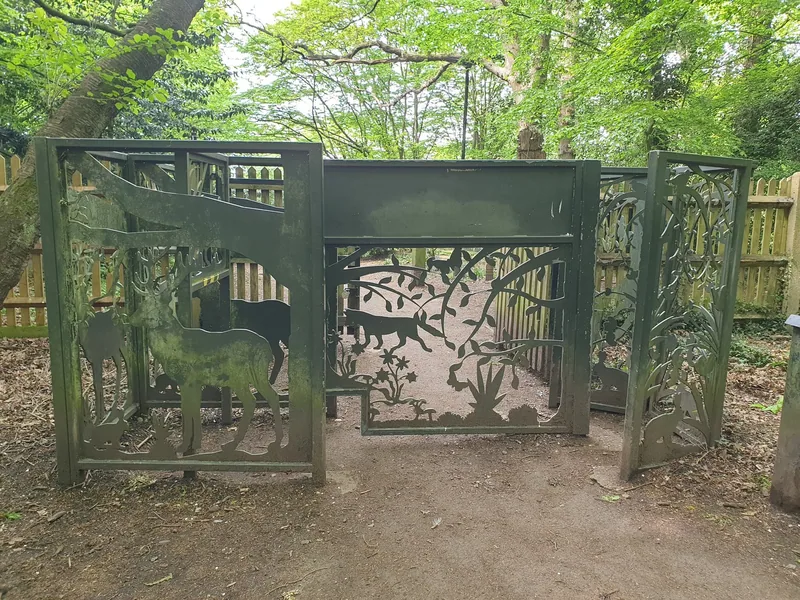
Highgate Wood: the one with a cricket field in it
Highgate Wood does not feel like a nature reserve from the main path, and that is deliberate. There is a mown sports ground in the centre used for cricket and casual games, a large playground, a cafe with a terrace beside the lodge, changing rooms and a drinking fountain. Families use it heavily at weekends and in the school holidays, and it is one of the better places in north London to take children who have run out of patience with museums.
The cafe trades on the food hygiene register as Hoxton Beach at the Pavilion Cafe and was rated 4 at its last inspection in February 2026. The two accessible lavatories are worth knowing about in detail, because the City publishes their dimensions: the one by the playground is 1.9 by 1.65 metres and the one by the cafe is 2.5 by 2.5 metres, and both need a Radar key.
Surfaces are mixed. Some paths are tarmac and the rest are unmade and get muddy. Cycling is banned everywhere in the wood, and so is flying a drone for fun, both under byelaws that are enforced by the Hampstead Heath Constabulary rather than by park keepers. Those byelaws also set the opening hours, and this is the frustrating part: they say the times are whatever is written on the notice board at each entrance, and the City does not publish them online. Read the board on the way in.
A wind forecast of 37mph closes Highgate Wood, at short notice. The City states that because the wood is full of old trees, it may have to shut for safety when wind speeds of 37mph or above are forecast, and it posts closures on social media when it can. Queen's Wood has no gate to close. If a gale is coming through, check before you travel, or plan on Queen's Wood instead and accept that walking under old trees in high wind is its own decision.
The Roman pottery kilns, and the one being rebuilt
Highgate Wood is one of the more important Roman industrial sites in London, which almost nobody arriving for the playground realises. Excavations in the 1960s and 1970s turned up more than 40,000 pottery fragments and the remains of at least ten kilns. The wood was a working pottery between about AD 50 and AD 160, producing the grey everyday tableware that supplied Londinium.
You can walk to the original kiln site on the ordinary woodland paths, and the City publishes a what3words reference for it, which is genuinely useful because there is not much to see unless you are standing in the right place. A National Lottery Heritage Fund project called Firing London's Imagination is restoring a second-century kiln first found in 1968 and will return it to the wood as the centrepiece of a new visitor centre, with live firings and workshops.
Meanwhile the restored kiln exhibition lives in the Information Hut, which was closed for a new roof from 13 April 2026. Two City pages give two different lengths for that closure, eight to ten weeks on one and reopening in September on the other, so if the exhibition is the reason you are going, check first. The self-guided historic trail through the wood is available whatever the hut is doing.
Queen's Wood: darker, steeper and usually empty
Cross Muswell Hill Road and the character changes within twenty metres. Queen's Wood drops away into a valley, the canopy is closer, and there is no mown grass anywhere in it. The paths are earth, they run up and down, and on a weekday you can walk for ten minutes without seeing anybody.
The ground flora is the reason ecologists rate it: Haringey lists large populations of wood anemone, native bluebells, wood goldilocks and wood sorrel, which is a remarkable list for somewhere six miles from Trafalgar Square. Late April into early May is when to come for it. For the same reason it is one of the better places in the city for autumn colour in late October, and it is quiet enough in winter to be slightly unnerving.
There is a cafe in the lodge on Queen's Wood Road and a lavatory, and that is the extent of the infrastructure. Haringey is blunt about access: the only entrance and the on-site paths are wide enough for a wheelchair but the wood is not fully accessible. The Friends of Queen's Wood do the practical maintenance, and Haringey's parks team runs a free guided walk for women on the last Saturday of the month.
Getting there, and which gate
Highgate station on the Northern line is a five-minute walk and is the only sensible approach by Underground; our guide to the Northern line explains which branch you want. Buses 43, 134 and 234 stop nearby, and the 43 and 134 both run down through Islington to the City, which makes them useful in their own right, as our page on bus routes worth riding explains.
There is no car park at Highgate Wood. Two blue badge bays sit inside the wood near the cafe, entered through Onslow Gate, and street parking in the surrounding roads is limited and restricted. When we checked in September 2026 the City's visitor page still carried a notice that Gypsy Gate on Muswell Hill Road was closed for about nine months for work on a property in the wood, without giving a year; if you find it shut, New Gate is a minute further down Muswell Hill Road and Archway Gate three minutes along Archway Road.
Walking both, and going on from there
The obvious circuit is 90 minutes: into Highgate Wood at New Gate, round the perimeter to Cranley Gate, back across Muswell Hill Road and down through Queen's Wood to the cafe, then out onto Priory Gardens. Look for the Capital Ring signs, which use this route.
The better plan is to make the woods the middle of a longer walk, because Queen's Wood is one of the three recommended ways of crossing the gap in the Parkland Walk, the dismantled railway that runs from Finsbury Park to Alexandra Palace. Coming from the south you leave the railway line at Holmesdale Road, climb through Queen's Wood and Highgate Wood, and rejoin it at Cranley Gardens.
Highgate Cemetery is fifteen minutes' walk west through the village, and beyond it Hampstead Heath and Kenwood House.
If it is ancient woodland specifically that interests you, Epping Forest on the north-east edge of London is the same thing on an enormous scale. All of these cost nothing, which puts them on our list of free things to do in London.
Frequently asked questions
What time do Highgate Wood and Queen's Wood close?
Queen's Wood does not close; Haringey lists it as open 24 hours a day. Highgate Wood is gated and its byelaws state that the day's opening and closing times are displayed on notice boards at each entrance rather than published, so check the board as you go in.
Can you cycle through Highgate Wood?
No. Cycling is prohibited anywhere in Highgate Wood under its byelaws, to protect the ancient woodland, and the byelaws are enforced by the Hampstead Heath Constabulary. Cyclists heading between the two halves of the Parkland Walk have to use the roads instead.
Are there toilets in Highgate Wood and Queen's Wood?
Highgate Wood has two wheelchair-accessible toilets, one by the playground and one by the cafe, both opened with a Radar key, plus ordinary facilities. Queen's Wood has a single lavatory. Neither wood has anything else, so use the cafes.
What are the Roman kilns in Highgate Wood?
The remains of a Roman pottery that worked between about AD 50 and AD 160, supplying grey everyday ware to Londinium. Excavations in the 1960s and 1970s found more than 40,000 fragments and at least ten kilns. The original site is reachable on the woodland paths, and a restored kiln is being returned to the wood as part of a Heritage Fund project.
Which wood is better with children?
Highgate Wood, without much argument: it has the playground, the open sports ground, the cafe with a terrace and lavatories you can find. Queen's Wood has steep earth paths, no playground and very little signage, which suits older children and walkers rather than pushchairs.
Sources
- City of London Corporation - Visit Highgate Wood: access, toilets, transport, gate closures (checked September 2026)
- City of London Corporation - Highgate Wood wildlife and woodland management (checked September 2026)
- City of London Corporation - Roman pottery kilns in Highgate Wood (checked September 2026)
- City of London Corporation - Highgate Wood rules and byelaws (checked September 2026)
- Haringey Council - Queen's Wood local nature reserve (checked September 2026)
- Friends of the Parkland Walk - Access, and the routes between the two sections (checked September 2026)
- Food Standards Agency - Hygiene rating, Hoxton Beach at the Pavilion Cafe, Highgate Wood (checked September 2026)