
The Piccadilly line is the dark blue one, and it is the line most visitors use without meaning to: 53 stations from Cockfosters in the far north, through King's Cross, Covent Garden and South Kensington, out to Heathrow and Uxbridge in the west. It is slow, it has no air conditioning yet, and it goes to more of the things you came for than any other line on the map.
Fix two facts before you build a day around it. The line splits at both ends, so the train on the platform may not be going where you think. And Transport for London is halfway through a £3.4bn rebuild of the whole route, which is why parts of it shut most weekends. The network, the fares and the unwritten rules of a crowded carriage belong to our introduction to the Underground; this page sticks to the line.
The Piccadilly line at a glance
- Colour on the map
- Dark blue
- Stations
- 53
- The three western ends
- Heathrow Terminal 5, Heathrow Terminal 4 and Uxbridge
- The eastern end
- Cockfosters, Zone 5
- Share of all Tube journeys
- More than 10%, about 158 million trips a year (TfL)
- Trains through the centre at the busiest times
- 24 an hour
- Air conditioning
- None in service in September 2026
- Night Tube
- Friday and Saturday nights, Cockfosters to Heathrow Terminal 5 only
- Zone 1 to Heathrow, pay as you go
- £5.90 at any hour
Where the line goes, and why it splits at both ends
Coming in from Cockfosters the line runs down through Southgate, Arnos Grove, Wood Green, Turnpike Lane and Finsbury Park, then Arsenal, Holloway Road and Caledonian Road into King's Cross St Pancras. From there it crosses the centre through Russell Square, Holborn, Covent Garden, Leicester Square, Piccadilly Circus, Green Park, Hyde Park Corner, Knightsbridge, South Kensington, Gloucester Road, Earl's Court, Barons Court and Hammersmith to Acton Town.
At Acton Town it divides. One branch runs north-west through Ealing Common, the Sudburys, South Harrow, Rayners Lane and Ruislip to Uxbridge. The other runs south-west through Northfields, Osterley and the three Hounslow stations to Hatton Cross, and then into Heathrow.
Inside the airport it divides again. A westbound train is signed either Heathrow Terminal 5, calling at Terminals 2 & 3 and then Terminal 5, or Heathrow Terminal 4, calling only at Terminal 4 and then looping back through Terminals 2 & 3. Read the front of the train.
Terminal 4 and Terminals 2 & 3 are not next to each other on this line. Because the Terminal 4 branch works as a one-way loop, going from Terminals 2 & 3 to Terminal 4 by Tube means travelling back out to Hatton Cross and changing, which TfL's own journey planner puts at about 12 minutes. The Elizabeth line does the same hop free and direct, and inter-terminal transfers on it are not charged.
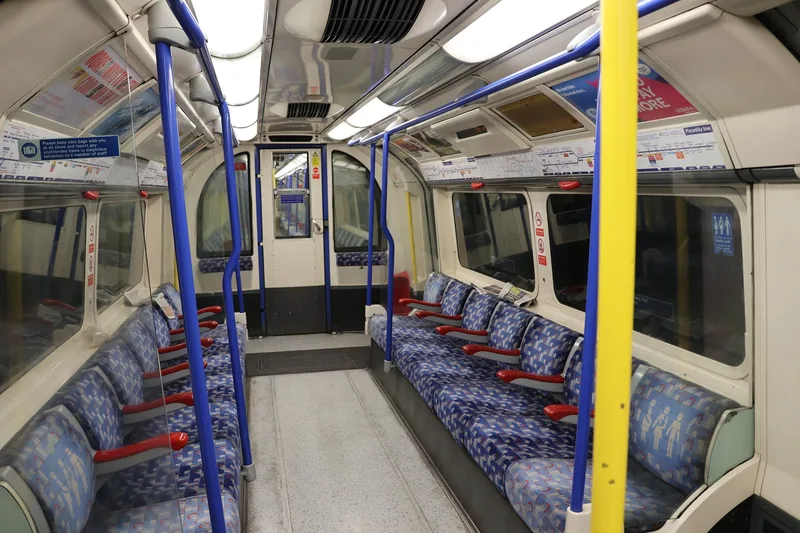
Photo: DiscoA340 · CC BY-SA 4.0 · Wikimedia Commons · resized
The trains: 1975 stock, and the 94 that will replace them
The Piccadilly line still runs the fleet that entered service in 1975. Short carriages, doors between them, narrow doorways, fabric seats. There is no through-carriage walk, no screen telling you which station is next and nowhere sensible to put a large suitcase.
TfL has ordered 94 trains from Siemens Mobility to replace the 86 in service. The published list of what changes is specific: walk-through carriages, wider double doorways, digital information screens, on-board cameras, improved step-free access from the platform onto the train, and air conditioning. The first of them reached London for testing towards the end of October 2024. TfL's published window for passenger service opens in December 2026 and closes in June 2027, which is a six-month spread rather than a date.
Once the whole fleet has changed over, TfL expects to run 27 trains an hour through central London instead of 24, one every 135 seconds, with up to 23% more capacity at peak times.
A big case is a real problem on this line, not a small one. The 1975 carriages have narrow single-leaf doors and standing room only in the vestibule. If you are moving hotels with two large cases, our notes on luggage on the Tube are worth five minutes first.
No air conditioning, and how hot it actually gets
No train on the line is cooled in September 2026. TfL ventilates the tunnels and chills some platforms instead, and is building a new platform cooling system as part of this upgrade with the Department for Transport. In fairness to the Piccadilly, it is not the worst offender: on TfL's platform temperature data it sits fifth of the seven deep lines, cooler than the Victoria, Central, Bakerloo and Northern. Our page on which Tube lines have air conditioning has the figures and the roll-out timetable.
The interchanges that are longer than they look
The Tube map shows a change of line as a small white circle. On this line, three of them deserve a warning.
- Hammersmith is two stations, not one. The Piccadilly and District platforms are in one building; the Circle and Hammersmith & City platforms are in another, across a busy road. TfL measures the step-free route between them at 520 metres. Allow ten minutes, more with luggage.
- Green Park is deep. The Piccadilly platforms are the lowest in the station. TfL's step-free distances from them are 160 metres to the Victoria line and 220 metres to the Jubilee.
- King's Cross St Pancras is a walk in itself. Six lines, two main-line stations and Eurostar share one ticket hall, and the Piccadilly platforms sit at the far end of it. Catching a train, add fifteen minutes to whatever the app says; our guide to King's Cross and St Pancras has the exits.
A smaller trap catches people at Holborn and South Kensington, where the eastbound and westbound Piccadilly platforms sit on different levels, two flights apart. Check the direction on the sign, not the platform number.
Leicester Square to Covent Garden is the one stop nobody should pay for; the walk is quicker, and we list the other such pairs in Tube stations it is quicker to walk between.
Step-free access: good at the ends, thin in the middle
Fewer than half of the line's 53 stations have a step-free route from the street to the platform, and the gap falls exactly where visitors need it. Across the whole central section, from Hammersmith to King's Cross, only Hammersmith, Earl's Court, Knightsbridge, Green Park, King's Cross St Pancras, Caledonian Road and Finsbury Park are step-free.
That leaves Barons Court, Gloucester Road, South Kensington, Hyde Park Corner, Piccadilly Circus, Leicester Square, Covent Garden, Russell Square and Holloway Road with stairs somewhere in the route. South Kensington is the one that hurts, because it is the stop for three of the biggest free museums in London, including the Natural History Museum. Covent Garden is worth singling out for a different reason: it has four lifts and still is not step-free, because there are stairs between the lift landing and the platforms. Do not read a lift symbol as step-free anywhere on the Underground.
At the western end the picture is better. All three Heathrow stations are step-free, and Terminals 2 & 3 and Terminal 4 have a marked level-access boarding point on the platform, which matters when you are pushing a case. Knightsbridge only joined the step-free list in April 2025. Our guide to step-free and accessible transport in London explains the turn-up-and-go service, which needs no booking.
Heathrow: the cheap way in, with the time cost stated plainly
This is the journey the line is famous for. Pay as you go from Zone 1 to any Heathrow terminal is £5.90 whatever the hour, because Heathrow journeys through Zone 1 are charged at the peak rate all day, and a paper single is £7.00. King's Cross St Pancras to Terminals 2 & 3 takes about 57 minutes, and to Terminal 5 about 62. From Piccadilly Circus it is about 47 minutes.
Whether that is worth it depends on your time and your bags, and we have done the arithmetic against the faster options in every way from Heathrow into central London compared.
Boarding at Heathrow means you get a seat. Westbound you join a train that filled up in the West End. Eastbound you board at the start of the line, and have 40 minutes before it gets busy at Hammersmith.
Weekends are when the line is being rebuilt
Because the track, signalling and power are being renewed at once, weekend closures here are frequent, long and sometimes cover the whole central section. On the last weekend of September 2026 there was no service at all between Cockfosters and Uxbridge, with trains running only between Acton Town and Heathrow.
Replacement buses run under route numbers in the PL series, but a bus along the Piccadilly corridor is no substitute for the train. The alternative rail routes work better: the District line towards Acton Town, the Metropolitan line for Rayners Lane to Uxbridge, and the Elizabeth line for anything to or from Heathrow.
Check the status on the Friday, not on the Saturday morning. TfL's live status page lists planned work weeks ahead, and our advice for the days when a line is down is in getting around London when the Tube is not running.
The Night Tube runs, but not on the branch you might want
On Friday and Saturday nights the line runs all night between Cockfosters and Heathrow Terminal 5, calling at 38 of its 53 stations. Two parts get nothing: the whole Uxbridge branch, from Ealing Common out through Rayners Lane, and Heathrow Terminal 4.
So if you land at Terminal 4 at three in the morning, the night service will not take you into town from there. Move between terminals first, or take the N9 bus from Terminal 5. Night fares are off-peak and count towards the daily cap; the sections that run on other lines are in our guide to the Night Tube, and ordinary last trains are in first and last Tube trains.
The journey the line is really for: King's Cross to the museums
Ignore the airport for a moment. The line threads a single train through more of central London's sights than anything else on the map, and it does it in minutes rather than the half-hour the map suggests.
| From King's Cross St Pancras | Journey time | What is at the other end |
|---|---|---|
| Russell Square | 2 minutes | The British Museum, about six minutes on foot |
| Covent Garden | 6 minutes | The piazza, the market and the Transport Museum |
| Piccadilly Circus | 9 minutes | Regent Street, Soho, the theatres |
| Green Park | 11 minutes | St James's, Buckingham Palace, Mayfair |
| South Kensington | 16 minutes | Three national museums, all free |
Times are from TfL's journey planner for a weekday late morning. One line, no changes, and off-peak you will usually sit down. The line also calls at Arsenal, the closest station to the ground and the reason that platform is unusable on a match evening; see how to get to the Emirates Stadium for the alternative.
The time to avoid the line is the evening peak between Green Park and Hammersmith, when it carries west London commuters on top of everyone with a suitcase. Half an hour either side makes a visible difference, as our notes on avoiding the London rush hour set out.
Frequently asked questions
Does the Piccadilly line have air conditioning?
Not in September 2026. Its trains date from 1975 and have forced ventilation only. The 94 replacement trains ordered from Siemens Mobility will be the first air-conditioned deep Tube trains in London. TfL's window for the first of them to carry passengers runs from December 2026 to June 2027, and the rest arrive in stages after that.
How long does the Piccadilly line take from Heathrow to central London?
About 47 minutes from Heathrow Terminals 2 & 3 to Piccadilly Circus, and about 57 minutes to King's Cross St Pancras. Terminal 5 adds roughly five minutes. The fare is £5.90 with a contactless card or Oyster at any time of day, because Heathrow journeys through Zone 1 are always charged at the peak rate.
Which Piccadilly line stations are step-free?
Fewer than half of the 53. In the central section only Hammersmith, Earl's Court, Knightsbridge, Green Park, King's Cross St Pancras, Caledonian Road and Finsbury Park have a step-free route from street to platform, and all three Heathrow stations do. Covent Garden has lifts but is not step-free, so plan with TfL's step-free option rather than the lift symbol.
Why does my Piccadilly line train say Heathrow Terminal 4?
Because the airport branch splits. Terminal 5 trains call at Terminals 2 & 3 and then run to Terminal 5. Terminal 4 trains call at Terminal 4 only, then loop back through Terminals 2 & 3 towards central London. Check the destination on the front of the train before Hatton Cross.
Does the Piccadilly line run all night?
On Friday and Saturday nights only, between Cockfosters and Heathrow Terminal 5. There is no night service on the Uxbridge branch and none to Heathrow Terminal 4. Night fares are off-peak and count towards the daily cap.
Sources
- Transport for London - Piccadilly line upgrade (checked September 2026)
- Transport for London - The Night Tube (checked September 2026)
- Transport for London - Step-free access (checked September 2026)
- Transport for London - Tube and rail fares (checked September 2026)
- Transport for London - Single Fare Finder (checked September 2026)
- Transport for London - Tube, DLR and Overground status (checked September 2026)
- Transport for London - Stations, platforms and step-free accessibility data (checked September 2026)