
Bunhill Fields is free, open every day except Christmas, Boxing Day and New Year's Day, and holds the graves of John Bunyan, Daniel Defoe and William Blake within four acres on City Road, five minutes from Old Street station. You need about half an hour, and you can see all three graves without leaving the main path.
It is a burial ground rather than a churchyard, and that distinction is the whole point. For roughly two centuries this was where Londoners who would not conform to the Church of England were buried: Baptists, Congregationalists, Quakers, Presbyterians and the rest, collectively known as Dissenters or Nonconformists. The ground was never consecrated by a bishop, which is exactly why they wanted it.
The City of London Corporation has run it as a public open space since 1867. Our wider guide to London's secret and semi-private gardens puts it in a list of City green spaces; this page is about the burial ground itself, who is under the grass, and how to combine it with the Methodist buildings across the road.
Bunhill Fields at a glance
- Address
- 38 City Road, London EC1Y 2BG; entrances on City Road and Bunhill Row
- Admission
- Free, no ticket, no booking
- Nearest stations
- Old Street (exit 3) and Moorgate
- Size
- 1.6 hectares, with 2,333 monuments in five railed enclosures and an open lawn to the north
- Burials
- Around 123,000, from the 1660s until the ground closed in 1853
- Famous graves
- John Bunyan, Daniel Defoe, William Blake, Isaac Watts, Susanna Wesley, Thomas Bayes
- Time needed
- 20-40 minutes; an hour if you add Wesley's Chapel opposite
- Closed
- Christmas Day, Boxing Day and New Year's Day
Who the Dissenters were, and why they are all here
After 1662, clergy who refused to accept the Book of Common Prayer were forced out of their parishes, and the congregations that followed them out became legally separate from the national church. Being outside it had consequences that reached past Sunday: Dissenters were barred from the universities, from many public offices, and from a straightforward burial in their parish churchyard by an Anglican priest reading Anglican words.
Bunhill Fields solved the last of those problems. It opened for burials in the 1660s on ground the City had walled but never had consecrated, and for nearly two hundred years it was the place where Nonconformist London buried its dead. Around 123,000 people were laid in it before it closed in 1853. That is an enormous number for four acres, and it explains what you are looking at: headstones packed shoulder to shoulder in a grid, because the ground had to take far more people than it was designed for.
The name is older than the burial ground and is usually explained as a worn-down form of "Bone Hill", although nobody can prove it. What is certain is that this was open land outside the City wall long before it was anything else.
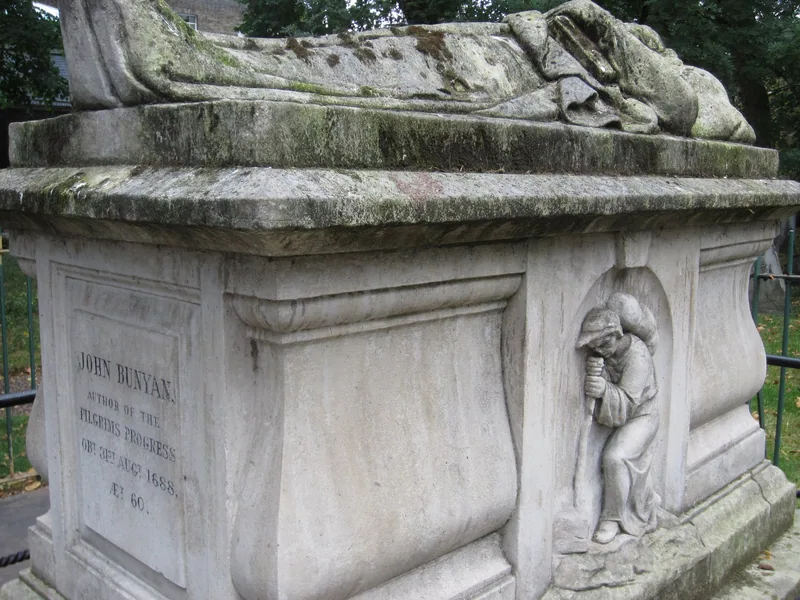
Photo: Another Believer · CC BY-SA 4.0 · Wikimedia Commons · resized
Finding Bunyan, Defoe and Blake without wandering
Most visitors come for three graves, and they are easy to find if you know the order. Walk in from City Road and follow the broad central path that cuts the ground in two.
- John Bunyan (died 1688), the author of The Pilgrim's Progress, lies under a stone chest with a carved recumbent figure of him on the lid, and panels showing scenes from the book. It is the most sculptural thing in the ground and the hardest to miss.
- Daniel Defoe (died 1731), who wrote Robinson Crusoe, has a tall, plain obelisk. It is not the original marker: the Victorians raised it by public subscription, largely from money sent in by children after a newspaper appeal.
- William Blake (died 1827) is the complicated one. He was buried in a common grave with no marker, and for most of the twentieth century a memorial stone stood some distance from the actual spot. The Blake Society commissioned a ledger stone for the real grave, which is now marked separately. So there are two Blake stones here, and only one of them is where he is.
The Blake Society holds a free gathering at the grave each August, around the anniversary of his death on 12 August, and anyone may turn up. If you are here in the right week it is worth looking up the date on the Society's events page.
The three big graves are inside the railings, not behind them. Bunyan, Defoe and Blake's memorial stone all stand in the cleared strip beside the central walk, so you can reach them without a key. The 2,000-odd other headstones are inside fenced enclosures that visitors cannot normally enter, which is why the place looks more locked-up than it is.
The names most people walk past
The famous three are not the reason the ground matters. Bunhill holds the people who built English religious dissent, and several of them changed things well beyond church walls.
Isaac Watts (died 1748) wrote the hymns that half the English-speaking world still sings, including When I survey the wondrous cross and the tune we now attach to Joy to the world. Susanna Wesley (died 1742), mother of John and Charles, is buried here; there is a memorial to her just inside the gate of the chapel across the road, which is a good reminder of how tightly linked the two sites are.
Thomas Bayes (died 1761) was a Presbyterian minister who worked on probability in his spare time. The rule that carries his name underpins a great deal of modern statistics and machine learning, and his monument in the middle enclosure is a scruffy stone vault that receives a surprising number of pilgrims from the technology industry. Also here are Defoe's fellow pamphleteers, dozens of ministers, and the printers and small tradespeople who made up most Nonconformist congregations.
What the ground looks like now, and why
Bunhill has been rebuilt twice. In the 1860s the City laid out paths, planted trees and recut the worn inscriptions. Then in 1964-65 the northern third, which had been wrecked by wartime bombing, was redesigned as a public garden by Peter Shepheard: an open lawn with shrub planting, benches and a break in the tone. The southern part was left as it was, a dense field of stone behind railings.
The result is unusual and rather good. You get the memorial landscape and a place to sit in the same 1.6 hectares, and the plane trees are now tall enough to close the whole thing off from City Road. The historic landscape is on the national register of parks and gardens at Grade I, the highest category, and there are 75 listed tombs inside the boundary.
At lunchtime on a weekday the lawn fills with office workers from the surrounding blocks, which is worth knowing whether you want company or not. Before 11am and after 3pm it is usually close to empty. For more green space in the Square Mile, Postman's Park and its wall of memorial tablets is fifteen minutes' walk south.
Opening hours and which gate to use
There are two entrances: one on City Road on the eastern side, one on Bunhill Row on the western side, with the central path running between them. Coming from Old Street station, take exit 3 and walk south; from Moorgate, walk north up Moorgate and Finsbury Pavement, about eight minutes.
The City of London's published hours are 8am on weekdays and 9.30am at weekends and on bank holidays, closing at 7pm or dusk, whichever comes first. The dusk rule is the one that matters: in December the gates shut in the middle of the afternoon, and a winter visit needs to be a morning visit. The current garden page does not print the times, so check the signs at the gate or ask the City Gardens team if you are travelling specially.
The ground is flat, the main paths are paved and the gates are level, so it is straightforward with a wheelchair or a pushchair. There are no toilets and no café inside; the nearest public facilities are in the surrounding streets.
Wesley's Chapel, directly across the road
Bunhill's natural companion is on the other side of City Road at number 49. Wesley's Chapel was built in 1778 as John Wesley's London base, and the complex includes the chapel itself, the Museum of Methodism in the crypt, and the Georgian townhouse Wesley lived in from 1779 until his death in 1791.
| What | Opening | Cost (September 2026) |
|---|---|---|
| Wesley's Chapel and grounds | Tuesday to Saturday, 10.30am to 4pm | Free; donations welcome |
| Museum of Methodism (crypt) | Tuesday to Saturday, 10.30am to 4pm | Free |
| John Wesley's House | By request at the desk; last entry 2.45pm | £10 adult, £6 concession, under-18s free |
The house is the part worth paying for. It is one of the few small Georgian townhouses in London still furnished as a home rather than a museum set, and access is on request rather than on a timetable: you ask one of the heritage stewards and they let you in. A party of six or more has to book ahead and pay a booking fee per visitor, so a family can simply turn up but a tour party cannot.
Two details connect the two sides of the road. Susanna Wesley's grave is in Bunhill Fields, and her memorial stands inside the chapel gate. And Charles Wesley's own organ is in the chapel complex, in the smaller Foundery Chapel. The chapel is a working church with services, so parts of it close at short notice; the opening hours above are for heritage visitors.
Half a day that makes sense around it
Bunhill is twenty minutes of content in an area with a great deal more, and the sensible thing is to build it into a walk rather than travel for it alone.
- Start at Old Street and do Bunhill Fields and Wesley's Chapel together, which runs to roughly 75 minutes including the house.
- Walk ten minutes south-west to the Charterhouse in Clerkenwell, a Tudor mansion built on a plague pit and still lived in.
- Continue to Smithfield for the new London Museum, whose West Smithfield site opens on 28 November 2026.
- Or turn east instead into Shoreditch for lunch, which is five minutes from the City Road gate.
Anyone whose interest is really the burial grounds should also look at St Pancras Old Church and its gardens, where Mary Wollstonecraft was buried and where the Hardy Tree stood, and at the seven great Victorian cemeteries that were built from the 1830s precisely because places like Bunhill had run out of room. None of the three charges a penny, which is worth remembering when you are filling a day in London without spending.
For context on the streets around it, Islington begins immediately north, the Square Mile starts a few hundred metres south, and the Barbican is a ten-minute walk west. Two other pages here cover places that survived by being useful rather than pretty: Walthamstow Wetlands, which is still a working reservoir system, and Severndroog Castle, saved from private sale by its neighbours.
Frequently asked questions
Is Bunhill Fields free to visit?
Yes. Nothing is charged, nothing is ticketed and nothing has to be booked. It is a public open space run by the City of London Corporation and is open every day except Christmas Day, Boxing Day and New Year's Day. The Museum of Methodism across the road is also free.
Where exactly is William Blake buried in Bunhill Fields?
Blake was buried in an unmarked common grave in 1827. For decades a memorial stone stood at a spot that was not the grave, and the Blake Society later commissioned a ledger stone for the actual burial place. Both stones are now in the ground, close to the central path on the eastern side.
Can you walk among the gravestones at Bunhill Fields?
Only along the paths. The five enclosures holding most of the 2,333 monuments are fenced and closed to visitors, but the graves of Bunyan, Defoe and Blake stand in the cleared strip beside the main walk, so the three that people come for are all reachable.
Is Old Street or Moorgate closer to Bunhill Fields?
Old Street is closest; take exit 3 and walk south along City Road for about five minutes. Moorgate is roughly eight minutes on foot, and it is the better choice off the Elizabeth line or the Northern line's Bank branch.
How much time should you allow for Bunhill Fields?
Half an hour covers the three famous graves and a walk round the lawn. Budget 75 minutes if you add Wesley's Chapel, the Museum of Methodism and John Wesley's House across the road, which is what most people do.
Sources
- City of London Corporation - Bunhill Fields Burial Ground (checked September 2026)
- The Museum of Methodism and John Wesley's House - opening times and admission (checked September 2026)
- Methodist Heritage - Museum of Methodism and John Wesley's House (checked September 2026)
- The Blake Society - the stone on Blake's grave and the annual gathering (checked September 2026)