
Postman's Park is a small, free garden in the City of London, a minute from St Paul's Underground station. Along one side runs a tiled wall commemorating ordinary people who died trying to save someone else's life. There are 54 tablets on it, recording 62 names, and reading them takes about twenty minutes.
The garden itself is modest: gravel paths, a seasonal bedding display in the middle, a fountain, mature planes and a lot of benches. Office workers eat lunch here. Nothing charges an entry fee, nothing is ticketed, and nothing is signposted from the main road, which is why most visitors to St Paul's walk straight past the entrance on Aldersgate Street.
Our pages on Richmond Park and Greenwich Park deal with the big open spaces where you go to walk for an afternoon. This one takes up less ground than a tennis court and a half, and you come to it to read.
Postman's Park at a glance
- Where
- Between King Edward Street, Little Britain and Aldersgate Street, EC1A. The what3words reference the City publishes is ///chill.lawn.forces
- Nearest station
- St Paul's (Central line), Exit 1 for Aldersgate Street. Barbican and Farringdon are both about eight minutes on foot
- Cost
- Free, and there is no ticket office, shop or café
- The memorial
- 54 ceramic tablets naming 62 people, under a wooden loggia
- Unveiled
- 30 July 1900, by the Lord Mayor of London and the Bishop of London
- How long to allow
- Twenty minutes to read the wall properly. Longer if you sit
- Busiest
- Weekday lunchtimes, roughly 12.30pm to 2pm
- Toilets
- None in the garden
The wall, and the man whose idea it was
George Frederic Watts was one of the most celebrated British painters of the Victorian age. In September 1887 he wrote an open letter to The Times headed "Another Jubilee Suggestion", proposing that Queen Victoria's Golden Jubilee be marked not with another statue of a general but with a record of heroism in everyday life: the deaths of people nobody would otherwise remember.
It took thirteen years to find a site and the money. The memorial was finally unveiled on 30 July 1900 with just four tablets in place. Watts died in 1904 and his widow, Mary Watts, took the scheme on. The ceramicist William De Morgan made 24 tablets before giving up ceramics in 1906 to write novels, after which only Royal Doulton could produce anything suitable, and Mary Watts disliked their designs. Work slowed, then stopped completely in 1931 with 53 of a planned 120 tiles fixed to the wall.
Nothing was added for 78 years. In 2009 the Diocese of London agreed to further additions and a new tablet went up, bringing the total to the 54 you see today. The gap of nearly eight decades is worth knowing about before you look: the wall is not full, and the blank space is deliberate.
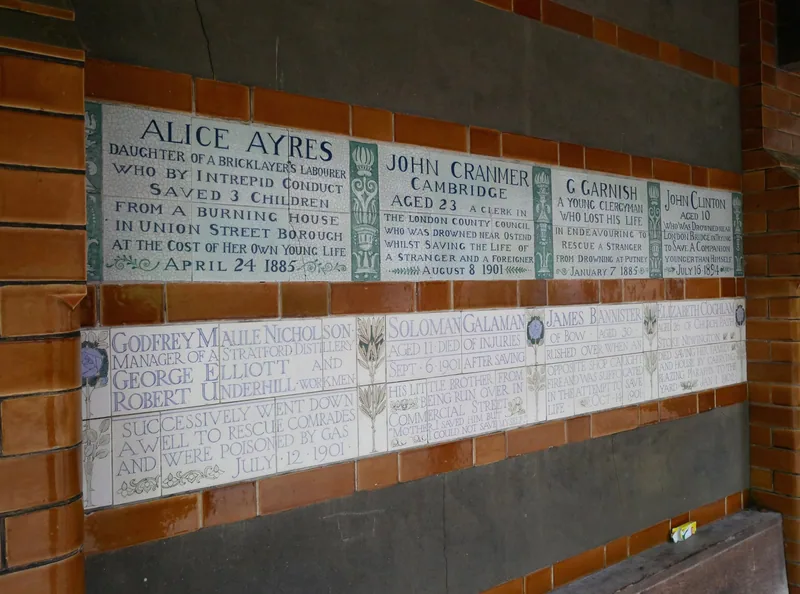
Photo: Doyle of London · CC BY-SA 4.0 · Wikimedia Commons · resized
What the tablets actually say
Each tile carries a name, an age, a date and one or two sentences of plain description. The deaths are domestic and industrial rather than military: people who went into burning houses, under trains, into the Thames, into sewers, into the path of runaway horses. Many of the dead are children. Several are servants and labourers whose surnames were probably never printed anywhere else.
The one most visitors look for is Alice Ayres, a builder's daughter who died after saving children from a fire. The City's own description of the garden singles her tablet out, because it is the pivot of the plot of the 2004 film Closer, adapted from Patrick Marber's 1997 play, which was partly shot here. If you are tracing screen locations round the capital, our guide to London on film and television covers the rest.
Read the wall from the King Edward Street end. The loggia runs along the north side of the garden and the light is better from that direction in the morning. The lettering on the older De Morgan tiles is smaller and harder to read than on the Doulton ones, and a few are weathered, so allow time to crouch rather than skim.
Why the ground is higher than the street
Stand at the King Edward Street gate and you will notice the garden sits well above pavement level. That is because it is made from three burial grounds pushed together: the churchyard of St Botolph without Aldersgate, and the former burial grounds of Christ Church Greyfriars and St Leonard, Foster Lane. Centuries of interments raised the soil.
The gardens were laid out for public use in the 1880s, and the name came from the postal workers of the old General Post Office headquarters next door, who used it as their lunch break garden. The GPO is long gone, the building replaced, but the name stuck. Our explainer on how the City of London works as a place covers why the Square Mile is full of small green plots like this one.
St Botolph without Aldersgate stands at the eastern edge of the garden, and when it is open its Georgian interior is one of the least visited good church interiors in the City. It is covered alongside the others in our guide to All Hallows by the Tower and the City churches.
The best and worst times to come
Between about 12.30pm and 2pm on a weekday the benches fill with people eating lunch, and reading the wall means standing behind someone's sandwich. Before 11am on a weekday the garden is close to empty. At weekends the whole district empties out, and you may well have the place to yourself, though the surrounding streets are quiet to the point of feeling deserted.
The memorial is under a roof, so a shower does not stop you, and that makes it a reasonable half-hour when the weather turns during a City walk. It is not lit for night visits and the City does not publish fixed opening hours for this particular garden on its page, so treat it as a daylight destination and do not plan an evening trip around it.
There are no toilets and no café in the garden. The nearest reliable facilities are in the cafés around St Paul's and in the Barbican complex, both about eight minutes away. Our list of where to find a public toilet in London has the detail, which matters more here than it sounds, because the City has very little that stays open at weekends.
Reaching it without walking in circles
The reason people fail to find Postman's Park is that its three entrances are all on side streets and none of them looks like the way into a park. From St Paul's station, take Exit 1 for Aldersgate Street, walk north for about two minutes and look for railings and a gate on your left. From the Barbican, come down Aldersgate Street instead. From Smithfield, cut through Little Britain.
It is a flat site with gravel and paved paths and gentle level changes at the gates, which makes it easier going than many City churchyards. There is no parking and the Congestion Charge applies on weekdays, so driving makes no sense; our guide to the Congestion Charge and ULEZ explains the daily cost if you are considering it anyway.
A City walk that takes in Postman's Park
The garden works best as one stop in a morning rather than a destination on its own. A sensible route: start at St Paul's Cathedral, cross to Postman's Park, then walk ten minutes north-east to Guildhall and the Roman amphitheatre under Guildhall Yard, and finish at the Monument for the view. That is about three hours with stops.
The other obvious neighbour is the London Museum, whose new West Smithfield site opens on 28 November 2026 a few minutes' walk away. Until then the Docklands site is the one that is open. The Barbican Centre is the same distance in the other direction, and its free conservatory is a useful pairing with a garden this small.
Where it sits among London's memorials
London has plenty of monuments to the famous. What makes this one unusual is that it commemorates people specifically because they were not famous, and it names them with their occupations. If that is the kind of thing you travel for, two other trails in the city do something similar from different angles: our guide to the blue plaque scheme maps where notable people lived, and the Magnificent Seven Victorian cemeteries are where the same generation of Londoners was buried, at far greater length and expense.
For more small, enclosed and largely unmarked green spaces across the capital, see our round-up of London's walled and hidden gardens, several of which are within twenty minutes of this one. And because Postman's Park costs nothing, it belongs on the list of things in London that are free and actually worth the detour.
Is it worth going out of your way for?
Yes, if
- You are already going to St Paul's, Smithfield or the Barbican
- You like reading and being left alone
- You have thirty minutes to fill and do not want to pay for anything
- You are travelling with teenagers who have had enough of cathedrals
Probably not, if
- You are crossing London specially; it is a twenty-minute experience
- You are with small children, who will find it dull
- You need a café, a toilet or a shop on site
- It is a summer weekday lunchtime and you want quiet
Frequently asked questions
How many tablets are there in Postman's Park?
There are 54 ceramic tablets on the Watts Memorial, recording 62 people. The first four went up when the memorial was unveiled in 1900, additions stopped in 1931 with 53 in place, and one more was added in 2009 after a gap of 78 years. The original plan was for 120.
Is Postman's Park free to visit?
Yes. It is a public garden managed by the City of London Corporation, with no entry charge, no ticket and no booking. There is also no café, shop or toilet on site, so plan for those elsewhere. The memorial is undercover, so light rain does not spoil a visit.
Which Tube station is closest to Postman's Park?
St Paul's on the Central line, using Exit 1 for Aldersgate Street, which leaves a walk of about two minutes. Barbican and Farringdon are each roughly eight minutes away, and Farringdon also has Elizabeth line and Thameslink services if you are coming from further out.
What film was shot in Postman's Park?
Closer, released in 2004 and based on Patrick Marber's 1997 play, used the park and the memorial. The tablet to Alice Ayres is central to the story, and it is the one most visitors look for when they arrive. The City Corporation mentions the connection in its own description of the garden.
How long should I spend at Postman's Park?
Twenty minutes is enough to read the whole wall at a steady pace, and half an hour if you want to sit afterwards. Most people combine it with St Paul's Cathedral, the Barbican or Smithfield rather than making a separate trip for it.
Sources
- City of London Corporation - Postman's Park (checked September 2026)
- Watts Gallery Trust - The Memorial to Heroic Self Sacrifice (checked September 2026)
- City of London Corporation - Find a City garden (checked September 2026)