
Walthamstow Wetlands is free, opens at 9.30am every day of the year, and sits about a twelve-minute train ride from Liverpool Street plus a ten-minute walk. Ten working drinking-water reservoirs were opened to the public in October 2017, and the partners who run it describe the result as Europe's largest urban wetland nature reserve.
The word to hold on to is "working". This is not a park with a lake in it. Thames Water still pumps drinking water for around 3.5 million people out of these reservoirs every day, and the public were let in around an operational site rather than the other way round. That is why the rules are strict, why some paths shut at short notice, and why there is a Victorian pumping station at the entrance instead of a visitor centre built for the purpose.
Our guide to Walthamstow as a district covers the market, the William Morris Gallery and how the area fits together. This page is about the reserve on its own: the hours that catch people out, which gate to use, what you can see in which month, and the several kinds of permit that exist here.
Before you set off for the reservoirs
- Address
- 2 Forest Road, Walthamstow, London N17 9NH
- Admission
- Free, no booking
- April to September
- 9.30am to 5pm; last entry 4.45pm on weekdays, 4.30pm at weekends
- October to March
- 9.30am to 4pm; last entry 3.45pm on weekdays, 3.30pm at weekends
- Café and toilets
- Close 30 minutes before the site does
- Stations
- Tottenham Hale and Blackhorse Road, both Victoria line, about ten minutes' walk
- Buses
- 123 and 230 stop on Forest Road, under five minutes away
- Dogs
- Assistance dogs only
- Run by
- London Wildlife Trust, with Thames Water and the London Borough of Waltham Forest
The closing time is earlier than you think, and so is the café
More visits go wrong here over timing than over anything else. There are two separate traps. The first is that the reserve shuts at 4pm from October to March, which in December is well before dark but after the light has already gone flat. The second is that last entry is fifteen minutes before closing on weekdays and half an hour before closing at weekends, so a Saturday in November means being through the gate by 3.30pm.
The café inside the Engine House and the toilets stop half an hour before the site closes. If you arrive at 3pm on a winter Sunday you have an hour of walking and no chance of a hot drink at the end of it. Go in the morning.
The other timing question is the light. The reservoirs run roughly north to south, the views west across the water are the good ones, and in winter the sun is low enough by two o'clock to be directly in your eyes on the return leg. Walk the western side first.
Two hours is the right budget for a first visit. A loop taking in the Engine House, the Coppermill area and two or three of the reservoir banks runs to about four kilometres on flat ground. An hour is enough only for the nearest water and the café; half a day is what serious birdwatchers spend, and they arrive at 9.30am.
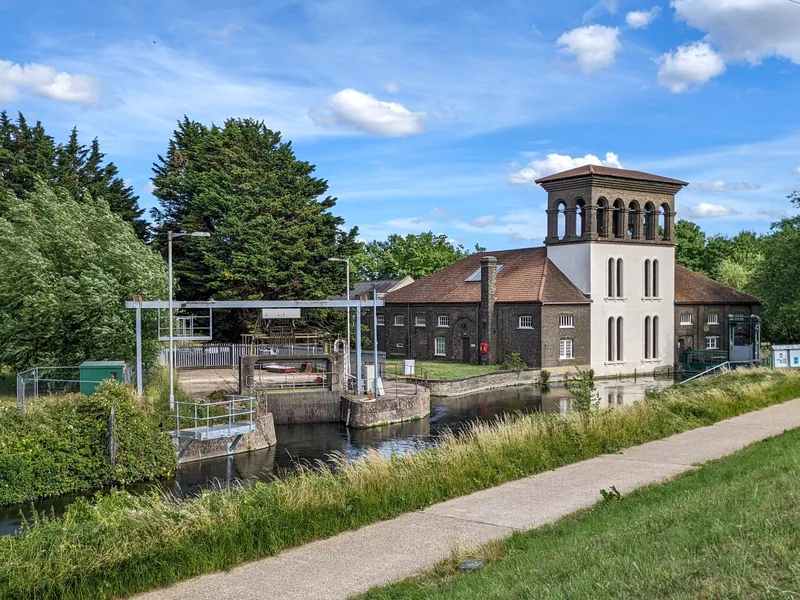
Photo: The wub · CC BY-SA 4.0 · Wikimedia Commons · resized
Which station, and which gate
Both Tottenham Hale and Blackhorse Road are on the Victoria line and both are about ten minutes on foot from the Forest Road entrance. Which is better depends entirely on where you start.
| From | Route | Train time |
|---|---|---|
| Liverpool Street | Greater Anglia to Tottenham Hale, direct | About 12 minutes |
| Oxford Circus | Victoria line to Blackhorse Road, direct | About 17 minutes |
| King's Cross St Pancras | Victoria line to Blackhorse Road, direct | No change needed |
| Anywhere on Forest Road | Bus 123 or 230 | Stops both sides of the road |
Tottenham Hale is also a mainline station with trains towards East Anglia, and it has the larger bus interchange. Blackhorse Road puts you on the Suffragette line of the Overground as well, which is useful if you are coming across from Hackney or Barking. Fares are ordinary Zone 3 pay as you go; how London's fare zones work explains the caps.
Drivers should know that parking on site is paid, with the payment details on the signs rather than online, and that there are four blue badge bays which are free of charge. Given how good the train connections are, the car is the worse option here.
What a walk round actually involves
The Engine House at the Forest Road end is the hub: reception, café, shop, toilets and a platform lift. From it, one wide concrete path runs into the site, and that path is the step-free spine of the whole reserve. Everything branching off it is a dirt track between reservoir banks, uneven in dry weather and properly muddy after rain.
There are ten reservoirs, some numbered and some named, the larger sheets of water to the north and the smaller ones to the south. The Grade II-listed Coppermill Tower stands among the southern group and is the one building on the site you will keep seeing from different angles; whether it can be climbed depends on the reserve's events programme, which is worth checking if that appeals. The reservoir banks are raised, so you are often walking above the water with a long view in both directions, and the contrast between that and the reed-fringed edges below is what makes the place feel bigger than it is. A two-kilometre cycle path runs through the site, and cyclists and joggers are welcome as long as they stay on the designated routes.
Paths do close. At the time of writing the 1-2-3 and 4-5 paths were shut while the electricity pylons that cross the site are upgraded, with reopening expected by the end of October, and there are signs at the junctions telling you to turn back. Parts of the reserve can also be closed at any time for machinery or nesting birds. Check the London Wildlife Trust page for the reserve before a long journey, and treat the printed map as a plan rather than a promise.
Search for the reserve by the trust that runs it, not by its old web address. The walthamstowwetlands.com domain no longer belongs to the reserve and now serves unrelated gambling content to anyone who lands on it. The reserve's pages live on wildlondon.org.uk, and the council's own listing is on walthamforest.gov.uk.
What you can see, and when
The reservoirs are part of the Walthamstow Reservoirs Site of Special Scientific Interest, sit inside the Lee Valley Special Protection Area, and are a Ramsar site of international importance. In plain terms: the birds here are the reason the designations exist, and the numbers change completely with the season.
- November to February is the best of it. Wildfowl arrive from northern Europe when the water there freezes, and the open reservoirs fill with duck: pochard, gadwall, shoveler, tufted duck, goldeneye. Bare trees also make everything easier to see.
- March to May brings the herons and egrets onto nests and the first warblers into the scrub. Grey heron, little egret and great crested grebe all breed on the site.
- June to August is the quietest for birds and the best for everything else: swifts overhead, dragonflies including common hawker, butterflies on the knapweed, and frogs and toads in the wet margins.
- All year: kingfisher and peregrine falcon are both resident, cormorants are everywhere, and the grebes are reliable.
Wetland bird counts at the site have recorded 54 key species, 37 of which are considered rare, among them garganey, green sandpiper and the kingfisher. You do not need to be a birdwatcher for this to be worth the trip, but bringing binoculars roughly doubles the value of the visit. For the other end of the same idea, the WWT London Wetland Centre in Barnes is a designed reserve with hides and an admission charge, and Camley Street Natural Park does the same thing on two acres behind King's Cross.
The rules are stricter than in a park, for a reason
Everything that follows comes from the fact that the water is drinking water and the site is an operating utility.
- No dogs at all, except trained assistance dogs on duty. This is not negotiable and there is nowhere to leave one. If you are travelling with a dog, our page on visiting London with a pet covers where they are welcome.
- No swimming, paddling or sitting at the water's edge. The reservoirs are deep, extremely cold below the surface even in summer, and have currents created by the pumps. The banks are steep and slip.
- No alcohol anywhere on site, because it is a Thames Water operational site as well as a reserve.
- No barbecues, no fires, and no smoking in the buildings.
- No foraging. Berries, seeds, wildflowers and fungi are food for the wildlife, and picking them is not allowed.
- Do not feed the birds. There is plenty for them.
Thames Water staff work on the site while the public are in it. If a vehicle or a work party needs the path, they have priority.
Fishing: London's largest fishery, and the paperwork
Angling has gone on here far longer than public access has, and the reserve remains the largest fishery in London, with two fly-fishing reservoirs stocked with trout and coarse fishing across the rest, for bream, perch, carp and chub. Day permits and seasonal permits are both available.
Two things catch people out. First, every angler needs a valid Environment Agency rod licence as well as the site permit; the licence is bought from the Environment Agency or at a Post Office, and fishing without one is an offence. Second, coarse anglers must carry a landing net and an unhooking mat. The permit rules and prices are on the reserve's angling pages, and they change from season to season.
For other visitors, the practical point is simply to keep clear. Anglers cast leads and flies from the banks, and the paths pass close behind them.
The birdwatching permit, and what it buys
There is a separate permit that lets holders into restricted areas and onto the site outside public opening hours, which in practice means the first light of a winter morning. It costs £15 for the year (September 2026), and the money goes towards bird ringing work on the reserve.
Places are limited and allocated by lottery rather than sold, and from 2026 the whole process moved online: no photograph is needed with the application, and successful applicants are sent a payment link. The 2026-27 application window has closed. The next one opens on 1 April 2027, which is worth noting a long way ahead if you are planning a winter trip to London around birds.
Visiting with children, and with a wheelchair
The reserve works better for children than its rules suggest, as long as expectations are set on the way there: this is looking and walking, not running and climbing. The Engine House has baby changing and high chairs, the café has a terrace with a view over the water, and there is a picnic area. What there is not is a playground, a play trail or anything to climb on.
For wheelchair users and anyone with limited walking, the Engine House and the main concrete path are step-free, with a platform lift inside the building and accessible toilets with ramp entry. That path alone gives a genuine reservoir walk with water on both sides. The dirt tracks beyond it do not, and after rain they are not passable.
Making a day of it in the Lea Valley
The reserve is the northern end of a long green corridor, and the walk south along the Lea is the natural continuation: Walthamstow Marshes, then Hackney Marshes, then the Olympic Park. That is a good half-day on flat ground, ending at a station with trains back into town.
In the other direction, ten minutes' walk from Blackhorse Road takes you to God's Own Junkyard and its warehouse of neon, which is open at weekends and is the strangest possible contrast with a morning among ducks. Hackney and London Fields is twenty minutes south by Overground, and Hackney Wick sits where the canal meets the Olympic Park. For woodland rather than water, Epping Forest begins a few stops further up the Central line, and the best places for autumn colour includes several within reach of the same trains.
Two other pages here cover London sites that were opened to the public without being tidied up first: Severndroog Castle and the woods on Shooter's Hill, and Bunhill Fields. Like the wetlands, both are free, and free things in London are worth collecting; our list of them has the rest.
Frequently asked questions
Do you have to pay to enter Walthamstow Wetlands?
No. Entry is free and no ticket or booking is needed. Parking on site is paid, and separate permits are required for angling and for birdwatching outside public hours, but walking round the reserve and using the Engine House visitor centre costs nothing.
What time does Walthamstow Wetlands close?
From October to March the reserve closes at 4pm, and from April to September at 5pm. Last entry is fifteen minutes before closing on weekdays and thirty minutes before closing at weekends, and the café and toilets shut half an hour before the site does.
How do you get to Walthamstow Wetlands from central London?
Take the Victoria line to Blackhorse Road or Tottenham Hale, or a Greater Anglia train from Liverpool Street to Tottenham Hale, which takes about twelve minutes. Both stations are roughly a ten-minute walk from the Forest Road entrance. Buses 123 and 230 stop on Forest Road itself.
How long does it take to walk round Walthamstow Wetlands?
A circuit taking in the Engine House and two or three reservoir banks is about four kilometres and takes two hours at an unhurried pace. The ground is flat throughout, but the tracks between the reservoirs are dirt rather than paved, so allow more time in wet weather.
Can you cycle through Walthamstow Wetlands?
Yes. A two-kilometre cycle path runs through the site and cyclists and joggers are welcome, but only on the designated paths. Most visitors are walking slowly and looking at birds, and their needs take priority on shared sections.
Sources
- London Wildlife Trust - Walthamstow Wetlands: opening times, access and visitor rules (checked September 2026)
- London Wildlife Trust - Birds at Walthamstow Wetlands and birdwatching permits (checked September 2026)
- London Borough of Waltham Forest - Walthamstow Wetlands (checked September 2026)
- Thames Water - Walthamstow Wetlands (checked September 2026)
- Transport for London - Journey Planner (checked September 2026)