
London's cherry blossom arrives in waves between late March and the middle of May, not on one weekend. The biggest single display is in Greenwich Park, which the Royal Parks describe as usually reaching its peak between late April and the first days of May, and all of it is free to look at.
Cherry trees flower for about a week or two each, and a wet, windy night can end a display early. That is the whole problem with planning a trip around blossom: nobody can promise you a date. What you can do is pick places that hold several different varieties, because they open at different times and stretch the season out.
Our guide to London's parks and gardens covers what each park is like year-round, and the month guide to what happens in London in March sets out the weather you should expect at the start of the season. Here we stay on the blossom itself: which trees are where, roughly when each group opens, and your options if you turn up a week too early.
Cherry blossom in London: the short version
- Season
- Roughly late March to mid-May, in overlapping waves
- Peak for the big pink avenues
- Greenwich Park is usually at its best from late April to early May (The Royal Parks)
- How long each tree lasts
- One to two weeks, less after heavy wind or rain
- Cost
- Nothing in the Royal Parks and the Olympic Park; Kew Gardens charges admission
- Best single spot
- Greenwich Park, between the Rose Garden and One Tree Hill
- Best for a landmark in the photograph
- St James's Park, towards Buckingham Palace
Three waves, not one flowering
It helps to stop thinking of "cherry blossom season" as a single event. In London it comes in three rough stages, and knowing which one you are in saves a wasted journey.
The first wave is not cherry at all. Cherry plum and blackthorn open while the weather is still cold, often in February and early March, and they are white rather than pink. Most visitors walk past them without noticing. The second wave is the early ornamental cherries, which usually start in the second half of March and carry through April, ranging from near-white to pale pink.
The third wave is the one people travel for: the heavy, double, deep-pink flowers of varieties such as Prunus 'Sekiyama', which is the cultivar along Greenwich Park's Cherry Avenue. The Royal Parks describe Greenwich as usually at its peak from late April to early May, and say the new hillside planting there gives about a two-week window.
The Royal Parks also point out something you can use: they plant single-flowering cherries rather than double-flowering ones where they can, because the single forms carry nectar for bees and butterflies. Single flowers look thinner and more delicate; the double ones look like pink pompoms. If your photographs are the point, you want the doubles, and they come later.
Parakeets will strip a cherry tree in a morning. London's ring-necked parakeets eat the blossom, and the Royal Parks list them alongside wind and rain as a reason a display ends early. If a park looks bare and the weather has been calm, this is usually why.
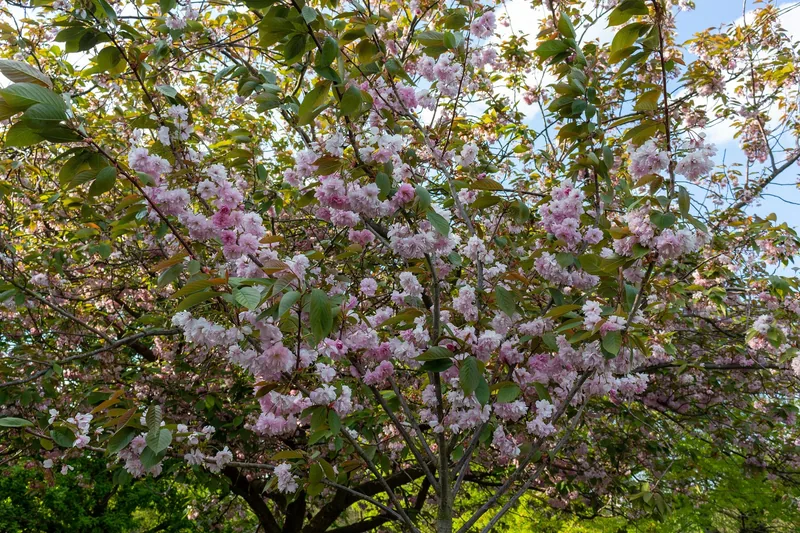
Photo: The wub · CC BY-SA 4.0 · Wikimedia Commons · resized
Greenwich Park: the Cherry Avenue and the new valley of blossom
If you can only go to one place, go here. Greenwich Park has a mature Cherry Avenue leading to the Rose Garden, near Ranger's House in the south-western corner of the park, and the Royal Parks recommend those paths and the surrounding avenues as the best of their blossom.
Since 2025 there is much more of it. The Royal Parks planted 130 Prunus 'Sekiyama' cherries along the hillside between the Grand Ascent and One Tree Hill, given through the Sakura Cherry Tree Project, which has donated cherry trees across the UK since 2019. The charity describes the result as a naturalistic "valley of blossom" running north-east across the slope. The trees went in as young saplings because of the park's gravelly soil, so they are still small; they will be far better in ten years than they are now.
Practical points. The pedestrian gates open 6am to 8pm, which matters if you want the trees without other people in your photograph. The hillside is steep, and the blossom is spread across a slope rather than concentrated on one path, so allow an hour rather than twenty minutes. Our full guide to Greenwich Park covers the view, the deer enclosure and where to eat afterwards.
Regent's Park: the Avenue Gardens and Queen Mary's Gardens
Regent's Park is the strongest choice in north-central London. The Royal Parks point visitors to the Avenue Gardens, where cherries line the formal walkways, and to Queen Mary's Gardens, which most people know for roses in June but which also holds cherry trees among the spring planting.
There is a reason the collection is good. Many of the park's cherries were a gift from Japan as part of the Japan-UK Season of Culture in 2019 and 2020, when 125 new cherry trees were planted across the Royal Parks. That included five Great White Cherry, or Taihaku, trees, a variety that had died out in Japan and was reintroduced there in the 1920s from cuttings taken in an English garden.
Check the gate times here, because visitors routinely misjudge them. The pedestrian gates at Regent's Park run 5am to 8pm, not until midnight. Primrose Hill next door stays open around the clock on weekdays. Our page on Regent's Park and Primrose Hill has the layout and the walking route between the two.
Central London, where the blossom comes with a landmark
If you have one free morning and a long list of sights, you do not need to travel for blossom at all.
- St James's Park. The Royal Parks suggest walking towards Buckingham Palace, where the cherries frame the palace and the Queen Victoria Memorial, or standing at the Blue Bridge for blossom above the lake. Nowhere else in the city puts a famous building and a cherry tree in one frame without a long lens. Our guide to St James's Park and Green Park explains the walk.
- Kensington Gardens. The best areas are around Lancaster Gate and the Albert Memorial. It is quieter than neighbouring Hyde Park, and wide avenues suit blossom better than a crowded path does. Note the gate times: Kensington Gardens runs 6am to 7:30pm while Hyde Park stays open 5am to midnight, so the two halves of what looks like one park close at different times.
- Holland Park. The Kyoto Garden is not a cherry collection, but it is the most Japanese-feeling green space in central London and it is a short walk from the Notting Hill end of the blossom trail. See our Holland Park guide for the rules there, which are enforced.
The London Blossom Garden, and why it flowers for longer
In the north of Queen Elizabeth Olympic Park at Stratford there is a garden built specifically to be looked at in spring. The London Blossom Garden was created by the Mayor of London and the National Trust with the park and Bloomberg, as a memorial to Londoners lost in the Coronavirus pandemic and a tribute to key workers.
It has 33 blossom trees, one for each London borough plus the City of London, arranged in three close circles and made up of eight different species. Deliberately, they are not all cherries: there is hawthorn, cherry plum and crab apple as well, chosen so that the different trees flower at different times and stretch the season. The path is laid with 33 pieces of recycled concrete and reclaimed timber, and there is seating by each ring.
It is free, it is fully accessible, with a hard path through the centre and seating designed for wheelchair transfers, and it is about as easy to reach as anywhere in this article. One rule to know: the park asks visitors not to tie ribbons or fix anything to the trees, because they are young and still growing, and anything attached will be removed. Combine it with our guide to the Olympic Park today or with Stratford itself.
Kew in spring, and whether the ticket is worth it for blossom
Kew Gardens has the widest range of flowering trees of anywhere in this article, and the advantage of somewhere to shelter when it rains. It is also the only place here that charges.
Kew's published prices at the time of writing run only to 31 January 2027, so we cannot quote you a spring 2027 figure. Look up the current adult and child prices on Kew's own tickets page first, and remember that booking online always beats paying at the gate. Our guide to Kew explains the site, and if the question is how much of it you can see in an afternoon, we have a separate answer in how long Kew Gardens takes.
Our honest view: if the weather forecast is good and you only want blossom, Greenwich costs nothing and gives you more of it in one place. If it is raining, or you want magnolias, spring bulbs and glasshouses as well, Kew earns the money.
The residential streets, and how to find them without guessing
The best blossom in London is often not in a park. Boroughs across outer London planted flowering cherries as street trees through the twentieth century, and a suburban road where every house has one in front of it can look better than any avenue in a royal park, because the trees are all the same age and all the same variety, so they open together.
The difficulty is that these streets are not signposted, and lists of them on social media are usually wrong by the time you read them. There is a better way. The Greater London Authority publishes the London Tree Map, which shows more than 1.1 million trees in streets, parks and other public spaces, with the species or genus recorded for each one. The data comes from all 32 boroughs, the City of London, Transport for London, the Royal Parks and the Olympic Park.
Zoom into the area around your hotel, filter to street trees, and look for Prunus. You will find clusters within walking distance of almost anywhere. Two cautions before you go: some records have no exact map location, so there are gaps, and these are ordinary residential streets where people live. Stay on the pavement, do not block a driveway, and do not photograph into anyone's windows.
What the rules actually are
Blossom brings out behaviour that park staff spend every April dealing with. The rules are short.
- Do not pick the blossom. The Royal Parks ask visitors directly not to. The flowers of the varieties grown here are edible, and in Japan they are pickled for sweets and tea, but that does not make the trees in a London park a food source.
- Do not climb the trees or hang from the branches. Ornamental cherries are short-lived anyway, typically fifteen to thirty years across most varieties, and damage shortens that further.
- Do not tie anything to a tree at the London Blossom Garden. It will be taken off.
- Check gate times before an evening visit. Kensington Gardens, Regent's Park and Greenwich Park all shut their pedestrian gates well before dark in May.
If you are a week early, go and look at magnolias instead. They open before most cherries and they are bigger and easier to photograph. Inside Richmond Park, the Isabella Plantation is London's best free collection of spring flowering shrubs; see our guide to the Isabella Plantation for what is out in each month.
Building a blossom day that works whatever the trees are doing
Because you cannot control the timing, build the day so that it is worth doing even if the blossom has gone over. Two routes do that well.
South-east. Greenwich Park in the morning for the Cherry Avenue and the hillside planting, then down the hill into Greenwich for lunch and the market. If the trees have finished, you still have the view, the park and the town, and nothing except food has cost you anything.
Central. St James's Park, then Green Park, then across to Kensington Gardens, roughly following the route of the Diana Memorial Walk. Blossom or no blossom, that walk takes you past three palaces. Our list of free things to do in London has more that fits alongside it.
For the other end of the year, when the same parks are worth crossing London for different reasons, see our guide to autumn colour in London. And if you would rather run through the blossom than stand in it, the running routes guide has the park loops with distances.
Frequently asked questions
When does cherry blossom peak in London?
For the big pink avenues, late April to early May. The Royal Parks describe Greenwich Park, the main blossom destination in London, as usually at its peak in that window. Earlier, paler cherries open from the second half of March, so the overall season runs from roughly late March to mid-May.
Where is the best cherry blossom in London?
Greenwich Park. The mature Cherry Avenue runs to the Rose Garden near Ranger's House, and 130 more cherry trees were planted in 2025 along the hillside between the Grand Ascent and One Tree Hill. The park is free and the pedestrian gates open at 6am.
Is cherry blossom in London free to see?
In the Royal Parks and at the London Blossom Garden in Queen Elizabeth Olympic Park, yes, with no ticket and no booking. Kew Gardens has flowering trees too, but it charges for entry, and its published prices at the time of writing run only to the end of January 2027.
How long does cherry blossom last in London?
Each tree flowers for about one to two weeks, and strong wind or heavy rain can cut that short. Parakeets eat the blossom as well. Because different varieties open at different times, the season as a whole is much longer than any single tree.
Are there cherry blossom streets in London?
Yes, mostly in outer London, where boroughs planted flowering cherries as street trees. Rather than relying on a list, search the Greater London Authority's London Tree Map for Prunus near where you are staying. These are residential roads, so stay on the pavement and be quiet about it.
Sources
- The Royal Parks - Best places to see cherry trees in the Royal Parks (checked September 2026)
- The Royal Parks - Greenwich Park welcomes 130 cherry trees (checked September 2026)
- The Royal Parks - Ten things you might not know about cherry trees (checked September 2026)
- Queen Elizabeth Olympic Park - London Blossom Garden (checked September 2026)
- Greater London Authority - London Tree Map (checked September 2026)
- The Royal Parks - Greenwich Park opening times (checked September 2026)
- The Royal Parks - Kensington Gardens opening times (checked September 2026)
- Royal Botanic Gardens, Kew - Tickets (checked September 2026)