
Shoreditch is the creative, slightly scruffy district on the eastern edge of the City of London, known for street art, independent shops, Brick Lane's curry houses and some of the city's busiest bars. Visit on a Sunday for the markets, or on a weekday evening for food and drinks without the weekend crowds.
Shoreditch lies just north of Liverpool Street station, where the glass towers of the financial district stop and older brick warehouses begin. Strictly speaking it is a small area in the borough of Hackney, but visitors use the name for a wider patch of East London: Shoreditch itself, Hoxton to the north, and Spitalfields and Brick Lane to the south-east, in the borough of Tower Hamlets. This guide covers all of them, because they flow into one another and most people visit them together.
For centuries this was a working district of weavers, furniture makers, breweries and markets, home to waves of immigrants, including French Huguenots, Jewish families from Eastern Europe and, from the 20th century, a large Bangladeshi community. From the 1990s artists moved into the empty warehouses, followed by tech companies, bars and restaurants. The result is a mix of old and new that can feel exciting or overdone, depending on the street and the time of day.
Shoreditch at a glance
- Best for
- Street art, Sunday markets, curry and bagels, bars and clubs, independent shops
- Main stations
- Shoreditch High Street and Hoxton (Overground, Windrush line); Old Street (Northern line); Liverpool Street and Aldgate East (Tube)
- Best day
- Sunday, when Columbia Road, Brick Lane and Spitalfields are all busy
- Quietest time
- Weekday mornings
- Liveliest time
- Thursday to Saturday nights
- Free sights
- Street art, Museum of the Home, markets to browse
Street art: where to look and what you will see
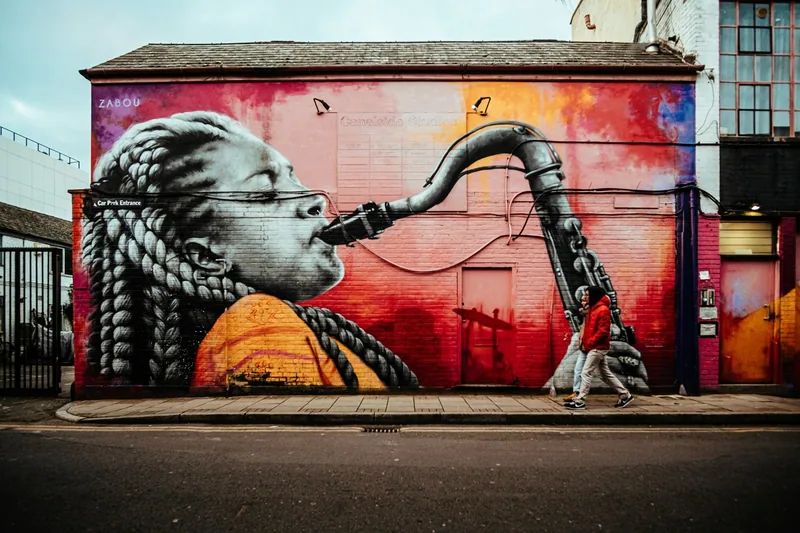
Shoreditch is London's best-known area for street art. The walls, shutters and alleyways change constantly, as new pieces are painted over old ones, so there is no fixed list of works to tick off. That is part of the pleasure: you wander and look up, down and around corners.
The streets around Brick Lane and its side streets, Hanbury Street, Fashion Street and Redchurch Street, usually have the densest mix of murals, paste-ups, stencils and small sculptures. Around Great Eastern Street, Rivington Street and Curtain Road you will find larger commissioned murals on the sides of buildings. Look out for tiny works too, such as small tiles or figures fixed high up on walls.
If you want context, guided street art walks run most days and are often led by people who know the artists. Our overview of London's best walking tours explains how to choose a reputable one. Spitalfields and Whitechapel are also where the evening Jack the Ripper walks take place, so you may meet large tour groups on narrow pavements after dark.
Weekday mornings are best for photographing the murals. By midday on a Saturday or Sunday, the best-known walls have people posing in front of them and tour groups filling the pavement. Before 11am on a weekday, the streets are empty, the shutters are still down (many are painted too) and you can take your time.
Brick Lane: curry, bagels and Sunday stalls
Brick Lane runs north from Whitechapel to Bethnal Green Road and is the heart of the area's Bangladeshi community. Its southern half is lined with curry houses, sweet shops and grocers, and the street signs are in both English and Bengali. The curry restaurants are famous, but quality varies a lot. Staff standing outside may offer discounts or free drinks to bring you in; you are under no pressure to accept, and it is worth looking at menus and prices before you choose.
Further north, around the old Truman Brewery buildings, the street changes character. Here you find vintage clothing shops, record stores, galleries and food stalls. At the very top of Brick Lane are two long-established bagel bakeries, which have fed night workers, clubbers and taxi drivers for decades with salt beef and smoked salmon bagels.
On Sundays the street and the brewery yards fill with market stalls selling food, second-hand goods, clothes and crafts. It gets very busy by lunchtime. Our guide to Brick Lane and its curry houses goes into the food in detail, and our page on the Spitalfields and Brick Lane markets explains which market runs on which day.
Spitalfields and Columbia Road
Old Spitalfields Market, at the southern end of the area and a few minutes from Liverpool Street, is a covered Victorian market hall with permanent shops and restaurants around the edges and stalls in the middle. It is open every day. According to the market's website the hours are 10am-8pm on Monday, Tuesday, Wednesday and Friday, 8am-6pm on Thursday, 10am-6pm on Saturday and 10am-5pm on Sunday, although individual shops and restaurants keep their own hours. The mix of stalls changes from day to day, so check the market's website if you are looking for something specific, such as antiques or records.
The streets immediately east of the market, such as Fournier Street and Princelet Street, have some of the best-preserved early 18th-century houses in London, built for Huguenot silk weavers. Christ Church Spitalfields, the tall white church by Nicholas Hawksmoor, towers over the corner of Commercial Street.
About 15 minutes' walk north-east, Columbia Road Flower Market fills a narrow Victorian street with plant and flower stalls every Sunday. The market's own site says it runs on Sundays from 8am until about 3pm, and that some of the small shops along the street also open on other days. It is at its most crowded from late morning, and the traders' calls get louder and the prices lower near closing time. See our guide to Columbia Road on a Sunday morning for tips.
A Sunday route that avoids backtracking. Start at Columbia Road around 9am, walk south to Brick Lane for the bagel bakeries and stalls, continue down Brick Lane to the Truman Brewery yards, then finish at Old Spitalfields Market, which closes at 5pm on Sundays. Liverpool Street station is a few minutes away when you are done.
Shops, galleries and a free museum
Shoreditch has fewer big chain shops than central London and more independent boutiques, concept stores, vintage shops and design studios. Redchurch Street, Calvert Avenue and the streets around Arnold Circus are good for browsing. Boxpark Shoreditch, a small shopping and food centre built from shipping containers next to Shoreditch High Street station, is a handy place to eat and meet.
For vintage clothes, the area competes with Camden as London's best. Our guide to second-hand and vintage shopping covers the main shops in both. If you are more interested in books, the independent shops around Shoreditch and Hoxton appear in our list of London's best bookshops.
The Museum of the Home on Kingsland Road, opposite Hoxton station, is one of the most rewarding small museums in London. It shows how people lived at home over four centuries, through a series of recreated living rooms, and it has gardens behind the building. Entry is free, and it is open from Tuesday to Sunday (and on bank holiday Mondays) from 10am to 5pm. It is covered, with other smaller museums, in our guide to London's best small museums.
Eating and drinking in Shoreditch
Shoreditch has one of the densest collections of restaurants, cafés and bars in London. You can eat very cheaply (bagels, street food, a curry on Brick Lane) or spend a lot at fashionable restaurants that need booking weeks ahead. The area is especially good for coffee, brunch, Middle Eastern and South Asian food, and small-plates restaurants. Our guide to London's coffee scene includes several local roasters and cafés.
Many restaurants add a discretionary service charge to the bill. Check the bill before you pay, and see our guide to tipping and service charges in London if you are unsure what to do.
Nightlife: busy, young and loud
From Thursday to Saturday, Shoreditch is one of the main places in London for a night out. Cocktail bars, pubs, basement clubs and late-night venues are packed into the streets around Shoreditch High Street, Old Street, Curtain Road and Kingsland Road. The crowd is mostly in its twenties and thirties, and the area stays busy well after midnight.
That also means queues outside bars, loud streets and, at closing time, a lot of drunk people. Stag and hen parties are common at weekends. If you are staying nearby, this is the side of Shoreditch you should know about before booking. For an overview of other areas, see our guide to going out in London at night.
Getting home is fairly easy. On Friday and Saturday nights, the Overground's Windrush line runs through the night, calling at Shoreditch High Street and Hoxton. Night buses run along the main roads every night. Use a licensed black cab or book a minicab through a licensed operator: never accept a lift from a driver who approaches you in the street. Our guide to taxis, minicabs and ride apps explains the difference.
Shoreditch by day and by night
The area has several different moods, and it helps to know which one you are walking into.
- Weekday mornings are calm. Office workers from the City and local tech companies fill the cafés, and the streets are good for art and architecture.
- Weekday afternoons are pleasant for shopping and browsing, with most shops open and crowds light.
- Sundays are market day. Brick Lane, Columbia Road and Spitalfields are crowded from late morning, and the atmosphere is lively and friendly.
- Thursday to Saturday nights are loud and busy around the bars, especially close to Shoreditch High Street and Old Street.
- Late at night on weekdays, some side streets are very quiet and poorly lit. Stay on the main roads when walking back to your hotel.
Like any crowded nightlife area, Shoreditch has its share of phone snatching, often by thieves on bikes or scooters. Keep your phone away from the kerb and put it away when you are not using it. Our guide to safety in London has more practical advice.
Getting to Shoreditch
Shoreditch High Street and Hoxton stations are on the Overground's Windrush line, which runs north to Highbury and Islington and south towards New Cross, Crystal Palace and Clapham Junction. Old Street is on the Bank branch of the Northern line. Liverpool Street, on the Central, Circle, Metropolitan, Hammersmith and City and Elizabeth lines, is about 10 minutes' walk from Shoreditch High Street, and Aldgate East is close to the southern end of Brick Lane.
The Elizabeth line at Liverpool Street is the fastest link to the West End, Paddington and Heathrow. Our guide to the Overground and DLR explains how the Windrush line fits in. All these trains accept contactless and Oyster, and the Zones 1-2 daily cap of £8.90 covers a day of Tube and Overground travel in and around Shoreditch.
Walking is often quickest. From Liverpool Street to Old Spitalfields Market takes about five minutes, and from the market to the Truman Brewery on Brick Lane about the same. The City of London is right next door, so Shoreditch makes an easy evening after a day at St Paul's or the Tower.
Frequently asked questions
What is the best day to visit Shoreditch and Brick Lane?
Sunday is the best day for markets: Columbia Road Flower Market, the Brick Lane stalls and Old Spitalfields Market all trade, although it gets very crowded by lunchtime. For street art and quieter shopping, a weekday morning is better.
Is Shoreditch safe for tourists?
Shoreditch is generally safe, and the main streets are busy until late. The biggest risks are phone snatching and pickpocketing in crowds and around bars. Stay on well-lit main roads at night and use licensed taxis or booked minicabs.
Where is the best street art in Shoreditch?
The side streets around Brick Lane, such as Hanbury Street and Fashion Street, and the area around Great Eastern Street, Rivington Street and Curtain Road usually have the most. The works change often, so the best approach is to walk and explore, or join a guided street art tour.
Is Shoreditch a good area to stay in London?
It suits travellers who want nightlife, restaurants and a creative atmosphere, and it has good links to the City and the West End via Liverpool Street. It is less suited to light sleepers and families, because the streets near the bars are loud late into the night at weekends.
How far is Shoreditch from Liverpool Street station?
Very close. Old Spitalfields Market is about five minutes' walk from Liverpool Street, and Shoreditch High Street is about ten minutes' walk. You can also take the Overground one stop from nearby stations, but walking is usually faster.
Sources
- Old Spitalfields Market - Visit and opening hours (checked September 2026)
- Columbia Road - Flower market and shops (checked September 2026)
- Museum of the Home - Plan your visit (checked September 2026)
- Transport for London - Night Tube and night Overground (checked September 2026)
- Transport for London - Capping (checked September 2026)