
Burgess Park is Southwark's largest park at 56 hectares, and it exists because the streets that stood here were bombed flat and never rebuilt. It stretches from Camberwell and Walworth in the west to Peckham and the Old Kent Road in the east, it is free, and it holds two listed structures, a lake, a BMX track and a set of council-installed electric hotplates that have replaced barbecues entirely.
That last point is worth getting right before you pack a bag. Charcoal and disposable barbecues are banned across the whole park, including in the designated cooking area. What Southwark provides instead are electric hotplates you press a button on, and they run for the summer season only.
The park's shape is the giveaway to its history. It is long, irregular and full of odd changes of level, because it was assembled over four decades from bombed terraces, closed factories and a filled-in canal. Our guide to Elephant and Castle covers the district at its western end.
Burgess Park at a glance
- Size
- 56 hectares, the largest park in Southwark
- Entry
- Free, no gates
- Planned
- 1943, under the Abercrombie Plan for open spaces
- Built
- Between the 1950s and the 1980s; reopened in 2012 after an £8m transformation
- Named after
- Councillor Jessie Burgess, Camberwell's first woman Mayor, in 1973
- Barbecues
- Charcoal and disposable barbecues banned throughout. Electric hotplates provided in summer
- Toilets
- Chumleigh Gardens, open 8am until half an hour before dusk; also at the tennis pavilion by Addington Square
- Getting there
- Bus 343 or 136 from Elephant & Castle, about 8 minutes, then a 3-minute walk. £1.75
How a park gets made out of a bombed district
Before the war this was one of the most densely built parts of south London: terraced streets, small factories, and the Surrey Canal running through the middle of it. The area was heavily bombed.
Rather than rebuild, the planners drew a park. Southwark dates the decision to 1943 and attributes it to the Abercrombie Plan, the wartime blueprint that proposed new open space for the bombed inner boroughs. Getting from the plan to the park took four decades of compulsory purchase and demolition, street by street, and the canal was filled in along the way. Construction ran from the 1950s to the 1980s.
It was named in 1973 after Councillor Jessie Burgess, who had been Camberwell's first woman Mayor. In 2012 it reopened after an £8m rebuild that gave it the lake, the paths and the play areas it has now.
You can still read the old geography if you know what to look for. The long straight spine through the middle of the park is the line of the canal. The changes in ground level are where streets were levelled. And two buildings that stood before the park survive inside it.
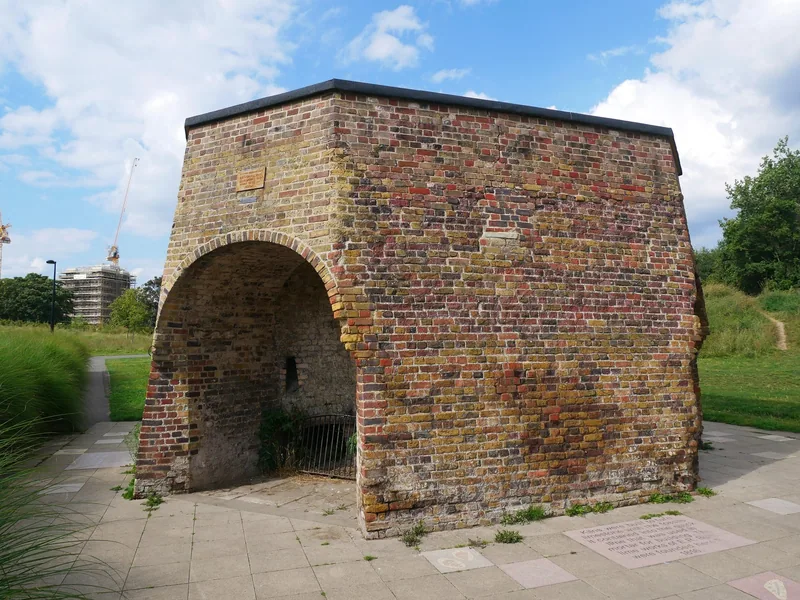
Photo: Doyle of London · CC BY-SA 4.0 · Wikimedia Commons · resized
The lime kiln, which is not a lime avenue
The oddest thing in Burgess Park is a brick cone near the junction of Albany Road and Wells Way. It is a lime kiln, listed at Grade II on 17 September 1998, and its list entry describes exactly what it is: a kiln built for the manufacture of Roman cement, early nineteenth century, brick laid in English bond, with the inside of the cone relined several times.
The detail in the listing is what makes it worth two minutes of your attention. It is a single-stage kiln with battered — that is, sloping — walls, octagonal in plan, with long and short facets alternating. Each of the short facets is pierced at the base by a round-arched drawhole, and the listing suggests each of these was once topped by a short canopy to shelter the workman feeding the fire from the weather. A cone in the centre helped the burnt cement fall down to the drawholes. The interior is an inverted, truncated cone.
Roman cement was the hydraulic cement of its day, superseded later in the century by Portland cement. Everything else about that industry has gone from the site. The kiln is the last of it.
Chumleigh Gardens and its three ranges of almshouses
The other survival is Chumleigh Gardens, in the middle of the park, which is a set of almshouses arranged in three ranges. Each range — north, centre and south — is separately listed at Grade II, all three added to the list on 12 March 1996.
The gardens inside them include a World Garden, whose thirtieth anniversary Southwark marked with an event here, and this is the part of Burgess Park that works in the rain, in winter and with a pushchair. It is also the practical hub: the toilets are here, and so is a drinking water fountain near the play area where you can wash your hands.
Note the toilet hours, because they follow the light rather than a clock: open from 8am until half an hour before dusk. In late December that means shutting before 4pm.
Southwark publishes an accessibility map for the route to the toilets. It marks the tarmac route in blue and the less accessible gravel route in red. If you are pushing a wheelchair or a buggy across the park to Chumleigh Gardens, take the blue line rather than the direct one.
The cooking area, and exactly how the hotplates work
This is the part of Burgess Park that no other London park has, and the rules are specific enough to be worth reading before you go.
Charcoal and disposable barbecues are not allowed in the park at all, even in the cooking area. Southwark says the hotplates replaced the old charcoal barbecues because those created fire risks, hurt local air quality and increased litter. Only the installed hotplates may be used.
Using one goes like this. Press and hold the button until it beeps or starts flashing red. After three to seven minutes the button turns from flashing red to green, which means the plate is hot enough. You then have 20 minutes of cooking before it shuts off automatically with a long beep. You can stop it early by holding the button for three seconds. The metal plate gets hot and stays hot, so it must be left to cool before you walk away.
The other rules are practical rather than bureaucratic: only food and foil trays go on the plate; clean it before and after with the tool attached to the hotplate, a little bottled water and a cloth, never anything metal; a little butter or oil stops food sticking; cook meat thoroughly; take your rubbish home where you can. The plates are first come, first served, and Southwark suggests 20 minutes to two hours per group.
The hotplates are seasonal, and were listed as closed when we checked. Southwark's pages say the outdoor cooking facilities reopen on 5 April, and describe the electric cooking area as open for the summer season — but the park's own facilities list read "outdoor cooking - currently closed" on 28 September 2026. Ring the parks team on 020 7525 2000 before you plan a meal around it outside high summer.
One national point sits behind all of this. Disposable barbecues are currently not on sale anywhere in Great Britain: the government issued statutory guidelines on 14 August 2026 stating that they cannot be considered a safe product in the present weather and environmental conditions and must not be made available for sale in store or online. So even if the park allowed them, you would struggle to buy one. A picnic is the reliable plan; our guide to picnic supplies and self-catering in London covers where to shop.
The lake, the pitches and the BMX track
Burgess Park is a working sports park as much as a green space, and most of it can be used or booked by anyone.
| Facility | Detail |
|---|---|
| Lake fishing | Day ticket, dawn to dusk, on half the lake. Dogs on leads and not in the water |
| Tennis | 7 courts near Addington Square and Camberwell Road, open daily 7am to 10pm, bookable |
| Artificial pitches | 2 full-size, bookable as quarters for 5-a-side, halves for 7-a-side, or whole for 11-a-side football or 15-a-side rugby |
| Grass | Cricket and rugby pitch, plus cricket practice nets |
| BMX | 400-metre national standard track, open regularly until 9pm; everyone welcome after an induction |
| Other | Outdoor basketball court, outdoor gym, changing rooms, meeting room, all from the Cobourg Road entrance |
The BMX track is the unexpected one. It is built to national standard, it is open late, and the council's own wording is that all are welcome following an induction — meaning you can turn up as a beginner rather than needing to be part of a club.
Runners get a 5 km route round the park, waymarked with butterfly symbols on the path and recycled iron markers. There is a Saturday parkrun and a Sunday junior parkrun here; our guide to running routes in London explains how a visitor joins one.
Children, water play and the age bands
The playgrounds are unusually well sorted by age. There is climbing and play equipment for children up to 14 — which is older than most London parks bother with — and separate areas for under-fives and over-fives, so a four-year-old is not competing with a ten-year-old.
Water play jets run at Chumleigh Gardens in summer. As with the hotplates, this is seasonal and subject to the borough's water position, so treat it as a bonus rather than the reason for the trip. Our guide to London with kids has the alternatives, and London in a heatwave covers what stays open when restrictions bite.
Getting there, and which entrance
The park has no single main gate; it has edges. Which one you use depends on what you have come for.
From Elephant & Castle, the 343 and the 136 both reach the Chumleigh Gardens end in about eight minutes, plus a three-minute walk, for a £1.75 bus fare — rising to £1.85 on 1 November 2026. Walking the same distance takes about 30 minutes, so take the bus. Our page on London buses explains the hopper fare, which makes a bus each way cost the same as one.
For the sports centre, use Cobourg Road. For the tennis courts, Addington Square or Camberwell Road. For the lake and the lime kiln, the Albany Road side. Elephant & Castle is the nearest Tube station and the southern terminus of the Bakerloo line, so trains north start empty.
Is it worth the journey?
For a visitor with a few days in London, Burgess Park is not a sight and does not pretend to be. There is no view, no formal garden and nothing you will photograph twice.
It is worth an hour for three reasons, and they are all specific. The lime kiln is a genuinely strange listed industrial survival in the middle of a lawn. The electric cooking area is, as far as we can establish, unique among London parks, and if you are staying nearby and want to cook outdoors it is the only lawful way to do it. And it is the most usable large green space in this part of south London: level, open late, full of pitches and courts that anyone can book.
If you are in the area with an afternoon and want something more scenic, Nunhead Cemetery and One Tree Hill is twenty minutes east and has the view that Burgess Park lacks, and Dulwich Park and Peckham Rye are the handsome Victorian alternatives. For the same scale of park with more going on, Victoria Park in east London is the closest comparison.
Eating afterwards is better handled a short walk east: our guide to where to eat in Peckham has the restaurants and Peckham covers the neighbourhood. Since the park costs nothing it earns a place among our free things to do in London, and its summer programme sits alongside the rest in summer concerts in the parks.
Frequently asked questions
Can you have a barbecue in Burgess Park?
Not a real one. Charcoal and disposable barbecues are banned throughout the park, including inside the designated cooking area. Southwark provides electric hotplates instead, used on a first-come basis during the summer season, and they are the only lawful way to cook in the park.
How do the electric hotplates work?
Press and hold the button until it beeps or flashes red, wait three to seven minutes until the button turns green, then cook. The plate switches itself off after 20 minutes with a long beep. Only food and foil trays should go on the surface, and it must be cleaned and left to cool.
What is the brick cone in the middle of the park?
A lime kiln, listed Grade II since 1998, built in the early nineteenth century to make Roman cement. It is octagonal, with alternating long and short facets, and the short ones are pierced at the base by arched drawholes through which the burnt cement was raked out.
Are there toilets in Burgess Park?
Yes, at Chumleigh Gardens near the play area, open from 8am until half an hour before dusk, and at the tennis pavilion by Addington Square. There is also a drinking water fountain at Chumleigh Gardens.
How do you get to Burgess Park from central London?
Take the Northern or Bakerloo line to Elephant & Castle, then the 343 or 136 bus for about eight minutes and walk three. That costs £1.75 on the bus, and the whole journey takes about eleven minutes from the station. Walking from Elephant & Castle takes around half an hour.
Sources
- Southwark Council - Burgess Park: size, history, facilities and sports (checked September 2026)
- Southwark Council - Burgess Park electric cooking area (checked September 2026)
- Southwark Council - outdoor cooking in Burgess Park (checked September 2026)
- Historic England - lime kiln, Burgess Park, Grade II (checked September 2026)
- Historic England - almshouses, centre range, Chumleigh Gardens, Grade II (checked September 2026)
- GOV.UK - statutory guidelines on disposable barbecues (checked September 2026)
- Transport for London - bus and tram fares (checked September 2026)