
The Bakerloo line is the brown one, 25 stations from Elephant & Castle in the south to Harrow & Wealdstone in the north-west, and it runs the oldest trains on the Underground: 1972 Tube Stock, more than half a century old and still doing sixteen trips an hour under Oxford Street. It is also the quickest way from Paddington to the West End, eight minutes to Oxford Circus, and the only line that calls at four main-line terminals in a row.
Two things shape any journey on it. The trains are small, hot and loud, and the service thins out dramatically at the northern end: sixteen to eighteen trains an hour cross central London, eight of them go beyond Queen's Park, and only four reach Harrow & Wealdstone. Everything about fares, the map and how to make a journey is in our introduction to the Underground.
Bakerloo line basics
- Colour on the map
- Brown
- Stations
- 25
- Route
- Elephant & Castle to Harrow & Wealdstone, no branches
- End to end
- 48 minutes
- Trains
- 1972 Tube Stock, seven cars, no air conditioning
- Trains an hour, central London
- 18-19 at the peak, 16-17 off-peak
- Trains an hour to Harrow & Wealdstone
- 4, all day, every day
- Step-free to a Bakerloo platform
- 4 stations, plus Waterloo southbound only
- Night Tube
- None on any night
- Main-line terminals served
- Paddington, Marylebone, Charing Cross, Waterloo
Where it goes, and why the top half feels like a different railway
South to north the order is Elephant & Castle, Lambeth North, Waterloo, Embankment, Charing Cross, Piccadilly Circus, Oxford Circus, Regent's Park, Baker Street, Marylebone, Edgware Road, Paddington, Warwick Avenue, Maida Vale, Kilburn Park, Queen's Park, Kensal Green, Willesden Junction, Harlesden, Stonebridge Park, Wembley Central, North Wembley, South Kenton, Kenton and Harrow & Wealdstone. There are no branches and no decisions to make.
North of Queen's Park the line comes to the surface and runs on Network Rail tracks shared with the Overground's Lioness line out of Euston. That is why the stations up there look like suburban railway stations rather than Tube stations, why the platforms are open to the weather, and why a Bakerloo train and a Lioness train can be standing at the same platform edge going to the same place. Either will do; the Lioness line is usually faster because it stops less.
The frequency is the thing to plan around. Trains alternate between terminating at Queen's Park, Stonebridge Park and Harrow & Wealdstone. In the middle of the day TfL's timetable puts eight an hour through Queen's Park and four an hour at Harrow & Wealdstone, so a quarter of an hour is a normal wait at the northern end. It is not a line to rely on for a tight connection at Wembley; our page on getting to Wembley Stadium explains why the Metropolitan and Jubilee lines to Wembley Park carry the crowds instead.
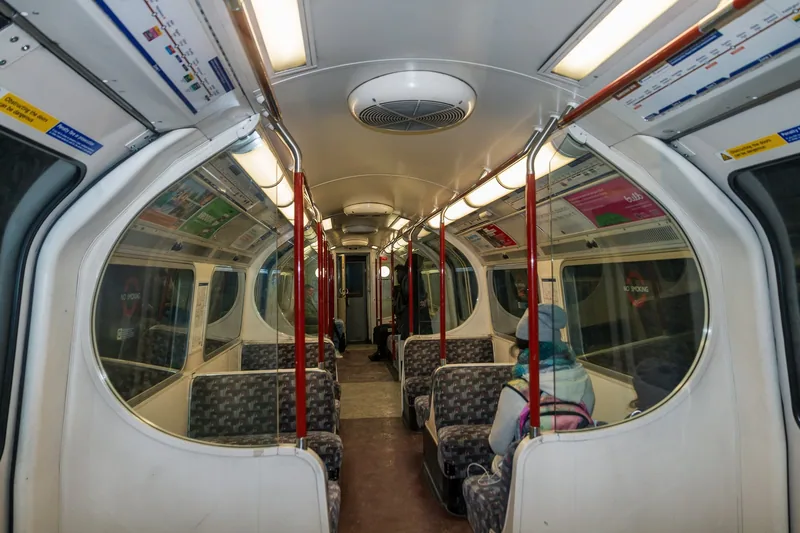
Photo: Øyvind Holmstad · CC BY-SA 4.0 · Wikimedia Commons · resized
The 1972 stock: what it is actually like in July
These are the oldest passenger trains on the Underground. Seven short cars with doors between them, single-leaf doors at the ends of each car, deep sprung seats in fabric, no through-carriage walk, no screen telling you the next station and no air conditioning. There is a small forced-ventilation fan and there are windows that open a crack near the ceiling, and on a hot afternoon neither makes much difference.
In numbers, the Bakerloo comes third of the seven deep lines on TfL's platform temperature data, averaging 29.9 °C in the August 2024 evening-peak figures, with only the Victoria and the Central above it. The 94 new air-conditioned trains TfL has ordered from Siemens are for the Piccadilly line, not this one, and no new Bakerloo train was in service in September 2026. Our page on which lines have air conditioning sets out the full order of misery and the cooler alternatives.
There is a compensation, and it is real. The narrow 1972 carriages are quieter at a stand than modern stock, the seats are softer than anything else on the network, and because the line is short and the trains are frequent you are rarely on one for more than a quarter of an hour. Take it two stops. Do not take it from Harrow & Wealdstone to Elephant & Castle in a heatwave.
Single-leaf doors change how you board with a case. The doorways on this stock are narrower than on any other line, and there is no luggage space by the doors. If you are moving between hotels, board at the end of a car where the vestibule is widest, and read our notes on luggage on the Tube first.
Changing lines: three easy ones and two that cost you ten minutes
The Bakerloo does well out of its central stations. At Oxford Circus the Bakerloo platforms are one level above the Victoria line and a short passage from the Central. At Embankment four lines meet in a compact station. At Baker Street the Bakerloo sits in the middle of a station with five lines.
Two changes are worse than they look on the map.
- Paddington. The Bakerloo platforms are under Praed Street, at the opposite end of the station complex from the Circle and District platforms and a full flight below the main concourse. Coming off a Great Western train you walk the length of the train shed and then down. Our guide to Paddington station has the route and the better entrance to use.
- Waterloo. The northbound and southbound Bakerloo platforms are on different levels, and the southbound one is reached from a different part of the station to the northbound. It is signposted, but it is not symmetrical, and people who arrived one way go looking for the same staircase on the way back.
One more thing to know before you trust a Tube map here: Edgware Road on the Bakerloo is not the same station as Edgware Road on the Circle and District. They stand a few minutes apart on opposite sides of the Marylebone Road flyover, with separate ticket barriers and no interchange. The District and Circle pair is covered in our guide to the District and Circle lines.
Step-free access: the worst on the network
Four of the 25 stations have a step-free route from the street to a Bakerloo line platform: Paddington, Willesden Junction, Wembley Central and Harrow & Wealdstone. Waterloo is step-free to the southbound platform only, which means you can leave central London from it but not arrive into it without stairs.
Across the whole central section, from Elephant & Castle to Queen's Park, Paddington is the only station with step-free access to a Bakerloo platform. Oxford Circus, Piccadilly Circus, Charing Cross, Embankment, Baker Street, Marylebone and Elephant & Castle all have stairs or escalators in the route. Elephant & Castle is a useful warning about symbols: it has lifts, and they serve the southbound Northern line platform, not the Bakerloo at all.
If step-free travel matters to you, the Bakerloo is a line to plan around rather than with. The Elizabeth line covers Paddington to Tottenham Court Road and Bond Street with every station step-free from street to platform, and the Jubilee line does the same for Waterloo, Westminster and Green Park. Our guide to step-free and accessible transport in London explains how to set the step-free option in the journey planner, and the turn-up-and-go help that needs no booking.
Weekends, and the earliest closing time in London
Weekend engineering work on the Bakerloo usually falls on the northern section, between Queen's Park and Harrow & Wealdstone, where the track belongs to Network Rail and is shared with other trains. When that happens the Lioness line from Euston is the direct substitute and calls at most of the same stations.
There is no Night Tube on the Bakerloo on any night of the week, and its Sunday service is the shortest of any deep line: the last southbound train to Elephant & Castle leaves well before midnight. Sunday mornings are late to start, too. The exact first and last departures are in our page on first and last Tube trains, and if you are out after the line stops, the night buses along Oxford Street and Whitehall follow much of its route; see London night buses.
The journey the line owns: four terminals in fifteen minutes
No other Underground line strings together four main-line stations the way this one does, and nothing else gets you from a train from Cardiff to a train from Portsmouth without changing. Southbound from Paddington the timetable runs like this.
| Southbound from Paddington | Minutes | What is there |
|---|---|---|
| Marylebone | 3 | Chiltern trains, and the calmest terminus in London |
| Baker Street | 4 | Regent's Park, Madame Tussauds, five other lines |
| Oxford Circus | 8 | Oxford Street and Regent Street |
| Piccadilly Circus | 10 | Theatreland, Soho, the lights |
| Charing Cross | 12 | Trafalgar Square and the National Gallery, at street level |
| Embankment | 13 | The river, the pier, the footbridges to the South Bank |
| Waterloo | 15 | South-western trains, the London Eye, the South Bank |
| Elephant & Castle | 19 | The end of the line, and a change for the Northern |
Those figures are from TfL's own timetable rather than a single journey-planner query. Charing Cross is the stop worth remembering: the exit puts you on the north side of Trafalgar Square without crossing a road, which makes the Bakerloo the most direct line to the National Gallery from anywhere on its route.
Paddington to Oxford Circus beats the Elizabeth line for the West End shops. The Elizabeth line is faster to Tottenham Court Road and Bond Street, but if Oxford Circus itself is where you are going, the Bakerloo is direct, eight minutes, and you come up in the middle of the crossroads instead of walking back along Oxford Street.
The one stretch to avoid is southbound between Baker Street and Waterloo between 17:30 and 18:30, when the narrow carriages fill with commuters heading for the main-line terminals and nobody can move at Oxford Circus. Twenty minutes later it is a different train, as our guide to avoiding the London rush hour sets out.
Frequently asked questions
Why are the Bakerloo line trains so old?
They are 1972 Tube Stock, the oldest passenger trains on the Underground. The new air-conditioned fleet TfL has ordered from Siemens is for the Piccadilly line, and no replacement for the Bakerloo was in service in September 2026. For a visitor the practical effects are narrow single-leaf doors, no through-carriage walk and no cooling.
Does the Bakerloo line run at night?
No. It is not one of the Night Tube lines on any night of the week, and its Sunday evening service finishes earlier than most. Night buses cover much of the route along Oxford Street, Whitehall and Kilburn High Road, and there are trains from Euston on the Lioness line for the north-western stations.
How long does the Bakerloo line take from end to end?
About 48 minutes from Harrow & Wealdstone to Elephant & Castle, measured across several consecutive weekday late-morning departures. Only four trains an hour run the full length, so check the destination on the front of the train before you settle in at the northern end.
Which Bakerloo line stations are step-free?
Paddington, Willesden Junction, Wembley Central and Harrow & Wealdstone, plus Waterloo for southbound trains only. That is the thinnest step-free coverage of any Underground line. Elephant & Castle has lifts, but they reach the southbound Northern line platform rather than the Bakerloo.
Is the Bakerloo line the hottest on the Underground?
No, it is third. TfL's platform temperature figures for the evening peak in August 2024 put the Victoria line at 31.1 °C and the Central at 30.6 °C, with the Bakerloo at 29.9 °C. It has no air conditioning, but neither do the two lines above it.
Sources
- Transport for London - Bakerloo line working timetable data (Unified API) (checked September 2026)
- Transport for London - Bakerloo line route sequence (Unified API) (checked September 2026)
- Transport for London - Stations, platforms, lifts and step-free data (checked September 2026)
- Transport for London - The Night Tube (checked September 2026)
- Transport for London - Piccadilly line upgrade (the Siemens order) (checked September 2026)
- Transport for London - Step-free access (checked September 2026)