
Elephant and Castle is a road junction in Zone 1 that has been under construction for most of the last fifteen years. The ugly red shopping centre that gave it its character came down in 2020, a new town centre opened in its place in 2026, and the Latin American businesses that made the old building worth visiting are now scattered across three or four addresses within ten minutes' walk. It is five minutes from Bank on the Northern line and worth an hour rather than a day.
The honest summary is that this is a transport interchange with two genuinely good reasons to get off: the Imperial War Museum, ten minutes north-west, and a large covered food market that stays open later than anything else south of the river. Everything else here is either a building site or a shop.
That is not a reason to avoid it. A great many visitors stay near Elephant and Castle because the hotels are cheaper than anywhere else in Zone 1, and the walk to the Tate Modern, Borough Market and the South Bank is fifteen to twenty minutes. This page is for them.
Elephant and Castle at a glance
- Where
- Southwark, SE1 and SE17, fare zones 1 and 2
- Station
- Northern and Bakerloo lines, plus Thameslink trains on the surface
- To the centre
- Bank in 5 minutes; Oxford Circus about 11 to 14 minutes with a change. £3.10 peak, £3.00 off-peak
- Best reason to stop
- The Imperial War Museum, free, 10 minutes' walk
- Open latest
- The market on Newington Causeway, to 01:00 on Friday and Saturday
- The market that moved
- Latin American traders are now on Walworth Road, around the station and on Liverpool Grove
What was here, and what happened to it
For thirty years the junction was defined by a red-painted shopping centre built in 1965, which by the end of its life housed the largest concentration of Latin American businesses in Britain: bakeries, money transfer desks, hairdressers, a bowling alley and a first-floor food court where whole families ate on Sundays. It closed in 2020 and was demolished.
In its place, a £1.5 billion scheme called The Elephant opened in 2026 with 485 homes, 172 of them affordable, 55 shops, restaurants and bars, offices and a new five-screen cinema. Southwark Council put £70.5 million into it. A new campus for the London College of Communication has also been built and opens in 2027 for more than 5,500 students and staff, with the college's old site earmarked for another 507 homes, student accommodation and a cultural venue.
The old Coronet, the cinema on the corner of New Kent Road, closed in 2018 and came down with everything else. It did not move and it has not been replaced in kind; the new five-screen cinema in the town centre is a different sort of thing. Our guide to cinemas in London worth visiting covers the survivors elsewhere.
Where the Latin American traders went
This is the question people arrive with, and the answer is that there is no longer one building to walk into. Some traders took units in Castle Square, a temporary parade beside the station; others are in the railway arches; a group of Latin American businesses occupies shop units on Walworth Road around numbers 331 to 333; and a Latin American street market, Elephant Passage, trades on Saturdays on Liverpool Grove off Walworth Road. Several traders could not afford the new rents and stopped altogether.
Our guide to Peruvian and Latin American food in London has the addresses, the dishes and the other centre of this food in Tottenham. If a printed guide sends you to a first-floor food court, it is describing something that no longer exists.
Come on a Saturday or do not come for the Latin American food at all. The Saturday street market on Liverpool Grove is the one day the trade looks like a community rather than a set of separate shopfronts. On a Tuesday you will walk between four addresses, find three of them open and wonder what the fuss was about.
The station, and the works that are not finished
Elephant and Castle station is two stations wedged together: a 1890 Northern line entrance with lifts on one side of the junction, and a separate Bakerloo line ticket hall on the other. Thameslink trains use surface platforms above, which is how you reach Blackfriars, Farringdon and St Pancras without going underground; see our guide to Thameslink explained.
A new Northern line entrance and ticket hall was completed in June 2025 as part of the town centre scheme. It increases capacity by more than 30 per cent and, importantly, brings step-free access to the Northern line, which the old entrance does not have. The station box was then handed to Transport for London for the tunnelling needed to connect it to the platforms, and the fit-out was waiting on confirmed funding when we checked in September 2026. Treat the station as not yet step-free until TfL says otherwise, and check our page on step-free travel in London before relying on it.
The Bakerloo line here is the southern terminus, which has two consequences: trains start empty, so you always get a seat going north, and the long-discussed extension to Lewisham via Burgess Park and Old Kent Road would change this junction completely if it is ever funded. Our guides to the Bakerloo line and the Northern line cover both.
The roundabout, and the silver box in the middle of it
The junction itself used to be two roundabouts and is now a series of signalised crossings, which is a genuine improvement for anybody on foot: you can now cross in most directions without a subway.
Standing in the middle of the northern junction is a windowless box of stainless steel panels, put up in 1961 to the design of Rodney Gordon. It is an electricity substation for the Northern line, built to be silver because a proposed illuminated advertising screen was refused, and it is named after Michael Faraday, who was born nearby. It is not open, there is nothing to see inside it, and it is one of the more interesting objects in south London to stand next to.
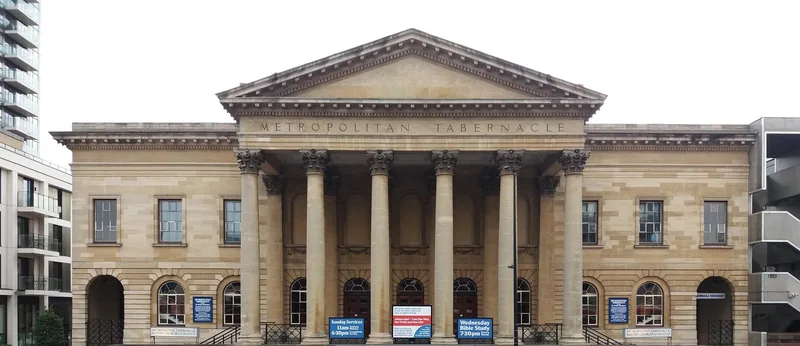
Two churches frame the junction. The Metropolitan Tabernacle, the large Greek-columned Baptist chapel on the western corner, opened in 1861 for Charles Haddon Spurgeon's congregation and is still a working church; only the portico survives from the original building. On the other side, St Mary Newington's churchyard gardens are one of the few quiet green spaces here.
The food market, and eating late
The single best reason to be at Elephant and Castle after dark is the large covered market at 42 Newington Causeway, two minutes from the station. It has more than forty independent traders, several bars and a garden, it opens every day from midday, and it stays open until 01:00 on Friday and Saturday, which no other food hall in London does. Our guide to food halls in London explains how the format works and London's food markets carries its full timetable.
The other food destination is Walworth Road, which runs south from the junction. At number 100 is a large Cantonese dining room that has been doing dim sum in a purpose-built room for close to twenty years, in an area that otherwise has no destination restaurants; our pages on Chinese food beyond Chinatown and dim sum in London cover it, and the tick-sheet system, properly.
A well-known club sits on Gaunt Street behind the station and has done since 1991. It is a club rather than a bar, with tickets sold in advance and nights that run to the morning; our guide to London nightlife explains door policies and getting home.
East Street Market is ten minutes south and almost no visitor finds it. Southwark Council calls it one of London's oldest, largest and busiest markets, and it trades from 08:00 Tuesday to Sunday, closing at 17:00 on weekdays, 18:30 on Saturday and 16:00 on Sunday. It is closed on Mondays. Fruit and vegetables, household goods, cosmetics and West African fabrics, at prices aimed at people who live here. Buses 12, 35, 40, 45, 68, 148, 171, 176, 343 and 468 all pass.
The Imperial War Museum, and the park around it
Ten minutes north-west, along St George's Road, stands the Imperial War Museum in the old Bethlem Royal Hospital building, with two naval guns outside it. It is free, it needs no booking and it is the strongest single attraction within walking distance of this junction; our Imperial War Museum guide has the hours and the layout.
The park it stands in, Geraldine Mary Harmsworth Park, is a good place to sit with something bought at the market, and the walk continues five minutes further to the Garden Museum beside Lambeth Palace. Between them, the two museums and the walk make a decent half day, and one of them costs nothing.
The Cinema Museum, in the old workhouse
Fifteen minutes west, at 2 Dugard Way off Renfrew Road, is one of the odder museums in London: a collection of projectors, ushers' uniforms, signage and ephemera from the 1890s onwards, housed in the master's building of the former Lambeth workhouse.
Two things to know before you set off. It is open by guided tour only, booked in advance; there are no ordinary opening hours. And a tour lasts about two hours and includes a 30-minute film screening, which is a longer commitment than most people expect. Adult tickets are £15 and concessions £12, with carers free. There is level access to the ground floor and a lift above it.
It is a museum about going to the cinema rather than about films, which makes it far more interesting than it sounds, and it has spent years trying to buy the building it occupies.
Walking out, in four directions
| Where | Minutes on foot | What you get |
|---|---|---|
| Imperial War Museum | 10 | Free national museum and a park to sit in |
| Borough Market and the George Inn | 15 | The best food market in London, closed on Mondays |
| Tate Modern and the river | 20 | Free galleries, the Millennium Bridge, St Paul's beyond |
| East Street Market | 10 | A working London street market, Tuesday to Sunday |
| Kennington, Vauxhall and the Oval | 15 to 25 | Georgian terraces, a cricket ground, an eighteenth-century pleasure garden |
Our guides to Southwark and Bankside and Borough and Bermondsey cover the two walks north, which is where most visitors staying here spend their days.
What it is like after dark, and what to expect
The junction is busy with traffic until late, well lit and overlooked by new flats, and the two stations put you in the middle of town in five minutes. It is also a large road interchange with underpasses at its edges, a nightclub, and a great deal of construction hoarding, which is not a pretty combination at midnight. We do not publish safety claims that are not on a police or government source, and we have not found figures for this junction specifically; use the same judgement you would at any large London interchange.
The bigger practical point is that this is not a neighbourhood with an evening. Apart from the market on Newington Causeway and the club, almost everything closes by 22:00, and the new town centre's restaurants and bars are only now filling up. If you want dinner and a walk afterwards, go north.
Frequently asked questions
Is Elephant and Castle worth visiting?
For an hour, not a day. The Imperial War Museum ten minutes away is free and excellent, the covered market on Newington Causeway is the latest-opening food hall in London, and East Street Market is a genuine working market. The junction itself is a transport interchange in the middle of a building site.
What happened to the Elephant and Castle shopping centre?
It closed in 2020 and was demolished. A £1.5 billion town centre scheme opened in its place in 2026 with 485 homes, 55 shops, restaurants and bars and a five-screen cinema, and a new London College of Communication campus opens in 2027.
Where can I find the Latin American shops at Elephant and Castle?
Spread across several addresses rather than one building: units near the station, shops on Walworth Road around numbers 331 to 333, businesses in the railway arches, and a Latin American street market on Liverpool Grove on Saturdays. Saturday is much the best day to go.
Is Elephant and Castle station step-free?
Not yet for the Northern line. A new entrance and ticket hall with step-free access was completed in June 2025, but the tunnelling and fit-out needed to connect it to the platforms were awaiting confirmed funding in September 2026. Check TfL's step-free information before relying on it.
How long does it take to get from Elephant and Castle to central London?
Five minutes to Bank on the Northern line and about eleven to fourteen minutes to Oxford Circus with one change, at £3.10 peak or £3.00 off-peak with contactless or Oyster. On foot, Borough Market is fifteen minutes and Tate Modern about twenty.
Sources
- Southwark Council - Elephant & Castle Tube station transformation reaches major milestone, 16 June 2025 (checked September 2026)
- Transport for London - Elephant & Castle station improvements (checked September 2026)
- Southwark Council - East Street Market, trading days and hours (checked September 2026)
- The Cinema Museum - Visit: guided tours, prices and address (checked September 2026)
- Imperial War Museum - IWM London, admission and opening (checked September 2026)
- Transport for London - Single Fare Finder (checked September 2026)
- Transport for London - detailed station data (fare zones, lifts and platforms at Elephant & Castle) (checked September 2026)