
Epping Forest is ancient woodland that starts in east London and runs almost 13 miles into Essex. It is free, open all year with no gates or closing time, and several Underground stations sit on its edge. You can be standing among 500-year-old pollarded beeches 40 minutes after leaving Oxford Circus.
It is the largest open space in London by a long way, and almost no visitors go. That is partly because there is no entrance, no visitor route and no obvious thing to look at. The forest simply begins at the edge of a car park or across a road from a station, and then continues for hours.
The City of London Corporation looks after it, as Conservators under the Epping Forest Act of 1878, and it has been protected public open space ever since. This guide is about the practical problem the forest creates: with no front door, where do you start?
Epping Forest at a glance
- Entry
- Free, all year, with no gates or opening hours
- Size
- The Forest and its Buffer Lands cover over 8,000 acres and stretch almost 13 miles; the Forest itself accounts for close to 6,000 of those acres
- Easiest arrival
- Chingford (London Overground, Weaver line) for the Visitor Centre, or Theydon Bois and Loughton on the Central line
- Managed by
- The City of London Corporation, as Conservators and Trustee of the Epping Forest charity
- Not allowed
- Fires and barbecues of any kind, anywhere, at any time of year. Swimming in any pond, lake or river
- Emergencies
- 999, or the Forest's own 24-hour line on 020 8532 1010
What "the end of the Central line" actually means
The Central line runs out through the north-eastern suburbs and ends at Epping, and four of its last stations put you at the forest edge. That makes Epping Forest the only genuinely wild landscape in Britain you can reach on a Tube ticket.
There is a catch, and the City is honest about it: Epping station, despite the name, does not give direct access to the forest. From there it is about a ten-minute walk to Sheppard's Meadows before the trees begin. If you want to step off a train and into woodland, get off earlier.
Most of the forest sits in Zones 4 to 6, so a day's travel is covered by the Zones 1-6 daily cap if you are using contactless or Oyster. Our guides to London's travel zones and the Underground explain how the caps work.
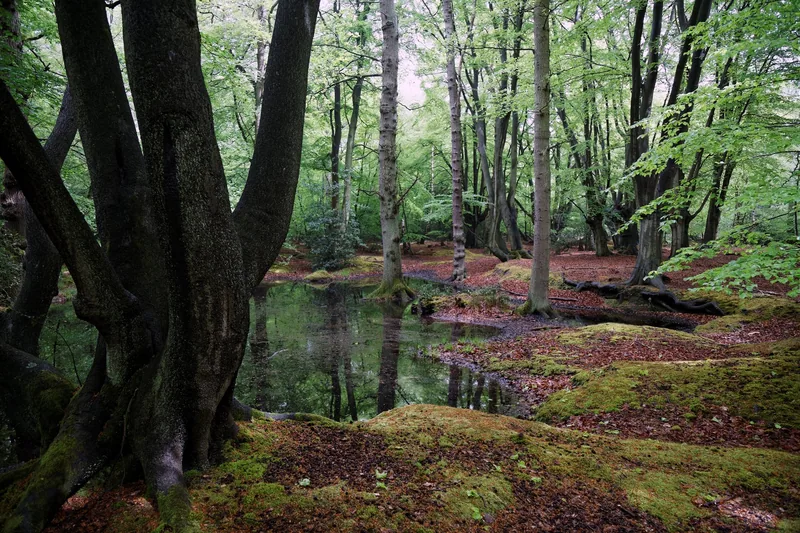
Photo: Acabashi · CC BY-SA 4.0 · Wikimedia Commons · resized
Where to start: a station-by-station guide
This is the most useful thing to know about Epping Forest, because the choice of station decides what kind of walk you get.
| Station | Line and zone | Walk to trees | What you reach |
|---|---|---|---|
| Chingford | Overground (Weaver), Zone 5 | About 5 minutes | The Visitor Centre, Queen Elizabeth's Hunting Lodge, Connaught Water and the Willow Trail; the Holly Trail via the golf course |
| Theydon Bois | Central, Zone 6 | A few minutes | Theydon Plain and Genesis Slade, then ancient oak, hornbeam and beech wood pasture; Ambresbury Banks to the north |
| Loughton | Central, Zone 6 | About 15 minutes, or bus 20 | Baldwin's Hill and the Golden Hill Trail. There is a map outside the station |
| Buckhurst Hill | Central, Zone 5 | About 5 minutes | Knighton Woods and Lords Bushes, and the 2.4km Rowan Trail round Knighton Lake |
| Roding Valley | Central, Zone 4 | Short | Another way into Knighton Woods and Lords Bushes |
| Snaresbrook | Central, Zone 4 | Short | Leyton Flats, Eagle Pond and Hollow Pond, and the Hornbeam Trail north |
| Wanstead | Central, Zone 4 | Short walk south | Wanstead Park, the Temple, and the Chestnut Trail |
| Forest Gate | Elizabeth line, Zone 3 | Short walk north | Wanstead Flats: open grassland, good for picnics and skylarks |
| Highams Park | Overground (Weaver), Zone 4 | Short | Highams Park and its Repton-designed lake |
| Epping | Central, Zone 6 | About 10 minutes | Sheppard's Meadows, then Bell Common and Epping Thicks |
Buses reach the same places. Routes 97, 179, 212, 313, 379, 385, 397, 444 and N26 all serve Chingford station, about 0.4 miles from the forest and the Visitor Centre. Routes 20, 167 and 397 serve Loughton. Our guide to the DLR and the London Overground explains the Weaver line and the rest of the renamed network.
If it is your first visit, go to Chingford. It is the only part of Epping Forest with a proper front door: a five-minute walk from the station brings you to the Visitor Centre, a Tudor hunting lodge and a signed walk to Connaught Water. Everywhere else you are on your own with a map.
Chingford, the Hunting Lodge and Queen Victoria
Chingford is where the forest's public history begins. In 1882 Queen Victoria travelled by train to Chingford station to declare the forest open for the people, four years after the Act that saved it.
Five minutes' walk from the station are the Visitor Centre and Queen Elizabeth's Hunting Lodge, a timber-framed Tudor building put up as a grandstand from which the hunt could be watched. Opening days are limited and change through the year, so check the City of London's Epping Forest pages before you plan a visit around it.
From there, the standard first walk is to Connaught Water, a lake about twenty minutes into the trees, which links up with the Willow Trail. Turn right out of the station instead and you can pick up the Holly Trail from Chingford Golf Course.
The trails, and why you will still get lost
The Forest has a set of named, waymarked trails: the Golden Hill Trail from Baldwin's Hill, the 2.4km Rowan Trail round Knighton Lake, the Hornbeam Trail from Leyton Flats, the Chestnut Trail through Wanstead Park, the Holly and Willow Trails at Chingford, and the Brambly Hedge Trail for younger children.
Between the trails, though, the forest is a maze of unsignposted paths through identical-looking woodland, and the tree cover means you cannot navigate by landmarks. Phone signal is patchy in the deeper sections. Download an offline map before you go, or stay on a waymarked route, or accept that you will emerge somewhere unexpected and have to work out which bus goes back.
Getting lost here is rarely dangerous, but it is time-consuming, and coming out of the trees a few miles from the station you started at is a normal way to end a walk. Allow for it, and check which bus routes serve the far side before you set off.
The trees, which are the actual attraction
Epping Forest holds nearly 55,000 ancient and veteran trees, which the City says is more than any other site in the United Kingdom, including over 80% of Britain's veteran beech pollards. A pollard is a tree cut repeatedly above grazing height, and centuries of that treatment have produced trunks like clenched fists with whole ecosystems living in their hollows.
The wider numbers are startling for a place inside the M25: more than 1,500 species of fungus, including some of the rarest deadwood beech fungi in Europe; ten species of bat; nine native reptiles and amphibians; 28 species of butterfly, among them purple emperor and white admiral. A 2025 ecological survey across more than 40 forest sites recorded 671 moth species, of which 79 are nationally scarce, and turned up two species entirely new to Britain.
The practical consequence is that the best time to walk here is not high summer. Late autumn, when the beeches turn and the fungi appear, is the forest at its most impressive, and the bare-tree months of January and February make the shapes of the old pollards visible in a way that leaf cover hides.
What to take, and what is not allowed
- Boots or proper shoes. The clay underfoot holds water, and paths that look dry from the car park are ankle-deep 300 metres in.
- Water and food. There are cafés at the edges, particularly around Chingford, but nothing in the middle.
- An offline map and a charged phone. Signal is unreliable.
- No fires or barbecues, ever. The City states plainly that these are never permitted anywhere in Epping Forest, at any time of year. Disposable barbecues have caused serious damage here.
- No swimming. The ponds, lakes and rivers are not safe for swimming: hidden hazards, cold water shock and unmonitored water quality. Our guide to swimming ponds and lidos lists the supervised places where you can.
- Watch the water with dogs. Blue-green algae blooms in the forest ponds can be fatal to dogs.
- Take your litter home. Discarded waste raises the fire risk.
To report a fire or an incident, call 999 for anything urgent, or the forest's own 24-hour line on 020 8532 1010. Our page on emergency numbers in London covers the rest. For clothing, see what to pack for London and our month-by-month weather guide.
Wanstead Flats and the southern end
The southern tip of Epping Forest reaches almost into inner east London, and it does not look like a forest at all. Wanstead Flats is a huge area of open grassland north of Forest Gate, used for football, picnics and kite-flying, and skylarks nest there in summer. It is a five-minute walk from an Elizabeth line station, which makes it the easiest piece of the forest to reach from central London.
Wanstead Park, a little further north, is the ornamental remains of a lost 18th-century estate, with lakes and a surviving classical Temple. The Chestnut Trail takes you round the historic features. This end of the forest suits an afternoon rather than a full day, and combines with Stratford or Walthamstow.
Why it is still free, and still there
Epping Forest survives because of an Act of Parliament. Through the 19th century landowners were enclosing the old commons and selling them for building, and the forest was being lost piece by piece. After a long campaign the Epping Forest Act 1878 came into force on 8 August that year, handing the forest to the City of London Corporation as Conservators with a duty to keep it as an open space for the public.
The 150th anniversary of the Act falls in 2028, and the City has begun a programme of events running through 2027 and 2028. The forest is run as a charity, and it costs nothing to enter, which puts it among the best entries in our guide to free things to do in London.
If you want more of this kind of place, Hampstead Heath is the closest equivalent in north London, Wimbledon Common the south-western one, and Bushy Park and Richmond Park offer the same scale with deer and signposts.
Frequently asked questions
Is Epping Forest free to visit?
Yes. There is no entry charge, no ticket and no gate, and the forest is open all year round with no closing time. It is managed as a charity by the City of London Corporation under the Epping Forest Act 1878. Some car parks and the visitor facilities have their own arrangements.
Which Tube station is best for Epping Forest?
Theydon Bois and Buckhurst Hill on the Central line put you in the trees within a few minutes. Loughton takes about 15 minutes on foot and has a map outside the station. Epping station, despite the name, is about ten minutes from the nearest forest, so it is not the best choice. For visitor facilities, take the Overground to Chingford instead.
How big is Epping Forest?
The City of London says the Forest and its Buffer Lands together cover over 8,000 acres and stretch almost 13 miles, with the Forest itself accounting for close to 6,000 acres. It is by a wide margin the largest open space in the London area.
Can you swim or have a barbecue in Epping Forest?
No to both. The City states that fires and barbecues are never permitted anywhere in Epping Forest at any time of year, and that the ponds, lakes and rivers are not safe for swimming because of hidden hazards, cold water shock and unmonitored water quality. Blue-green algae in the ponds can be dangerous for dogs.
Is it easy to get lost in Epping Forest?
Yes, away from the waymarked trails. The paths are numerous and unsignposted, the tree cover hides landmarks, and phone signal is patchy in the deeper parts. Download an offline map before you go, or stick to a named trail such as the Rowan Trail or the Willow Trail.
Sources
- City of London Corporation - Epping Forest (checked September 2026)
- City of London Corporation - Getting to Epping Forest by public transport (checked September 2026)
- City of London Corporation - Epping Forest wildlife (checked September 2026)
- City of London Corporation - What's new in Epping Forest (checked September 2026)
- City of London Corporation - How we manage Epping Forest (checked September 2026)