
God's Own Junkyard is a warehouse on an industrial estate in Walthamstow packed with several thousand neon and lightbulb signs, and nothing is charged at the door. It opens on three days a week only: Friday and Saturday until 10pm, Sunday until 6pm, all from 11am. Forty-five minutes is enough unless you stay for a drink, which most people do.
The collection is the life's work of Chris Bracey, a sign maker who spent decades rescuing neon that nobody else wanted: shop fascias, fairground lettering, film props, the lit-up signs from Soho's sex shops, religious slogans in cursive tubing. His family still runs the business, still makes and hires out signs, and keeps the warehouse open at weekends as a place you can simply walk through.
It is not a museum. There are no labels, no route and no staff explaining anything. It is a working stock room with a bar in the middle of it, and the whole of it is switched on. Our guide to Walthamstow places it in the wider district; this page is about the practical details that catch visitors out.
God's Own Junkyard: what you need before you set off
- Address
- Unit 12, Ravenswood Industrial Estate, Shernhall Street, London E17 9HQ
- Admission
- Free. No tickets are sold and none can be booked
- Friday
- 11am to 10pm
- Saturday
- 11am to 10pm
- Sunday
- 11am to 6pm
- Monday to Thursday
- Shut. The whole estate is quiet and there is nothing to see
- Cameras
- Phones only. Separate cameras are not allowed (see below)
- Nearest station
- Walthamstow Central (zone 3), served by the Victoria line and the Overground. Roughly a quarter of an hour on foot
What is actually in the warehouse
The space is bigger than photographs suggest and runs back further than you expect. Signs are hung floor to ceiling and stacked against each other on the floor, so you move through narrow channels rather than around an open room. There is no lighting other than the signs themselves, which means the colour temperature changes every few steps and the whole place hums faintly.
Three kinds of thing are mixed together. There is salvaged commercial neon, mostly British, some of it fifty or sixty years old and rescued from shopfronts before demolition. There is film and television work: Bracey made and supplied signs for productions over a long career, and pieces that appeared in Batman, Eyes Wide Shut and Charlie and the Chocolate Factory are among the stock. And there are new pieces made in the workshop, from single words to large commissions, many of them for sale or hire.
Almost everything has a price on it if you ask. That is worth knowing, because the atmosphere is closer to an antiques warehouse than a gallery, and browsing with intent is normal here.
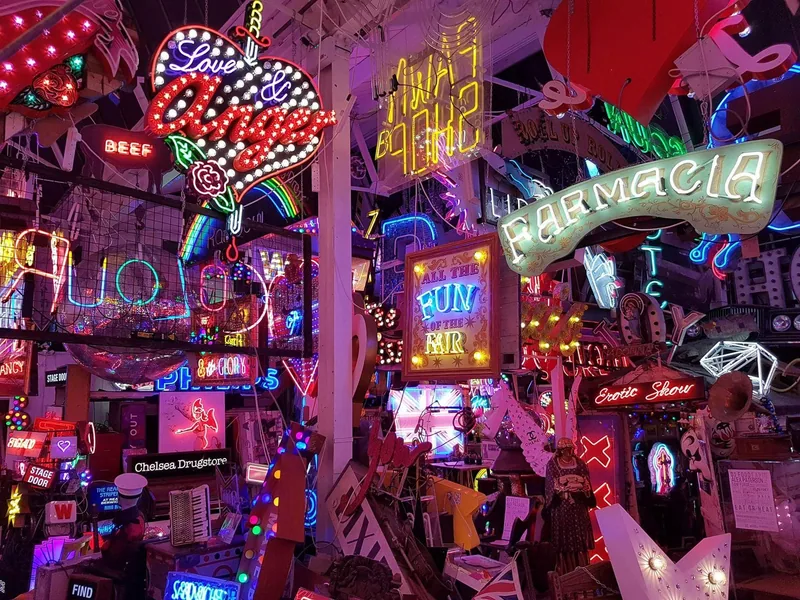
Photo: JRennocks · CC BY 4.0 · Wikimedia Commons · resized
The rule that catches photographers out
Of everything on this page, this is the detail most worth knowing in advance. God's Own Junkyard does not allow separate cameras. Its published rule is that mobile phone cameras are fine, for personal use or for social media, and that other cameras are not permitted. People arrive with a bag of lenses expecting one of the most photogenic interiors in London and are asked to put it away.
If you are serious about the pictures, that constraint is workable. The light is bright and coloured, so a phone will cope, but it will also try to correct the colour cast, which is the thing you came for. Lock the exposure down, expect the reds and magentas to bleed, and shoot the reflections in the glass as much as the signs themselves. Filming, drones and anything that looks like a commercial shoot are a separate matter and need to be arranged with the business first. Our guide to photography rules in London covers what the law says in public places, which is not the same as what a private venue allows.
Leave the camera bag at the hotel. The Junkyard permits phone photography only. A visitor who has travelled to zone 3 with a camera body and lenses will be asked not to use them, and there is no storage on site.
Getting in after 6pm on a Friday or Saturday
The Junkyard stays open until 10pm on Fridays and Saturdays, but the industrial estate around it does not run as an open thoroughfare all evening. After 6pm the arrangement changes: on foot you use one of the two pedestrian gates, one off Shernhall Street and one off Summit Road, and by car you come through the vehicle entrance on Shernhall Street.
In practice this means an evening visitor should walk in from Shernhall Street rather than trying whichever gap in the fence looks nearest. If you arrive at 8pm on a Saturday and find a closed gate, walk round the block rather than assuming the place has shut.
The closures nobody plans for
The Junkyard hires itself out for private events, and when it does it either shuts early or does not open at all. These closures are posted on its own website and nowhere else, they are often on Saturdays, and they are announced weeks rather than months ahead. As an example, the notice board for autumn 2026 has the site closing at 2pm on Saturday 24 October.
The lesson is simple. Check the website on the morning you travel, not the week before. This is a forty-minute journey each way from central London and there is very little else on the estate to fall back on if the gates are locked.
Look at the closure notices before you leave your hotel, not the night before. Early closings for private hire go up on the Junkyard's own site at short notice and are usually on Saturdays, the day most visitors pick.
The bar in the middle, and who it suits
Inside the warehouse is a café and bar called the Rolling Scones, serving food and drink throughout the weekend opening hours. It is not an afterthought: a good proportion of the people in the building at six on a Saturday evening are sitting down with a drink under the signs rather than walking round.
That changes the calculation for families. Early in the day it is a bright, strange, noisy-in-a-good-way place for children, who generally find it far more interesting than adults expect. From late afternoon it fills with adults drinking, and the usual British rules on licensed premises apply, which our guide to alcohol laws in London explains. Arrive at eleven if you have small children; arrive at five if you want the bar.
Older children are the group this suits best of all. It photographs well, it takes an hour, and it is the sort of place teenagers will actually talk about afterwards, which is why it appears in our guide to London with teenagers.
The rest of the estate
Ravenswood is a small industrial estate that has quietly filled up with drinks producers and workshops, which is why people arrive in the afternoon and stay into the evening. A brewery taproom and a gin producer trade alongside the Junkyard at weekends, along with other small units, and between them they turn a Saturday afternoon here into something closer to an evening out.
Their hours are not the Junkyard's hours, so check each one separately before planning around it. Our guides to brewery taprooms and London's gin distilleries cover this kind of place across the city. Note that there is nowhere on the estate to buy a proper meal beyond the café, so eat in Walthamstow itself before or after.
Getting there and what the day costs
Walthamstow Central is the end of the Victoria line and is quicker from central London than its position on the map suggests: it is a straight run with no changes from Oxford Circus, King's Cross or Victoria. From the station, the walk south and east along Hoe Street and Shernhall Street takes about fifteen minutes and is unremarkable but straightforward.
The station sits in zone 3, so a day of travel that includes this trip is capped at £10.50 on pay as you go for an adult, unless you go further out elsewhere (September 2026). Children aged 5 to 10 travel free on the Tube with a fare-paying adult, up to four per adult, so a family of four typically pays two adult fares. The details are in our guide to how London's zones work and our page on using the Underground.
Worth the journey if
- You like objects, signs, salvage or film props, and do not need them explained
- You are combining it with the wetlands, the market or a taproom and making a half-day of it
- You are travelling with teenagers who are tired of museums
- It is raining and you want somewhere indoors that is not a gallery
Skip it if
- You are in London for two or three days and have not seen the centre yet
- You wanted to take proper photographs with a camera
- You are travelling on a Monday to Thursday, when it is simply shut
- Bright flickering light and a loud room are a problem for anyone in your group
Making a day of it in Walthamstow
On its own, the Junkyard does not justify the trip for a first-time visitor to London. Combined with two or three other things in E17, it easily does. The reservoirs at Walthamstow Wetlands are a twenty-minute walk north-west and are free. The High Street market runs most days. Epping Forest begins a few stops further out on the Overground.
For a broader east London day, Hackney and London Fields are twenty minutes south by Overground, and the second-hand shops covered in our guide to vintage shopping are thick on the ground in both. A wet afternoon here works better than most alternatives on our rainy day list, and since it charges nothing it also belongs among the free things to do. If the appeal is the sheer unexpectedness, the other place in this vein is the legal graffiti tunnel under Waterloo, and readers who came here for the 1930s and 1960s lettering should look at our guide to Art Deco London.
Frequently asked questions
Do you have to pay to get into God's Own Junkyard?
No. Entry is free and there is no ticketing system, so you cannot book ahead and you do not need to. Anything you eat or drink in the café and bar is paid for separately, and the signs themselves are for sale or hire.
Which days is God's Own Junkyard open?
Fridays, Saturdays and Sundays only. Doors open at 11am on all three days; Friday and Saturday carry on to 10pm, while Sunday stops at 6pm. It does not open from Monday to Thursday at all. Private hire occasionally closes it early, most often on a Saturday, and those dates appear on its own website.
Can you take photographs at God's Own Junkyard?
With a phone, yes, for personal use and social media. Separate cameras are not permitted under the published rules, and there is no cloakroom to leave equipment in. Filming and commercial shoots have to be agreed with the business in advance.
How long does a visit to God's Own Junkyard take?
Thirty to forty-five minutes to walk round and photograph it properly. People who sit down in the bar or move on to the brewery and distillery on the same estate stay two or three hours, which is what most weekend visitors end up doing.
Is God's Own Junkyard suitable for children?
Yes, and younger children tend to enjoy it more than their parents expect. Go early in the day: by late afternoon it is largely an adult drinking crowd, and the space is narrow, crowded and loud. There is no lift issue to worry about, as the whole warehouse is on one level.
Sources
- God's Own Junkyard – opening hours, address, access after 6pm, photography rules and current closure notices (checked September 2026)
- Transport for London – Daily and weekly fare capping (checked September 2026)
- Transport for London – Travel for children aged 5 to 10 (checked September 2026)